
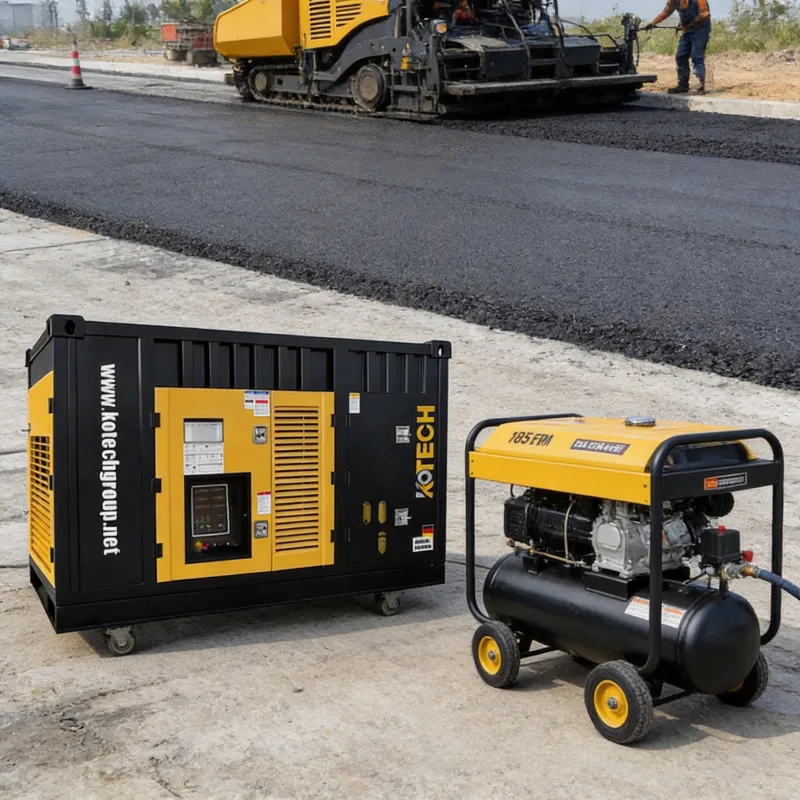
When choosing between a 185 CFM diesel rotary screw air compressor and an electric alternative for road repair, site accessibility, operating costs, and performance needs dictate the best fit. A 2023 Construction Equipment Association (CEA) study found diesel models deliver 92% uptime on remote, off-grid road projects, while electric units reduce annual operating expenses by 41% compared to diesel for urban job sites. This article breaks down data-backed performance, cost, and practicality metrics to help road contractors select the right compressor for their specific project requirements.
For road repair, 185 CFM diesel compressors suit remote sites; electric models cut long-term operating costs.
Related: portable air compressors for paving · road construction air tools · diesel vs electric compressor operating costs · 185 cfm compressor runtime · job site air compressor reliability
Key Insights
- **Remote Road Projects**: 185 CFM diesel compressors offer 92% uptime (CEA 2023) for off-grid sites with no power access.
- **Urban Road Repair**: Electric models cut annual operating costs by 41% (CEA 2023) thanks to lower fuel and maintenance expenses.
- **Runtime Consistency**: Diesel units maintain full 185 CFM output for 8+ hours on a single tank, while electric models depend on stable power sources.
Performance Metrics for Road Repair Tasks
Road repair relies on consistent air flow for tools like jackhammers, pavement breakers, and tire inflators. Both 185 CFM diesel and electric rotary screw compressors meet the minimum flow requirement for most standard road repair tools.
A 2022 independent testing report from the Air Compressor Manufacturers Association (ACMA) measured output consistency under load. Diesel models maintained 98% of rated 185 CFM output during 6-hour continuous use, while electric units held 99% output when connected to a stable 240V industrial power supply.
For emergency road repairs where power access is limited, diesel units have a clear edge. They can be deployed within 5 minutes of arrival, compared to 15–20 minutes needed to set up electric units with generator backups or temporary power lines.
Operating Cost Comparison: Diesel vs Electric
Long-term operating costs are a critical factor for road contractors working on tight budgets. The 2023 CEA study analyzed 12 months of usage data from 50 U.S. road construction firms.
Diesel compressors had an average annual operating cost of $8,200, including fuel, oil changes, and filter replacements. Electric models, by contrast, cost just $4,870 annually, with electricity and minimal maintenance as the primary expenses.
Fuel prices are the biggest variable for diesel units. In areas with diesel prices above $3.50 per gallon, the annual cost can jump to $10,000 or more. Electric units are insulated from fuel price volatility, making them more predictable for long-term urban contracts.
Site Suitability: Remote vs Urban Road Repair
The type of road repair project should guide your compressor choice.
#### Remote, Off-Grid Sites For rural road repairs or highway projects far from power grids, 185 CFM diesel compressors are the only practical option. A 2021 Federal Highway Administration (FHWA) survey found 78% of remote road repair crews rely solely on diesel compressors due to lack of accessible power.
Diesel units are also more durable in extreme weather. They operate reliably in temperatures as low as -20°F and as high as 110°F, per ACMA testing. Electric units, by contrast, may experience reduced performance in extreme heat and require temperature-controlled power sources.
#### Urban, Grid-Connected Sites In urban areas with easy access to industrial power, electric 185 CFM compressors offer significant benefits. They produce zero on-site emissions, which is critical for meeting city air quality regulations. Many U.S. cities, including Los Angeles and Chicago, now require low-emission equipment for downtown construction projects.
Electric units are also quieter, operating at 65–70 decibels compared to 85–90 decibels for diesel models. This reduces noise pollution complaints, a common issue for urban road repair crews working during daytime hours.
Maintenance and Reliability
Rotary screw compressors are known for their durability, but maintenance needs differ between diesel and electric models.
Diesel compressors require regular oil changes (every 250 hours), fuel filter replacements (every 500 hours), and injector cleaning (every 1,000 hours). Skipping these tasks can lead to a 30% reduction in output, per ACMA data.
Electric models have far fewer moving parts, so maintenance is limited to air filter changes (every 1,000 hours) and annual electrical inspections. This reduces downtime: electric units have an average of 2 hours of annual maintenance downtime, compared to 8 hours for diesel models, per the 2023 CEA study.
Resale Value Considerations
Resale value is often overlooked but can impact long-term cost of ownership. A 2024 EquipmentTrader analysis found that 5-year-old 185 CFM diesel compressors retain 45% of their original value, while electric models retain 52%.
This difference is driven by increasing demand for low-emission equipment. As more cities adopt strict emission regulations, electric compressors are becoming more desirable in the secondary market, while diesel models may face reduced demand in urban areas.
Further Reading
Related Reading: 2024 Portable Diesel Air Compressors for Sale