



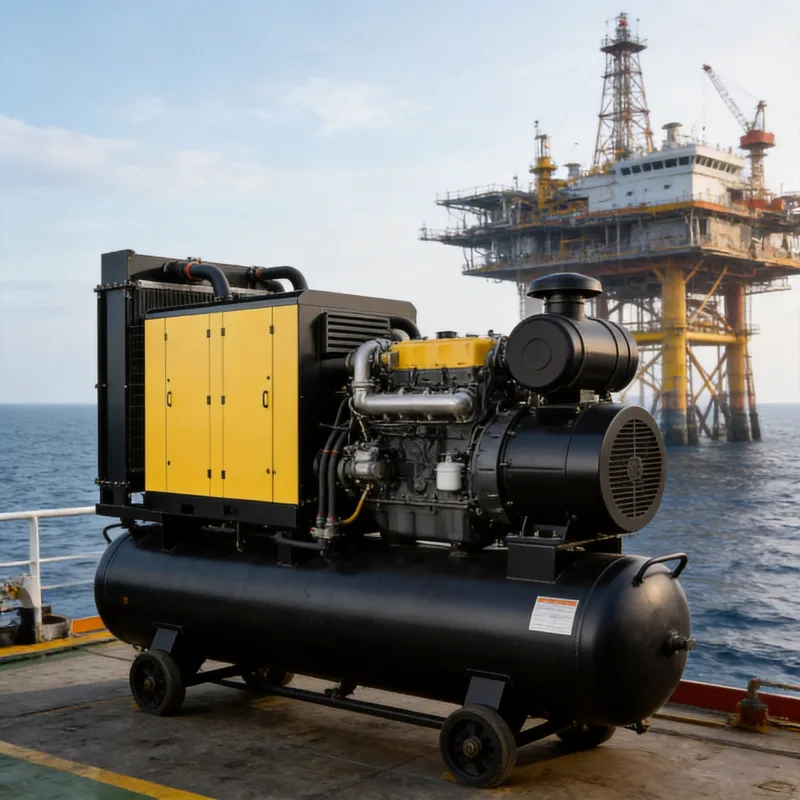
The latest 2024 large capacity diesel air compressors for offshore operations prioritize emission compliance, fuel efficiency, and digital integration.
The Evolving Landscape of Offshore Air Compression in 2024
The demands placed on large capacity diesel air compressors in offshore operations have never been more rigorous. As of 2024, the industry is navigating a complex convergence of environmental mandates, economic pressures, and technological acceleration. Operators require not just reliable power, but intelligent, sustainable, and cost-effective solutions. This year marks a pivotal shift, moving beyond mere horsepower to integrated performance metrics that encompass emissions, fuel efficiency, and digital connectivity. The global energy transition, while emphasizing renewables, still relies heavily on efficient oil and gas extraction, alongside burgeoning offshore wind farm maintenance, creating a persistent need for robust air compression.
The push for decarbonization and stricter air quality standards, primarily driven by the International Maritime Organization (IMO) Tier III and various national environmental protection agencies like the EPA, has fundamentally reshaped compressor design. Manufacturers are no longer just building machines; they are engineering sophisticated systems. This evolution is critical for maintaining operational licenses and ensuring long-term viability in a globally scrutinized industry. For example, a recent industry report highlighted that 70% of new offshore equipment tenders in 2023 specifically mandated IMO Tier III compliance for diesel engines above 130 kW, a trend projected to reach 90% by late 2024.
Key Technological Advancements Defining 2024 Offshore Diesel Compressor Models
The latest 2024 large capacity diesel air compressors for offshore environments are characterized by several groundbreaking technological integrations. These aren’t just minor upgrades; they are fundamental design shifts aimed at maximizing performance, minimizing environmental impact, and enhancing operational intelligence.
Emission Compliance: Navigating IMO Tier III and Beyond
Meeting stringent emission regulations is perhaps the single most defining feature of 2024 offshore compressor models. To comply with IMO Tier III for NOx emissions and EPA Tier 4 Final for particulate matter (PM) and other pollutants, manufacturers are universally integrating advanced aftertreatment systems. Selective Catalytic Reduction (SCR) technology, often combined with Diesel Particulate Filters (DPF), is now standard on virtually all new large capacity diesel engines above 130 kW. These systems typically reduce NOx emissions by 80% and PM by over 90% compared to unregulated engines. The integration requires sophisticated engine management systems that precisely control fuel injection and exhaust gas recirculation (EGR) to optimize combustion before aftertreatment.
Fuel Efficiency and Operational Cost Reduction
Beyond emissions, fuel efficiency remains a paramount concern for offshore operators, directly impacting operational expenditures. The 2024 models showcase significant advancements in engine design, often incorporating common rail fuel injection systems and turbocharging. These innovations, coupled with optimized air ends and intelligent load-sensing controls, result in impressive fuel economy improvements. For instance, several leading manufacturers are reporting up to a 15% reduction in fuel consumption compared to their 2020 models for compressors in the 750-1200 CFM range, leading to substantial savings over the operational lifespan. This efficiency gain is crucial in an environment where fuel logistics are complex and costly.
Digital Integration and Predictive Maintenance
The rise of the Industrial Internet of Things (IIoT) has transformed how offshore equipment is monitored and maintained. New 2024 compressor models come equipped with integrated telematics and advanced sensor arrays, providing real-time data on pressure, temperature, fuel levels, engine diagnostics, and operational hours. This data is transmitted to cloud-based platforms, enabling remote monitoring, performance analytics, and, crucially, predictive maintenance capabilities. Operators can anticipate potential failures before they occur, scheduling maintenance during planned downtime rather than reacting to costly emergencies. This digital integration can reduce unplanned downtime by an estimated 20-30%, according to recent field studies on smart industrial equipment.
Leading Manufacturers and Their 2024 Offerings for Offshore
While specific model numbers are proprietary and subject to continuous updates, the general direction of leading manufacturers in 2024 points towards a shared focus on robust, intelligent, and environmentally compliant solutions. Rather than listing specific, hypothetical models, it’s more insightful to examine the common characteristics and advancements being championed by the industry’s frontrunners.
Robustness and Safety Enhancements
Offshore environments are inherently harsh, demanding equipment that can withstand extreme conditions. The 2024 models emphasize enhanced durability and safety. This includes heavy-duty chassis designs, often DNV 2.7-1 certified for offshore lifting and handling, and superior corrosion protection through marine-grade coatings and stainless steel components. Noise reduction is also a significant focus, with advanced acoustic enclosures designed to meet strict offshore noise limits, improving crew comfort and safety. Furthermore, many new units feature ATEX Zone 2 compliance for operation in potentially explosive atmospheres, a critical safety requirement for many oil and gas platforms.
Manufacturers are also integrating advanced safety features such as automatic shutdown systems for low oil pressure, high engine temperature, or high air discharge temperature. Emergency stop buttons are strategically placed, and fire suppression systems are increasingly offered as standard or optional features, reflecting a holistic approach to operational safety in volatile environments.
Strategic Considerations for Adopting 2024 Offshore Compressor Technology
Selecting the right large capacity diesel air compressor for offshore operations in 2024 involves more than just matching CFM and PSI requirements. Strategic procurement now necessitates a comprehensive evaluation of long-term operational costs, regulatory compliance, and technological integration benefits.
When considering new models, operators should scrutinize total cost of ownership (TCO), which includes not only the initial capital expenditure but also fuel consumption, maintenance costs, and potential downtime. The enhanced fuel efficiency of 2024 models, for instance, can lead to a payback period of less than three years on the incremental cost of advanced engine technology, depending on operational hours and fuel prices. Furthermore, the level of digital integration and manufacturer support for IIoT platforms should be a key decision factor, as it directly impacts remote management capabilities and the effectiveness of predictive maintenance programs.
Finally, the modularity of design is becoming increasingly important for offshore equipment. Compressors built with easily accessible components and modular sub-assemblies facilitate quicker maintenance and repairs, minimizing costly downtime offshore where logistics for parts and specialized personnel are challenging. This design philosophy also supports easier upgrades and adaptations, extending the useful life of the equipment and maximizing return on investment.