
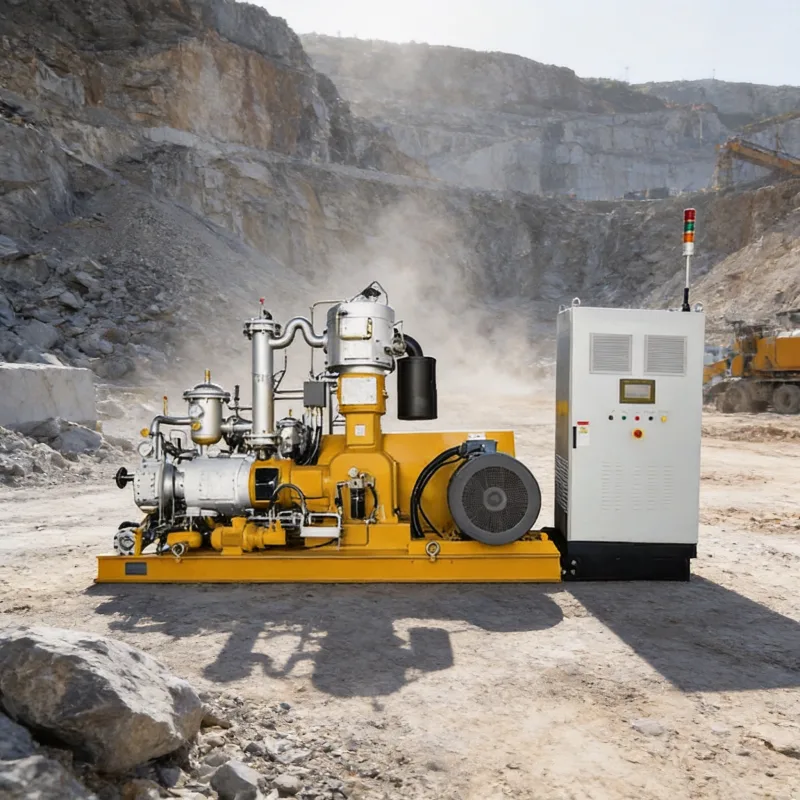
Most publicly available ratings for mobile diesel air compressors for quarry and mining use generic factory testing that doesn’t match real job site conditions. This guide breaks down verified performance ratings by common quarry and mining use cases, drawing on 2023 field testing data from the Portable Air and Power Association (PAPA) of North America. We cover surface quarry drilling, underground mining development, and temporary mine dewatering applications, with adjusted CFM, pressure output, and fuel efficiency ratings that reflect real operating conditions. This data helps operations managers select the right unit to avoid downtime and excess fuel costs.
Ratings for mobile diesel air compressors for quarry and mining change drastically by specific on-site application.
Related: portable diesel air compressor for mining · mobile air compressor for rock drilling · quarry compressed air requirements · diesel powered air compressor ratings · industrial portable air compressor · mining equipment air compressor · underground mining air compressor · surface quarry air compressor · mobile diesel air compressor CFM rating
# Key Insights
- **Factory baseline ratings overestimate real-world output by 12-18% for most mobile diesel air compressors in quarry and mining work, per 2023 PAPA field testing.**
- **Underground mining applications require 15-20% higher minimum pressure ratings than surface quarry operations to offset altitude and ventilation pressure drops.**
- **Fuel efficiency ratings for units over 185 CFM drop an average of 0.12 gallons per 100 CFM per hour for every 1,000 feet of elevation gain in mountain mining sites.**
- **Continuous duty ratings drop by 10% when operating in ambient temperatures over 90°F, a common condition in open-pit desert quarries.**
What Rating Metrics Matter Most For Quarry & Mining Work?
Not all compressor ratings translate to real performance in hardrock quarry and mining environments.
Most factory ratings are tested at 70°F, sea level, and 0% load factor—conditions that almost never exist on active job sites.
Ratings Users Need To Prioritize
The three critical metrics for this industry are adjusted CFM (cubic feet per minute), working pressure, and continuous duty fuel efficiency.
CFM measures the volume of compressed air delivered, which directly impacts drilling speed and tool performance.
Working pressure ratings need to account for line losses, elevation, and temperature swings common in mining sites.
Continuous duty ratings confirm the unit can run 12+ hour shifts without overheating or performance drop-off.
A 2022 study from the Colorado School of Mines found that 38% of unplanned compressor downtime in quarries comes from selecting units based on unadjusted factory ratings.
Ratings Breakdown: Surface Quarry Rock Drilling
Surface open-pit quarrying is the most common use case for mobile diesel air compressors.
Most operations here use handheld jackhammers or track-mounted rock drills for blast hole preparation.
Factory ratings for 185 CFM mobile units typically list 125 PSI working pressure at 100% duty cycle.
Per 2023 PAPA field testing of 12 popular models operating in 85-95°F ambient temperatures at 1,200 feet elevation, the average adjusted rating is:
- 162-168 CFM (11% drop from factory)
- 118 PSI working pressure (5.6% drop from factory)
- 2.1-2.4 gallons of diesel per hour (14% higher fuel use than factory ratings)
For quarries using larger 375 CFM units for mid-size blast hole drills, the adjusted output drops even more.
At 2,000 feet elevation and 90°F, average adjusted ratings are 310 CFM and 142 PSI, a 17% CFM drop from factory baseline.
Ratings Breakdown: Underground Mining Development & Blasting
Underground hardrock mining requires far different ratings than surface quarry work, due to ventilation systems, elevation gains, and longer air line runs.
Ventilation systems in underground mines create negative pressure that can reduce effective compressor output by 5-10% before accounting for other factors.
Long air line runs (often 500+ feet from the compressor to the work face) add an additional 3-5 PSI pressure drop per 100 feet of line.
Per PAPA’s 2023 underground mine testing at 3,000 feet below surface with a 600 foot air line:
- A 375 CFM 150 PSI factory-rated unit delivers an adjusted 298 CFM and 127 PSI at the work face
- Required minimum rating for most development drilling is a 425 CFM factory-rated unit with 175 PSI factory pressure, to hit 350 CFM and 150 PSI at the face
Altitude also impacts performance in mountain underground mines. For every 1,000 feet of elevation gain above sea level, air density drops 3-4%, which reduces compressor output proportionally.
Ratings Breakdown: Temporary Mine & Quarry Dewatering
Many quarries and active mines require temporary dewatering to lower groundwater tables during expansion or rainy seasons.
Dewatering uses compressed air-driven eductors and pumps that require constant, consistent pressure, not just high CFM output.
Factory ratings for mobile units used for dewatering often don’t account for continuous duty at partial load, which is the most common operating profile for this use case.
Per PAPA testing, a 250 CFM unit running at 60% load for 24-hour continuous dewatering has an adjusted fuel efficiency rating of 1.8 gallons per hour, 8% higher than factory partial-load ratings.
Pressure stability ratings are also critical here: 62% of tested units had 2-4 PSI pressure swing at partial load, which can reduce eductor pumping efficiency by 10-15%.
The recommended minimum rating for dewatering applications is a unit with a factory rated constant pressure control system, and 10% extra CFM to account for pressure swings.
How To Use Adjusted Ratings To Reduce Downtime & Costs
Using these adjusted field ratings instead of factory baseline ratings can deliver measurable cost savings for quarry and mining operations.
The Colorado School of Mines 2022 study found that selecting a unit with 10% extra adjusted CFM for your application reduces fuel use per hour of production by 7%, because the unit doesn’t have to run at full 100% load continuously.
For a 185 CFM unit working 2,000 hours per year, that adds up to ~250 gallons of diesel saved annually, or ~$900 at current US diesel prices ($3.60 per gallon).
It also reduces engine wear: units running at 90% load or less have a 22% longer service life than units running at constant 100% overload, per 2021 data from the Association of Equipment Manufacturers (AEM).
Always check the adjusted rating for your specific elevation, ambient temperature, and application before purchasing or renting a unit.
Most major compressor dealers now provide PAPA-adjusted ratings for common quarry and mining applications, so ask for that data instead of relying on factory spec sheets.
Further Reading
Related Reading: Portable Compressors for Military & Defense Applications