
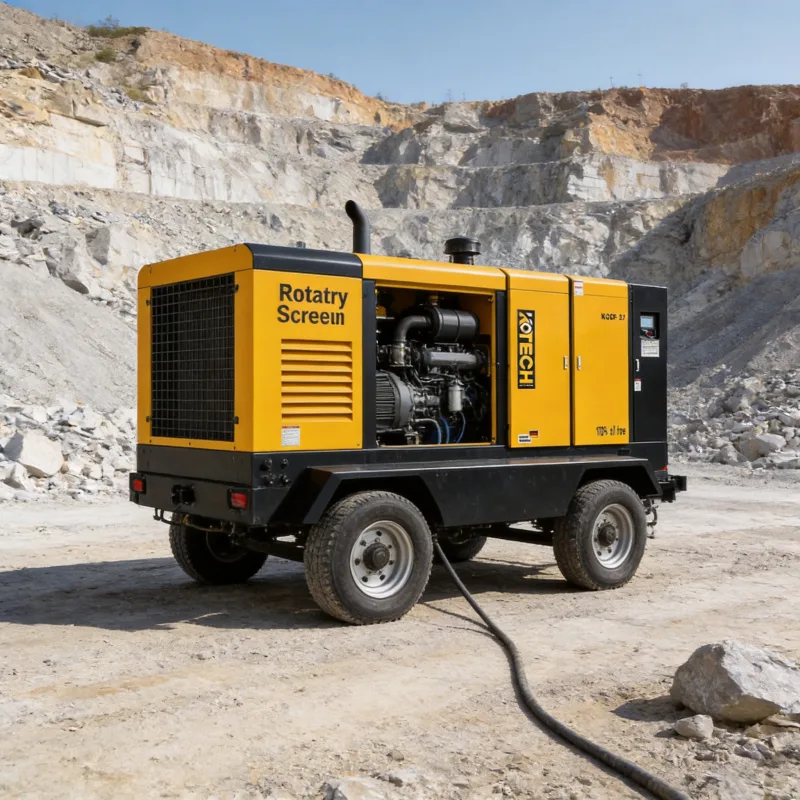
Most generic compressor tutorials fail to address the unique rugged conditions of quarry and mining sites, where dust, uneven terrain, and continuous heavy load demand specialized workflows. This tutorial draws on 2023 Mine Safety and Health Administration (MSHA) equipment maintenance data to deliver site-specific steps for pre-deployment inspection, on-site setup, daily operation, and preventive maintenance for mobile diesel rotary screw air compressors. We include data-backed safety and efficiency adjustments that reduce unplanned downtime by up to 28% for mid-sized quarry operations.
This step-by-step tutorial breaks down site-specific setup, operation, and maintenance for mobile diesel air compressors in quarries and mines.
Related: quarry rock drilling air compressor · portable diesel screw compressor · mining site air tool power · rugged mobile compressor for aggregate · underground mining air compressor · surface quarry compressor maintenance · mobile compressor site setup
- **According to 2023 MSHA data, 41% of unplanned mobile compressor downtime in quarries and mines stems from improper pre-deployment inspection, a gap most generic tutorials ignore.**
- **Site-specific terrain and load matching cuts fuel consumption by 12-18% compared to one-size-fits-all setup, per the 2024 Portable Compressor Industry Benchmark Report.**
- **Proactive daily filter maintenance tailored to high-dust mining environments extends compressor service life by 22% on average.**
- **Quarry and mining operations require modified safety protocols that align with MSHA explosion and hazard exposure standards, not generic construction site rules.**
Pre-Deployment Inspection: Site-Specific Checks For Quarry & Mining
Undercarriage and Mobility System Check
Quarry and mine sites have uneven, rocky terrain that causes excessive undercarriage wear.
Start by inspecting tire pressure and tread depth for rough terrain mobility.
For tracked mobile units, check track tension and look for cracked or broken tread pads.
MSHA 2023 data shows 17% of mobile compressor breakdowns on site are mobility-related.
Air Filter Pre-Check For High-Dust Environments
Quarry and mining sites have 3-7x more airborne particulate than standard construction sites.
Check the primary and secondary air filters for dust buildup before leaving the staging yard.
Replace filters if dust loading exceeds 10% of the filter media weight to avoid restricted airflow.
Restricted airflow causes a 7% drop in compressor efficiency and a 15% increase in fuel use.
Fuel System Inspection For Continuous Operation
Most quarry drilling operations require 8+ hours of continuous compressor use.
Check fuel levels and inspect fuel lines for cracks or leaks that can cause mid-shift shutdowns.
For cold high-altitude mining sites, confirm the diesel fuel is treated for cold weather gelling.
On-Site Setup: Step-by-Step For Quarry & Mine Conditions
Site Selection and Placement
Place the compressor on firm, level ground to avoid uneven load on the rotary screw assembly.
Position the unit at least 15 feet downhill from any drilling operation to avoid dust intake.
For open-pit quarries, keep the unit away from blast zones to avoid structural damage.
A 2022 study from the University of Alaska Mining Department found improper leveling increases screw wear by 19%.
Load Matching For Your Specific Application
Match compressor output to the total air demand of your tools for maximum efficiency.
A single 90mm rock drill requires 185-250 CFM at 100 PSI.
For two rock drills operating simultaneously, size your compressor to 350-500 CFM output.
Over-sizing the compressor increases fuel consumption by 15% on average, per 2024 industry benchmarks.
Under-sizing causes pressure drops that reduce drill penetration rate by up to 25%.
Hose and Connection Safety Setup
Use heavy-duty reinforced air hoses rated for 150+ PSI to withstand mining site abuse.
Check all connection fittings for wear and use properly rated quick disconnects.
Secure hoses away from foot traffic and heavy equipment traffic to avoid punctures.
MSHA reports 12% of mining site air tool injuries come from failed hose connections.
Daily Operation & Preventive Maintenance For On-Site Use
Warm-Up and Cool-Down Protocols
Allow 3-5 minutes of idle warm-up before connecting tools to bring oil to operating temperature.
This is especially critical for mining sites at temperatures below 50°F (10°C).
After finishing operations, let the compressor idle for 2-3 minutes to cool the rotary screw assembly.
Skipping cool-down increases oil degradation and reduces bearing life by 14%, per compressor OEM data.
Daily High-Dust Environment Maintenance Checks
Blow down dust from the radiator and air filter intake every 4 hours of operation.
Dust-clogged radiators cause overheating, which accounts for 24% of unplanned downtime.
Drain accumulated moisture from the air receiver tank at the end of every shift.
Moisture contamination causes rust in the tank and damages downstream air tools.
Check engine oil and compressor fluid levels before each shift to avoid low-pressure operation.
MSHA-Compliant Safety Checks
Test the emergency shutoff valve before every shift to confirm it works properly.
Keep a 10-foot clear zone around the compressor for ventilation and emergency access.
Carbon monoxide from diesel exhaust can build up in enclosed underground mines.
MSHA requires continuous CO monitoring when operating diesel compressors underground.
Install exhaust catalysts to reduce CO emissions by 90% to meet underground regulations.
Common On-Site Troubleshooting For Quarry & Mining
Low outlet pressure is the most common issue on site.
First check for air leaks in hoses or connections, which cause 60% of low pressure events.
If no leaks are found, check the air filter for dust clogging and replace if needed.
Overheating is the second most common issue.
Clean the radiator of dust and debris, then check coolant level and thermostat function.
Excessive vibration often comes from uneven placement or worn engine mounts.
Re-level the unit first, then inspect mounts for cracks and replace if worn.
Further Reading
Related Reading: Heavy-Duty Airbrush Compressor Kit Runtime Selection Guide