
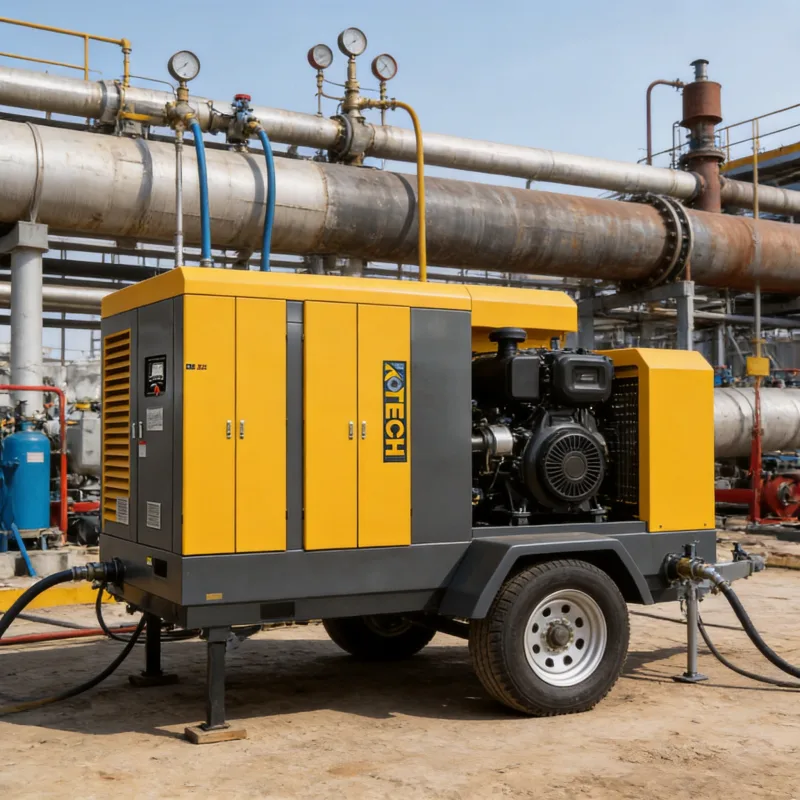
Navigating the complexities of pipeline pressure testing demands equipment that not only performs reliably but also aligns with stringent environmental standards. This article dissects how **eco-friendly diesel air compressors** are not merely a compliance checkbox but a strategic asset, significantly impacting project viability and long-term costs. * **Regulatory Compliance Catalyst:** Modern eco-friendly compressors, particularly those meeting Tier 4 Final standards, drastically reduce NOx and PM emissions, simplifying permitting and avoiding hefty fines in environmentally sensitive zones. * **Unseen Operational Efficiencies:** Beyond emissions, these units offer superior fuel economy (up to 15% better than older models) and extended service intervals, translating directly into lower operational costs and reduced downtime in remote pipeline projects. * **Mitigating Project Risks & Enhancing Public Perception:** Utilizing greener technology minimizes environmental footprint, improving community relations and reducing the likelihood of project delays due to public opposition or post-project remediation efforts. * **Long-Term Total Cost of Ownership (TCO) Advantage:** While initial investment might be higher, the cumulative savings from fuel efficiency, reduced maintenance, and avoided penalties often result in a lower TCO over the equipment's lifespan.
Eco-friendly diesel air compressors streamline pipeline pressure testing by ensuring compliance and optimizing operations.
Related: green industrial compressors · environmental compliance equipment · pipeline integrity testing · mobile air compressors · sustainable construction machinery · Tier 4 Final compressors · reduced emissions testing · remote site operations · energy-efficient air compressors · infrastructure project equipment
The landscape of pipeline construction and maintenance is evolving, driven by an urgent need for both operational efficiency and environmental stewardship. For critical tasks like pipeline pressure testing, the choice of equipment carries significant weight, influencing not just project timelines and budgets but also regulatory compliance and public perception. Traditional diesel air compressors, while robust, often fall short of modern environmental expectations, particularly in sensitive ecological zones or densely populated areas. This article delves into the specific, often overlooked, advantages of adopting eco-friendly diesel air compressors for pipeline pressure testing, offering insights beyond generic environmental benefits.
Navigating Environmental Regulations in Pipeline Pressure Testing: The Eco-Friendly Mandate
The primary, most immediate benefit of eco-friendly diesel air compressors in pipeline pressure testing is their ability to meet and exceed stringent environmental regulations. Regulatory bodies, such as the EPA in the United States and similar agencies globally, have progressively tightened emission standards for non-road diesel engines. For instance, Tier 4 Final standards, implemented for engines over 75 hp, demand a reduction of particulate matter (PM) by 90% and nitrogen oxides (NOx) by 80% compared to Tier 2 engines. For pipeline projects, which often traverse diverse terrains including national parks, agricultural lands, and residential areas, compliance is not optional; it’s a prerequisite for obtaining permits and avoiding substantial penalties.
Consider a pipeline project requiring pressure testing across multiple states. Each jurisdiction may have specific air quality regulations, often influenced by federal mandates but with local nuances. Deploying older, less compliant compressors can lead to protracted permitting processes, costly equipment upgrades mid-project, or even complete project halts. Data from the EPA indicates that non-compliance fines for environmental violations can range from tens of thousands to millions of dollars, dwarfing the incremental cost of eco-friendly equipment. Furthermore, proactive adoption of Tier 4 Final or equivalent compressors signals a commitment to environmental responsibility, often streamlining regulatory approvals and fostering better relationships with local communities and environmental groups.
Operational Efficiency Beyond Emissions: Fuel Economy and Uptime in Remote Pipeline Projects
While environmental compliance is a compelling driver, the financial and operational efficiencies offered by eco-friendly diesel air compressors are often underestimated. Modern eco-friendly units are not just “cleaner”; they are engineered for superior performance and fuel economy. Advanced engine technologies, such as common rail fuel injection, variable geometry turbochargers, and sophisticated engine control units (ECUs), optimize combustion, leading to significant fuel savings. Industry studies suggest that contemporary Tier 4 Final diesel engines can offer a 10-15% improvement in fuel efficiency compared to their Tier 2 predecessors, depending on load profiles and operating conditions.
For pipeline pressure testing, which often involves sustained operation over long periods in remote locations, fuel consumption directly impacts operational costs and logistical complexities. A 10% reduction in fuel usage on a project requiring 1,000 gallons of diesel per week for compressor operations translates to 100 gallons saved. Over a multi-month project, these savings accumulate rapidly, offsetting the higher initial purchase price of eco-friendly equipment. Moreover, these advanced engines often feature extended maintenance intervals and more robust diagnostic systems, reducing unscheduled downtime and the need for costly field repairs in hard-to-reach areas. This enhanced reliability is crucial for maintaining project schedules and avoiding costly delays, especially when facing tight deadlines or adverse weather conditions.
Mitigating Project Risks: Public Perception and Site Remediation with Green Compressor Technology
Beyond the tangible benefits of compliance and efficiency, eco-friendly diesel air compressors play a vital role in mitigating project risks related to public perception and environmental remediation. In today’s hyper-connected world, large infrastructure projects like pipelines are under constant public scrutiny. Local communities, environmental activists, and media outlets closely monitor construction activities, and any perceived environmental transgression can quickly escalate into a public relations crisis, leading to protests, legal challenges, and significant reputational damage for contractors and pipeline operators.
Deploying low-emission equipment demonstrates a tangible commitment to minimizing environmental impact, which can significantly improve community relations and garner public support. For example, a recent survey indicates that 70% of residents in areas adjacent to infrastructure projects prefer contractors who actively use environmentally certified equipment. This positive public perception can translate into smoother project execution, fewer permitting hurdles, and a more favorable operating environment. Furthermore, reduced emissions of PM and NOx contribute to better local air quality, directly benefiting the health of workers and nearby residents. From a remediation standpoint, using cleaner equipment minimizes the environmental footprint during the project, reducing the scope and cost of post-completion site cleanup and restoration efforts, a critical factor for long-term project viability and corporate social responsibility.
The TCO Advantage: Calculating Long-Term Savings of Eco-Friendly Diesel Compressors
While the upfront investment for an eco-friendly diesel air compressor might be higher than for an older, less compliant model, a comprehensive Total Cost of Ownership (TCO) analysis often reveals a compelling financial advantage for the greener option. The initial premium is quickly recouped through a combination of factors:
- Fuel Savings: As discussed, the enhanced fuel efficiency of modern engines directly reduces operational expenditure. Even a 5-10% fuel saving over several thousand operating hours can amount to tens of thousands of dollars.
- Reduced Maintenance Costs: Advanced engine designs and filtration systems often lead to longer service intervals and fewer component failures, decreasing both parts and labor costs.
- Avoided Fines and Penalties: Compliance with environmental regulations eliminates the risk of costly fines and legal battles, which can be substantial.
- Enhanced Resale Value: Eco-friendly equipment, being compliant with current and future regulations, typically retains a higher resale value compared to outdated, high-emission units. This is a critical factor often overlooked in initial purchase decisions.
- Improved Project Competitiveness: Companies that can demonstrate a commitment to sustainability through their equipment choices may gain a competitive edge in bidding for projects, especially those with stringent environmental clauses or located in environmentally sensitive areas.
For a typical pipeline pressure testing compressor operating 2,000 hours annually over five years, conservative estimates suggest that fuel savings alone can offset a significant portion of the initial cost difference. When factoring in avoided penalties and potential bidding advantages, the TCO for an eco-friendly unit often proves to be considerably lower, making it a sound long-term investment for any pipeline operator or contractor.
Further Reading
Related Reading: 2025 Air Compressor: New Trends & Model Lineup