
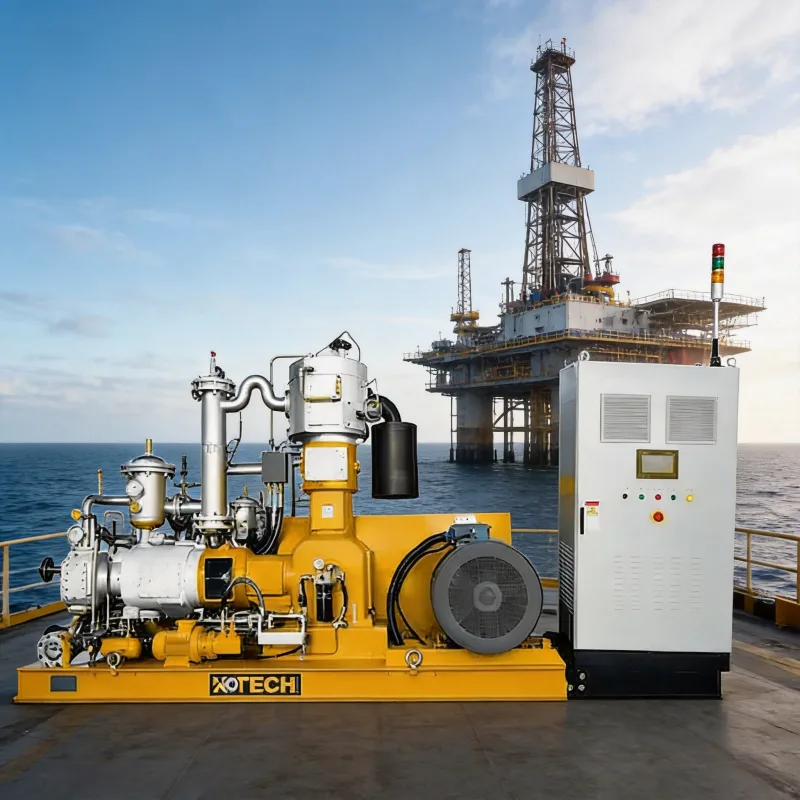
Selecting the right large capacity air compressor for offshore operations—diesel or electric—is a complex decision influenced by capital expenditure (CAPEX), operational expenditure (OPEX), environmental regulations, and logistical challenges. While diesel compressors offer robust self-sufficiency and high power density, their fuel consumption, emissions, and maintenance demands can lead to higher long-term costs and environmental impact. Electric compressors, conversely, present a greener, quieter, and potentially more cost-effective solution in terms of OPEX, assuming a reliable and adequately sized power source is available. This article delves into a comprehensive, data-backed comparison, highlighting the critical factors offshore operators must consider to optimize performance, reduce costs, and ensure regulatory compliance in an increasingly stringent global environment.
Electric offshore air compressors generally offer lower OPEX and environmental impact, while diesel provides greater flexibility for remote, power-constrained operations.
Related: offshore energy compressed air · oil and gas platform air systems · subsea equipment power · remote marine operations · sustainable offshore solutions · energy efficiency offshore · total cost of ownership offshore · environmental compliance offshore · operational resilience marine · power generation offshore
Key Insights
- Electric compressors offer up to 30% lower OPEX annually due to reduced fuel costs and significantly less maintenance, assuming grid power availability.
- Diesel compressors maintain superior operational flexibility for remote or power-constrained offshore sites, requiring no external grid connection.
- Electric compressors reduce direct CO2 emissions by 100% at the point of use, aligning with stringent IMO 2020 and future decarbonization targets, though upstream emissions vary by power source.
- Noise levels for electric units are typically 10-20 dBA lower than comparable diesel models, significantly improving onboard working conditions.
- Total Cost of Ownership (TCO) analysis is paramount, where initial CAPEX differences can be overshadowed by long-term fuel, maintenance, and compliance costs.
- The availability and reliability of offshore power infrastructure is the primary determinant for electric compressor viability.
Navigating the Offshore Power Divide: Diesel vs. Electric Air Compressors
The choice between a large capacity diesel and an electric air compressor for offshore operations is far more than a simple power source decision; it’s a strategic imperative impacting everything from operational costs and environmental footprint to safety and logistical complexity. As offshore industries, particularly oil & gas, renewables, and marine construction, push into more remote and environmentally sensitive areas, the demands on compressed air systems are intensifying. This necessitates a detailed, data-driven comparison to determine which power solution offers superior long-term value and operational resilience.
Operators commonly face the dilemma of diesel’s proven robustness and self-sufficiency against electric’s promise of lower emissions and potentially reduced operating expenses. The traditional reliance on diesel engines offshore is being challenged by evolving regulations, technological advancements, and a growing emphasis on sustainability. Understanding the nuanced trade-offs is crucial for making an informed investment that stands up to the rigors and evolving demands of the marine environment.
Capital Investment vs. Long-Term Operating Costs: A Financial Deep Dive
When evaluating large capacity air compressors for offshore use, the financial calculus extends far beyond the initial purchase price. Capital Expenditure (CAPEX) and Operational Expenditure (OPEX) present distinct profiles for diesel and electric units, often leading to surprising conclusions regarding Total Cost of Ownership (TCO).
Unpacking CAPEX Differences
On average, a large capacity electric air compressor unit might have a slightly lower initial CAPEX compared to a diesel-powered equivalent, primarily due to the simpler motor and lack of complex exhaust treatment systems. However, this advantage can quickly diminish if significant investments are required in offshore power infrastructure to support the electric unit. For instance, upgrading an existing platform’s electrical grid or installing new generators to handle a multi-megawatt electric compressor can escalate CAPEX by 15-25%. Diesel units, while having a higher upfront cost for the engine, fuel injection, and emission control systems, offer a self-contained solution, avoiding additional electrical infrastructure CAPEX. A 2022 industry report indicated that for a 500 kW compressor, the base unit CAPEX for electric might be 5-10% lower, but total installed cost could swing either way depending on existing power availability.
Analyzing OPEX: Fuel, Maintenance, and Logistics
OPEX is where the most significant divergence occurs. Diesel compressors are inherently fuel-intensive. A typical large capacity diesel compressor consumes between 0.2 to 0.25 liters of marine diesel per kWh of compressed air produced, depending on load and efficiency. With marine diesel prices fluctuating significantly (e.g., $700-$1000 per metric ton), fuel can account for 60-70% of a diesel compressor’s total OPEX. This is compounded by the logistics of offshore fuel delivery, which adds transportation and storage costs.
Electric compressors, by contrast, eliminate direct fuel consumption. Their OPEX is dominated by electricity costs, which, while variable, are generally more stable and predictable than offshore fuel prices. Furthermore, electric motors are mechanically simpler than internal combustion engines, leading to significantly lower maintenance requirements. Industry data suggests electric compressors require 30-40% less routine maintenance than diesel units, translating to annual savings of 10-15% on parts and labor. These savings, combined with the absence of fuel delivery logistics, can result in an overall OPEX reduction of up to 30% annually for electric units compared to diesel, assuming a readily available and cost-effective power supply.
Environmental Footprint and Regulatory Compliance: The Green Imperative
The environmental impact of offshore operations is under increasing scrutiny, driving a strong preference for solutions that minimize emissions. This is particularly critical given international regulations like IMO 2020 and the broader push towards decarbonization.
Direct Emissions and Air Quality
Diesel compressors are direct emitters of greenhouse gases (GHGs) and other pollutants. Burning marine diesel oil (MDO) releases approximately 3.15 kg of CO2 per liter. For a compressor operating 6,000 hours annually at 75% load, this can translate to thousands of metric tons of CO2, along with significant quantities of Nitrogen Oxides (NOx), Sulfur Oxides (SOx), and particulate matter (PM). While modern diesel engines incorporate Selective Catalytic Reduction (SCR) and Exhaust Gas Recirculation (EGR) to meet Tier IV or IMO Tier III standards for NOx, these systems add complexity, weight, and maintenance.
Electric compressors, conversely, produce zero direct emissions at the point of use. This is a crucial advantage for air quality on platforms and vessels, and for compliance with local emission caps. Their upstream emissions depend entirely on the source of electricity. If powered by offshore wind, solar, or a platform’s waste heat recovery system, the overall carbon footprint can be dramatically reduced, aligning with net-zero targets. Even when powered by a platform’s gas turbines, the centralized combustion can be more efficient and easier to control for emissions than multiple distributed diesel engines.
Noise Pollution and Regulatory Pressure
Noise pollution is another significant environmental and occupational health concern. Diesel compressors typically operate at noise levels between 95-110 dBA, requiring extensive sound attenuation measures and potentially impacting marine life. Electric compressors are considerably quieter, often operating in the 75-85 dBA range, improving working conditions and reducing the need for costly noise mitigation. As environmental regulations become more stringent, particularly concerning marine ecosystems and worker safety, the lower noise and emission profile of electric compressors offers a substantial competitive advantage and future-proofing.
Operational Reliability and Maintenance Demands in Harsh Offshore Environments
Offshore operations demand equipment that is not only powerful but also exceptionally reliable and resilient to harsh conditions. Both diesel and electric compressors have inherent strengths and weaknesses in this regard.
Reliability in Extreme Conditions
Diesel engines have a long history of robust performance in demanding offshore environments. Their self-contained nature means they are less susceptible to external power grid fluctuations or failures. However, their complexity (fuel injection, turbochargers, exhaust systems) means more potential points of failure and a greater sensitivity to fuel quality and contamination. Marine diesel engines also require consistent cooling, which, while standard, adds to the system’s overall complexity.
Electric motors are known for their inherent simplicity and reliability, with fewer moving parts than internal combustion engines. This translates to higher mean time between failures (MTBF). Their reliability offshore is primarily tied to the stability and quality of the electrical power supply. If the platform’s generators are unreliable or susceptible to trips, the electric compressor’s uptime will suffer. This highlights the importance of a robust and redundant power generation and distribution system for electric compressor integration.
Maintenance Regimes and Downtime
Maintenance is a critical factor influencing operational costs and uptime. Diesel compressors require frequent scheduled maintenance, including oil changes, filter replacements (fuel, air, oil), fuel system checks, and exhaust system inspections. These tasks are often complex, require specialized tools and personnel, and can be challenging to perform offshore due to space constraints and logistical hurdles. Unscheduled maintenance due to fuel quality issues or component failures can lead to significant downtime.
Electric compressors, with their simpler design, require substantially less routine maintenance. Key tasks typically involve bearing lubrication, electrical connection checks, and general inspection. This reduced maintenance burden translates directly to lower labor costs, fewer spare parts, and crucially, higher availability. A study on industrial compressor maintenance showed that electric units typically experience 15-20% less unplanned downtime compared to diesel units over a five-year operational period. This can be a game-changer for critical offshore applications where every hour of uptime is valuable.
Power Infrastructure and Integration Challenges: Offshore Logistics
The decision between diesel and electric often hinges on the existing and planned power infrastructure of the offshore facility. This is a unique challenge for marine operations compared to land-based installations.
Grid Availability and Stability
For electric compressors, a reliable and stable power grid is non-negotiable. On an offshore platform, this means adequate generator capacity, robust switchgear, and potentially dedicated feeders to prevent voltage drops or power quality issues. Integrating a large capacity electric compressor might necessitate significant upgrades to the platform’s power generation capabilities, which can be costly and complex. However, platforms increasingly leverage gas turbines or even renewable energy sources (e.g., offshore wind integration) for power, making electric compressors a natural fit.
Diesel compressors, being self-contained, sidestep this issue. They bring their own power source, offering unparalleled flexibility for remote installations, temporary operations, or locations with insufficient electrical infrastructure. This independence is a major advantage for exploration rigs, construction vessels, or older platforms not designed for high electrical loads. However, this flexibility comes with the logistical burden of fuel storage and replenishment.
Footprint and Weight Considerations
Space and weight are always at a premium offshore. Diesel compressors require not only the engine and compressor unit but also significant ancillary systems: large fuel tanks, exhaust stacks, emission control equipment, and potentially larger cooling systems. This can lead to a larger overall footprint and greater weight. Electric compressors, while still substantial, often have a more compact footprint due especially to the absence of fuel storage and exhaust systems. This can be a decisive factor on space-constrained platforms or vessels.
Strategic Selection: Matching Compressor Type to Offshore Project Needs
Ultimately, the “better” choice is highly contextual, dependent on the specific offshore project’s requirements, operational philosophy, and long-term strategic goals. There is no one-size-fits-all answer.
For new builds or platforms with ample, stable, and relatively clean power generation (e.g., gas turbines, renewables), electric compressors are increasingly the preferred option. Their lower OPEX, reduced emissions, quieter operation, and simpler maintenance profile offer a compelling TCO and align with modern sustainability objectives. They are ideal for long-term, fixed installations where power infrastructure can be optimized.
Conversely, for existing platforms with limited electrical capacity, temporary projects, remote exploration vessels, or scenarios where operational flexibility and self-sufficiency are paramount, large capacity diesel air compressors remain indispensable. Their ability to operate independently of a complex electrical grid provides critical operational resilience, despite their higher fuel and maintenance costs and larger environmental footprint. The decision matrix must weigh the CAPEX of power infrastructure upgrades against the ongoing OPEX and environmental costs of diesel.
Forward-thinking operators are also exploring hybrid solutions, combining the benefits of both. This might involve using electric compressors as primary units with a diesel compressor as a backup or for peak demand, offering a blend of efficiency, environmental responsibility, and robust reliability. The trend towards electrification offshore is undeniable, but the practicalities of existing infrastructure and diverse operational needs ensure diesel will retain a niche for the foreseeable future. A thorough TCO analysis, incorporating all direct and indirect costs, environmental impact, and regulatory foresight, is the only way to make the truly optimal decision.
References
Further Reading
Related Reading: 2025 Air Compressor: New Trends & Model Lineup