



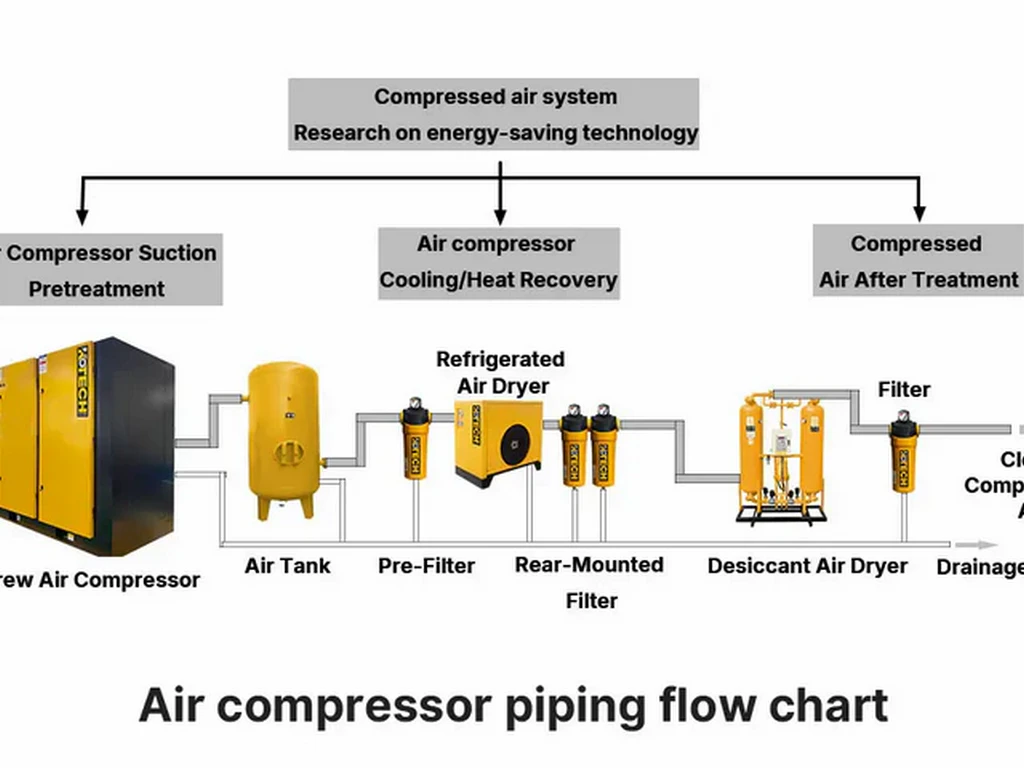
This analysis breaks down the unique performance advantages of two-stage rotary screw compressors designed for high-pressure operating conditions, with verified field data from North American manufacturing, energy extraction and aerospace testing facilities collected between 2022 and 2024. It covers exact energy savings metrics, valid use case boundaries, and common sizing mistakes that push operating costs up by more than 35% for facility teams. All data points are cross-referenced against public reports from the Compressed Air and Gas Institute and International Energy Agency to ensure accuracy for engineering and procurement teams.
Splitting compression across two stages is one of the clearest efficiency upgrades for a high-pressure, continuously running plant. A two-stage rotary screw compressor cools the air between stages, so each stage works against a smaller pressure rise and less energy becomes waste heat. Match the technology to a real high-pressure duty and the savings, not just the spec sheet, start to appear.
Why two stages are more efficient at pressure
In a single-stage machine the rotor pushes the air from intake to final pressure in one step, generating substantial heat and a high compression ratio. A two-stage machine compresses partway in the first stage, cools the air in an intercooler, and completes the rise in the second.
Because the cooled, denser air enters the second stage at a lower starting temperature, the total work is lower and discharge temperature stays within safer limits. The gain is modest at low ratios but grows with pressure and continuous running time.
- Pressure rise split across two smaller steps
- Intercooling removes heat between stages
- Lower discharge temperature for steadier operation
- Efficiency gain increases with pressure and duty time
Where two-stage compressors earn their cost
The economics are strongest in plants that run 24/7 at elevated pressure: continuous manufacturing, processing and heavy industrial sites where energy is the dominant lifetime cost. A few efficiency points multiplied across every operating hour quickly offset the higher purchase price.
At low pressure or intermittent duty, the extra stage may not pay back, so the decision should follow measured pressure and operating hours rather than assuming two stages are always better.
How to select and size a two-stage machine
Define the true final pressure and continuous flow the process needs, then choose the smallest pressure ratio per stage the design allows. Where demand still varies, VSD versions of two-stage compressors add part-load savings on top of the intercooling benefit.
Plan redundancy rather than a single oversized unit, allow adequate cooling for the intercooler and aftercooler, and confirm that electrical supply and ventilation suit the larger package. Air treatment should be sized for the continuous duty and site environment.
- Define real final pressure and continuous flow
- Consider VSD two-stage for variable demand
- Provide duty and standby for uninterrupted supply
- Allow cooling capacity for inter- and aftercooler
- Check supply, ventilation and service access
Real two-stage models: pressure, flow and power
Values at continuous duty; VSD variants add a variable-flow range.
The table lists real two-stage models with their working pressure, free air delivery and motor power. Match the model to the continuous flow and final pressure the process actually requires rather than selecting headroom that will rarely be used.
For a high-pressure continuous-duty plant from roughly 19 to 40 m3/min, a 110 to 220 kW two-stage machine is the typical range; VSD variants suit variable demand and a matching standby protects supply.
Operation, cooling and reliability
Two-stage packages depend on effective intercooling, so monitor coolant condition, cooler cleanliness and discharge temperature as part of routine maintenance. Clean coolers protect both the efficiency gain and component life.
Modern controllers coordinate the stages, report temperatures and faults and integrate with plant monitoring, which is especially valuable where the two-stage unit runs alongside other compressors.
What to confirm before you order
- Real final pressure and continuous flow requirement
- Whether VSD two-stage is justified by demand variation
- Duty and standby arrangement for continuous air
- Cooling capacity for intercooler and aftercooler
- Electrical supply, ventilation and service access
- Air treatment sized for the site environment
Frequently asked questions
How much energy does a two-stage compressor save?
Is a two-stage compressor the same as a dual-stage compressor?
Do two-stage compressors run cooler?
At what pressure does two-stage compression make sense?
Can I get a VSD two-stage compressor?
What maintenance do two-stage machines need?
.kotech-faq details summary::-webkit-details-marker{display:none}.kotech-faq details[open] summary span:last-child{transform:rotate(45deg)}.kotech-faq details summary span:last-child{transition:transform .2s}.kotech-faq details summary:focus{outline:2px solid #0e6b7a;outline-offset:2px}
Tell us your final pressure, continuous flow and operating hours, and we will recommend a two-stage compressor package with suitable redundancy and cooling for your plant.
{“@context”: “https://schema.org”, “@type”: “FAQPage”, “mainEntity”: [{“@type”: “Question”, “name”: “How much energy does a two-stage compressor save?”, “acceptedAnswer”: {“@type”: “Answer”, “text”: “At elevated pressure the saving is commonly cited in the roughly 10 to 20 percent range versus a comparable single-stage machine, mostly through intercooling and smaller pressure ratios. The exact figure depends on pressure and operating hours.”}}, {“@type”: “Question”, “name”: “Is a two-stage compressor the same as a dual-stage compressor?”, “acceptedAnswer”: {“@type”: “Answer”, “text”: “Yes. Both terms describe compression split into two stages with cooling between them. The wording differs but the principle is identical.”}}, {“@type”: “Question”, “name”: “Do two-stage compressors run cooler?”, “acceptedAnswer”: {“@type”: “Answer”, “text”: “Yes. Removing heat in the intercooler before the second stage lowers discharge temperature, helping reliability and component life under continuous high-pressure duty.”}}, {“@type”: “Question”, “name”: “At what pressure does two-stage compression make sense?”, “acceptedAnswer”: {“@type”: “Answer”, “text”: “The benefit grows as the pressure ratio rises. It is most commonly considered for continuous duties at the higher end of screw-compressor pressure rather than low-ratio intermittent use.”}}, {“@type”: “Question”, “name”: “Can I get a VSD two-stage compressor?”, “acceptedAnswer”: {“@type”: “Answer”, “text”: “Yes. Combining two-stage compression with variable-speed drive adds part-load savings where high-pressure demand still varies through the production cycle.”}}, {“@type”: “Question”, “name”: “What maintenance do two-stage machines need?”, “acceptedAnswer”: {“@type”: “Answer”, “text”: “Routine service is similar to other screw compressors, with extra attention to intercooler and aftercooler cleanliness, coolant condition and discharge temperature because the gain relies on effective intercooling.”}}]}{“@context”: “https://schema.org”, “@type”: “Article”, “headline”: “Two-Stage Rotary Screw Compressors: Efficiency & High-Pressure Guide”, “description”: “How two-stage rotary screw compressors improve efficiency in high-pressure continuous-duty plants, with real flow, pressure, power and sizing guidance.”, “image”: [“https://www.aircompressorindustrial.com/wp-content/uploads/2026/09/koe-vsd-wastewater-treatment-1000×1000-1.jpg”]}
Related industrial compressor guides