



In a wastewater treatment plant, a screw compressor rarely feeds the aeration basins — that is the job of low-pressure blowers. The permanent magnet VSD screw compressor instead supplies the higher-pressure utility and process air that runs automated valves, instruments, dissolved-air flotation and chemical handling. Size it against those real, often intermittent loads and the energy savings follow.
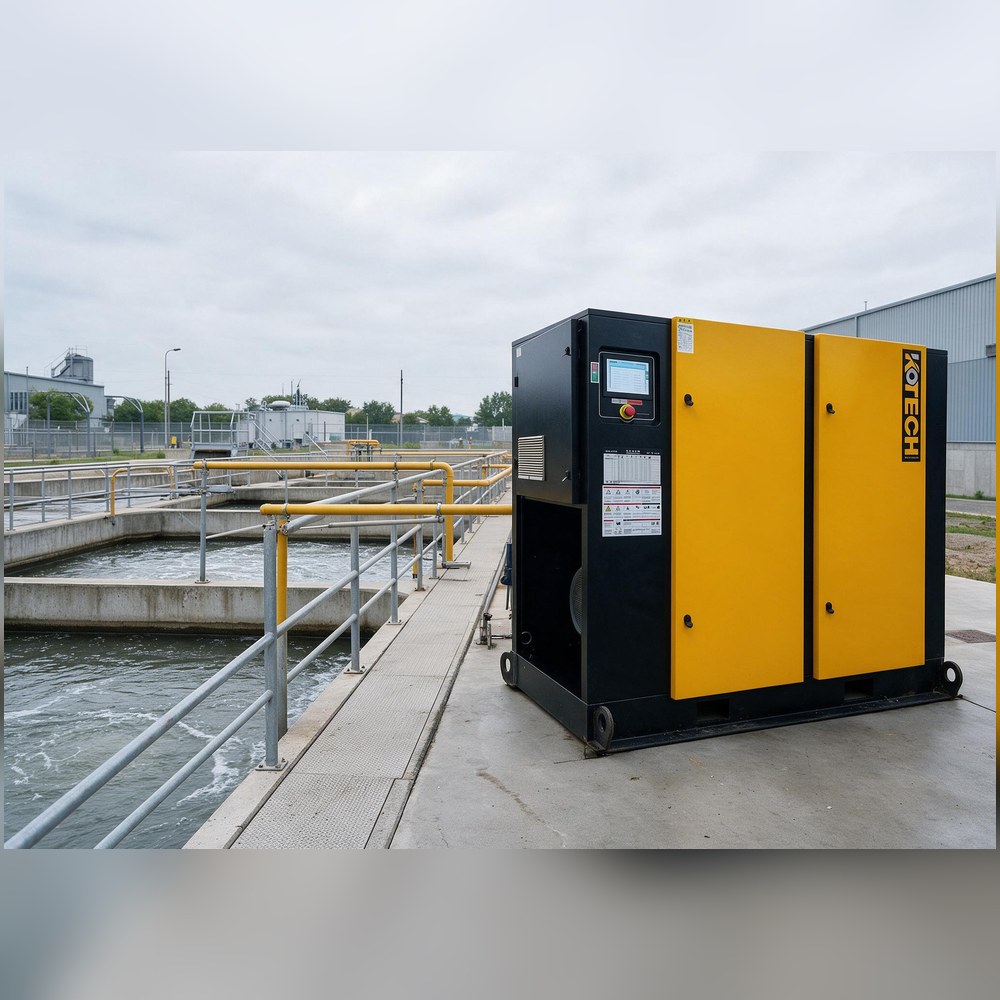
What a screw compressor actually powers in a wastewater plant
It helps to separate two air systems. Bulk biological aeration uses large volumes of air at very low pressure and is handled by centrifugal or rotary-lobe blowers. A rotary screw compressor delivers a smaller flow at roughly 7 to 10 bar for the mechanical, control and process duties around the plant.
Those higher-pressure duties include pneumatically actuated inlet and return valves, sluice gates and penstocks; clean instrument and control air for analyzers, transmitters and solenoid panels; compressed air for dissolved-air flotation saturators; pneumatic conveying of lime, powdered activated carbon and polymer; and pneumatic tensioning and control on belt-filter presses and centrifuges.
- Automated valves, gates and penstocks
- Instrument and control-air panels
- Dissolved-air flotation (DAF) air supply
- Pneumatic transfer of lime, carbon and polymer
- Sludge dewatering equipment controls
Why permanent magnet VSD fits this load profile
Most of these loads are not constant. Valve operation happens in short bursts, DAF runs in cycles, chemical dosing follows batch shifts, and night shifts use far less air than the day. A fixed-speed compressor running loaded or unloaded against this profile wastes energy during unloaded time and frequent venting.
A permanent magnet VSD unit changes motor and rotor speed to track demand, keeping system pressure within a narrow band instead of cycling between load and idle. Because wastewater plants run continuously, even a modest reduction in unloaded power and part-losses accumulates across every hour of the year.
How to size the compressor correctly
Begin with an air-use list, not a nameplate. Note the flow and pressure of each consumer, how often it operates and whether several consumers run at once. Add the largest simultaneous demand rather than the sum of every device, then include a realistic growth margin.
Set pressure to the minimum the highest-pressure consumer requires, plus legitimate pressure-drop allowance — selecting 10 bar when the plant runs at 7 wastes energy. Because treatment plants cannot tolerate a loss of control air, plan redundancy such as a duty and standby machine rather than one oversized compressor, and account for humid, often outdoor air with drying and filtration.
- List every consumer with flow, pressure and duty cycle
- Use peak simultaneous demand plus a growth margin
- Choose the lowest pressure that still clears pressure drop
- Provide duty and standby redundancy
- Treat moisture with dryers, drains and filtration
Real permanent magnet VSD models for wastewater utility air
Flow is the variable-speed turndown range at each working pressure; noise is the enclosed package level.
The table lists real permanent magnet VSD models at two common plant pressures. Flow is shown as the turndown range the variable-speed drive can hold, so you can match a model to the minimum and maximum air demand your air-use study identifies.
For a typical municipal plant where the simultaneous utility load falls between roughly 3 and 16 m3/min, a single 37 to 90 kW VSD machine with a matching standby is often sufficient; larger facilities add a third unit instead of running one compressor far above its efficient range.
Air quality and installation in a damp plant
Wastewater environments carry high humidity and corrosive gases, and instrument air must stay dry to protect controllers. A common setup pairs the compressor with a refrigerated or desiccant dryer, line and point-of-use filtration, and reliable condensate drains. Drawing inlet air from a clean, ventilated space rather than a wet well also extends component life.
Enclosed, low-noise packages are practical near control rooms and residential boundaries, and the compressor room should allow service access and adequate ventilation for cooling.
What to confirm before you order
- An air-use table covering every valve, instrument and process consumer
- Peak simultaneous demand and a stated growth margin
- Working pressure chosen from real demand, not defaulted higher
- Duty and standby arrangement for uninterrupted control air
- Dryer, filtration and condensate handling sized for humid air
- Ventilation, noise and service access for the installation location
Frequently asked questions
Can a screw compressor aerate the biological basins directly?
Why choose permanent magnet VSD instead of a fixed-speed compressor?
What pressure does a wastewater plant utility system usually need?
How do I protect controls from moisture in a treatment plant?
Should I install one large compressor or smaller redundant units?
Is compressed air used in dissolved-air flotation?
.kotech-faq details summary::-webkit-details-marker{display:none}.kotech-faq details[open] summary span:last-child{transform:rotate(45deg)}.kotech-faq details summary span:last-child{transition:transform .2s}.kotech-faq details summary:focus{outline:2px solid #0e6b7a;outline-offset:2px}
Share your valve list, DAF duty and plant pressure, and we will size a permanent magnet VSD compressor package with suitable redundancy and air treatment for your treatment works.
Related reading
- Industrial Air Compressor | High Efficiency Industrial Compressor for Manufacturing & Heavy-Duty Use
- Premium Rotary Screw Compressors – CE, ISO Certified Quality
{“@context”: “https://schema.org”, “@type”: “FAQPage”, “mainEntity”: [{“@type”: “Question”, “name”: “Can a screw compressor aerate the biological basins directly?”, “acceptedAnswer”: {“@type”: “Answer”, “text”: “Not efficiently. Aeration basins need very high flow at low pressure, which is the role of dedicated aeration blowers. A screw compressor at 7 to 10 bar serves utility and process loads such as valves, instruments and dissolved-air flotation.”}}, {“@type”: “Question”, “name”: “Why choose permanent magnet VSD instead of a fixed-speed compressor?”, “acceptedAnswer”: {“@type”: “Answer”, “text”: “Wastewater utility air demand rises and falls with valves, DAF cycles and shifts. A permanent magnet VSD compressor adjusts speed to match that demand, reducing unloaded running and keeping pressure stable, which lowers energy use in a continuously operating plant.”}}, {“@type”: “Question”, “name”: “What pressure does a wastewater plant utility system usually need?”, “acceptedAnswer”: {“@type”: “Answer”, “text”: “Most pneumatic valves, instruments and process consumers operate at about 7 to 10 bar. Select the lowest pressure that satisfies the highest-demand consumer after accounting for filter, dryer and piping losses.”}}, {“@type”: “Question”, “name”: “How do I protect controls from moisture in a treatment plant?”, “acceptedAnswer”: {“@type”: “Answer”, “text”: “Use a suitably sized dryer, line and point-of-use filtration, and automatic condensate drains, and draw inlet air from a clean ventilated area. Dry instrument air prevents corrosion and unreliable pneumatic equipment.”}}, {“@type”: “Question”, “name”: “Should I install one large compressor or smaller redundant units?”, “acceptedAnswer”: {“@type”: “Answer”, “text”: “Prefer a duty and standby arrangement sized for peak simultaneous demand. Redundant units keep control air available during servicing and let each machine run nearer its efficient range instead of running one oversized compressor lightly loaded.”}}, {“@type”: “Question”, “name”: “Is compressed air used in dissolved-air flotation?”, “acceptedAnswer”: {“@type”: “Answer”, “text”: “Yes. DAF saturators use compressed air at several bar so that air dissolves under pressure and releases as fine bubbles when the flow enters the flotation tank. This cyclic load is well suited to variable-speed control.”}}]}{“@context”: “https://schema.org”, “@type”: “Article”, “headline”: “Permanent Magnet VSD Screw Compressors for Wastewater Treatment: Sizing Guide”, “description”: “How to size a permanent magnet VSD rotary screw compressor for wastewater treatment plant utility and process air, with real flow, pressure and duty guidance.”, “image”: [“https://www.aircompressorindustrial.com/wp-content/uploads/2026/09/koe-vsd-wastewater-treatment-1000×1000-1.jpg”]}