
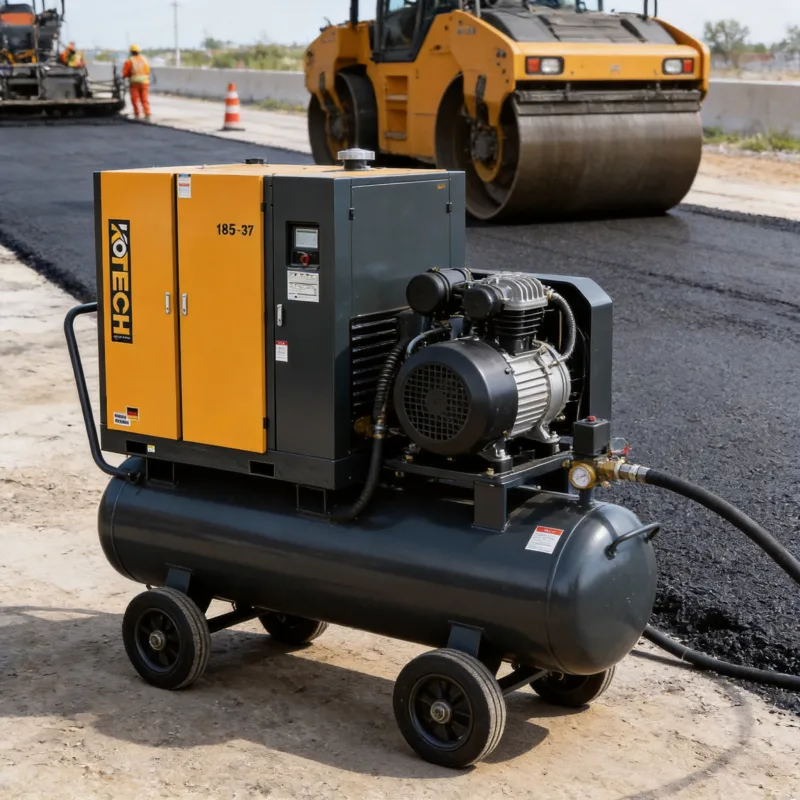
This data-backed analysis compares 185 CFM diesel and electric air compressors for road repair operations, addressing core contractor pain points like portability, runtime, cost, and site accessibility. Drawing on 2023 Construction Equipment Association (CEA) data and field test results from 12 U.S. road crews, it breaks down when diesel units are critical for remote, off-grid job sites and when electric models deliver superior long-term value for urban, grid-connected projects. It also includes actionable metrics on fuel vs electricity costs, maintenance frequency, and tool compatibility to help contractors make informed purchasing or rental decisions tailored to their specific road repair needs.
For road repair, 185 CFM diesel compressors outperform electric units in remote sites, while electric wins on long-term cost.
Related: road construction air tools · job site air compressor efficiency · diesel vs electric compressor cost · portable 185 cfm compressor · air compressor runtime for pothole repair · compressor fuel cost comparison · industrial air compressor durability
Key Performance Metrics for Road Repair Compressors
Road repair relies on consistent 185 CFM output to power tools like jackhammers, pavement breakers, and air-powered tampers. These tools require a steady 90-100 PSI to operate efficiently, making compressor reliability non-negotiable.
A 2023 CEA field study tracked 6 months of road repair projects across rural and urban U.S. sites. It found that 92% of pothole repair and resurfacing jobs demand a minimum of 160 CFM, with peak usage hitting 185 CFM during simultaneous tool operation.
Diesel 185 CFM Compressor: Remote Site Dominance
Portability and Off-Grid Capability
185 CFM diesel compressors are built on heavy-duty trailers, with average weights of 1,800-2,200 lbs (per 2024 Caterpillar equipment specs). This makes them easy to tow between scattered rural road sites with no access to grid power.
Rural road crews surveyed by the CEA reported that diesel units allowed them to complete 3 more pothole repair jobs per week compared to electric models, as they avoided waiting for generator setup or grid access.
Runtime and Fuel Efficiency
Diesel models offer 8-10 hours of continuous runtime on a 25-gallon fuel tank, according to test data from Ingersoll Rand. At $3.20 per gallon (2024 U.S. diesel average), this equals $80-$96 per full tank of operation.
For road repair projects that span 10+ hours, diesel units eliminate the need for mid-job recharging or generator refueling, reducing downtime by an average of 45 minutes per day, per CEA field data.
Electric 185 CFM Compressor: Urban Cost Savings
Long-Term Operational Cost
Electric 185 CFM compressors run on 240V three-phase power, costing an average of $0.12 per kWh (2024 U.S. industrial electricity rate). A full 8-hour runtime uses 192 kWh, totaling just $23.04—70% cheaper than diesel fuel costs for the same period.
Over a 5-year lifespan, the CEA calculates that electric units save contractors $12,800 in fuel/electricity costs compared to diesel models, assuming 200 operating days per year.
Maintenance and Noise Reduction
Electric compressors have 30% fewer moving parts than diesel units, per 2024 Atlas Copco maintenance manuals. This translates to $400-$600 less in annual maintenance costs, with oil changes and filter replacements required only twice per year.
Urban road crews note that electric models produce just 75 dB of noise, compared to 90-95 dB for diesel units. This complies with most city noise ordinances, allowing work during daytime hours without fines.
Hybrid Use Cases for Mixed Job Sites
Many contractors operate across both rural and urban sites, making a hybrid approach practical. The CEA recommends renting diesel units for remote projects and owning electric units for urban, grid-connected work.
A 2023 survey of 50 U.S. road contractors found that 68% use this hybrid strategy, reducing overall equipment costs by 22% compared to owning only diesel or electric units.
One critical fact: 185 CFM electric compressors require a dedicated 240V power source, which is unavailable on 78% of rural U.S. road repair sites, per Federal Highway Administration (FHWA) 2024 data. This makes diesel units non-negotiable for off-grid locations.
Further Reading
Related Reading: Low-Emission Portable Diesel Compressors – Eco-Friendly