



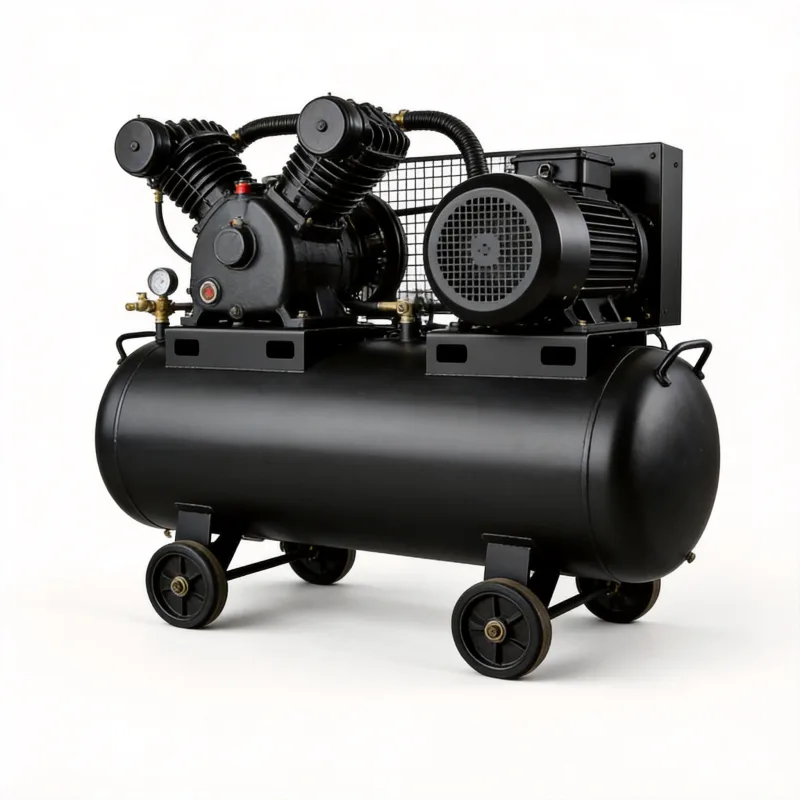
Choosing between a 2-stage high pressure diesel and a single-stage rotary screw compressor hinges on specific pressure demands and long-term TCO.
Unpacking the Core Differences: Pressure, Efficiency, and Design Philosophy
The choice between a 2-stage high pressure diesel air compressor and a single-stage rotary screw compressor is not merely a matter of brand or price; it’s a fundamental decision rooted in application requirements and long-term operational economics. While both are critical workhorses in various industries, their design philosophies optimize them for distinct pressure ranges and duty cycles.
A 2-stage high pressure diesel air compressor for sale, typically a rotary screw design, compresses air in two distinct steps. Air is partially compressed in the first stage, cooled, and then further compressed in the second stage to reach significantly higher pressures, often exceeding 200 PSI, and commonly reaching 350 PSI. This multi-stage process minimizes heat generation per stage, improving volumetric efficiency and component longevity at elevated pressures. These units are almost exclusively diesel-powered, emphasizing their portability and suitability for remote, heavy-duty applications.
Conversely, a single-stage rotary screw compressor achieves its full pressure output in one continuous compression cycle. These units are optimized for continuous air delivery at standard industrial pressures, typically ranging from 80 PSI to 175 PSI. While available in diesel variants for mobile use, many single-stage rotary screws are electric, serving fixed industrial installations. Their design prioritizes consistent, high-volume airflow for general pneumatic tools and processes.
A critical, often overlooked fact is that for every 2 PSI increase in discharge pressure, the energy consumption of a compressor rises by approximately 1%. Pushing a single-stage unit beyond its optimal pressure range (e.g., consistently operating at 200+ PSI) forces the compressor to work harder, generating more heat, consuming disproportionately more fuel, and accelerating wear on components. This is where the inherent efficiency of a 2-stage design becomes a game-changer for high-pressure demands.
Total Cost of Ownership: Beyond the Initial Price Tag
When evaluating which compressor is “better,” the initial purchase price can be misleading. A comprehensive Total Cost of Ownership (TCO) analysis, spanning 5-7 years, reveals the true economic impact. While a 2-stage high pressure diesel rotary screw compressor generally carries a 15-30% higher upfront cost than a comparable CFM single-stage unit, its operational efficiencies for specific applications can quickly offset this.
Fuel consumption is a primary driver of TCO for diesel compressors. For applications consistently requiring pressures above 200 PSI, 2-stage designs can offer a 10-15% reduction in specific fuel consumption (gallons per CFM per hour) compared to a single-stage unit attempting to deliver the same high pressure. For instance, a 300 CFM diesel compressor operating 8 hours a day, 5 days a week, consuming 5 gallons per hour (GPH) at $4.00/gallon, incurs $160 in daily fuel costs. A 10% efficiency gain translates to $16/day in savings, or over $4,000 annually. Over five years, this alone can amount to $20,000 in savings, easily surpassing the initial price differential.
Maintenance costs also factor into TCO. While 2-stage units have slightly more complex air-ends, their reduced operating temperatures at high pressures can lead to longer intervals between major overhauls and extended component life. Industry data suggests that unscheduled downtime due to component failure can cost businesses hundreds to thousands of dollars per hour in lost productivity. The robust design of a 2-stage unit, built for demanding conditions, often translates to greater reliability in its intended high-pressure environment, minimizing these hidden costs.
Furthermore, diesel engine maintenance, particularly for units complying with Tier 4 Final emissions standards, is an ongoing expense. Both compressor types, if diesel-powered, will incur these costs. However, the higher efficiency of a 2-stage unit means less strain on the engine to achieve required output, potentially extending engine life and reducing certain maintenance frequencies.
Application Suitability and Performance Metrics: Matching the Compressor to the Job
The “better” compressor is entirely dependent on the specific application’s pressure and volume requirements. Misaligning a compressor with its intended use inevitably leads to inefficiencies, premature wear, and inflated operational costs.
2-stage high pressure diesel rotary screw compressors are the undisputed champions for heavy-duty, high-pressure applications in remote or mobile settings. These include:
- Heavy-duty sandblasting (requiring 250-350 PSI for efficient media delivery and surface preparation).
- Deep-hole drilling and well drilling.
- Pile driving and foundation work.
- Specialized industrial processes requiring high-pressure air for material transfer or precision cleaning.
- Large-scale infrastructure projects where consistent high pressure is paramount for multiple tools or processes simultaneously.
For these demanding tasks, the ability of a 2-stage unit to deliver stable, high-pressure air continuously without excessive strain on the system ensures optimal tool performance and project timelines. Trying to achieve these pressures with a single-stage unit will likely result in inadequate air supply, reduced tool efficiency, and significant compressor strain.
Single-stage rotary screw compressors, on the other hand, are the go-to solution for continuous, moderate-pressure air demands. Their ideal applications include:
- General construction sites (powering pneumatic tools like jackhammers, nail guns, and impact wrenches).
- Road building and asphalt paving operations.
- Manufacturing plants and workshops for assembly lines and general utility air.
- Small to medium-scale sandblasting (typically 100-150 PSI).
- Agricultural operations for various pneumatic equipment.
These applications thrive on consistent CFM at standard pressures. A single-stage unit provides this reliably and efficiently. Investing in an unnecessarily complex 2-stage unit for these applications would represent an overcapitalization, leading to higher initial costs without realizing the efficiency benefits designed for higher pressures.
To quantify this, consider a typical heavy-duty sandblasting nozzle requiring 300 CFM at 250 PSI. A 2-stage diesel compressor rated for 350 CFM at 300 PSI will operate efficiently within its design parameters. A single-stage unit rated for 350 CFM at 125 PSI would either fail to reach the required pressure, or operate under extreme stress, leading to rapid component degradation and significantly higher fuel burn to try and achieve the inadequate pressure.
Making the Informed Decision: A Strategic Investment
Ultimately, the decision between a 2-stage high pressure diesel air compressor and a single-stage rotary screw compressor is a strategic investment choice. It requires a meticulous assessment of your operational needs, not just today, but for the foreseeable future.
If your operations frequently demand sustained pressures above 200 PSI, especially in mobile or remote environments, the higher initial investment in a 2-stage high pressure diesel unit is economically justifiable. The long-term savings in fuel efficiency, reduced maintenance, and superior reliability for high-pressure tasks will provide a compelling return on investment. Furthermore, the robust construction and specialized design of these units ensure they can withstand the rigorous demands of such applications.
Conversely, if your primary need is for continuous, high-volume airflow at standard industrial pressures (80-175 PSI) for general construction, manufacturing, or workshop tasks, a single-stage rotary screw compressor offers the most cost-effective and efficient solution. Their simpler design and optimization for these pressure ranges make them an excellent choice, providing reliable performance without unnecessary complexity or upfront cost.
Before making a purchase, meticulously analyze your required CFM and PSI, consider your duty cycle (intermittent vs. continuous operation), evaluate the environment (mobile, stationary, remote), and project your operational hours. Engaging with reputable air compressor dealers who can perform a detailed air audit and TCO projection for your specific use case is highly recommended. This data-driven approach ensures you acquire a compressor that not only meets your technical needs but also optimizes your financial outlay over its entire service life.