
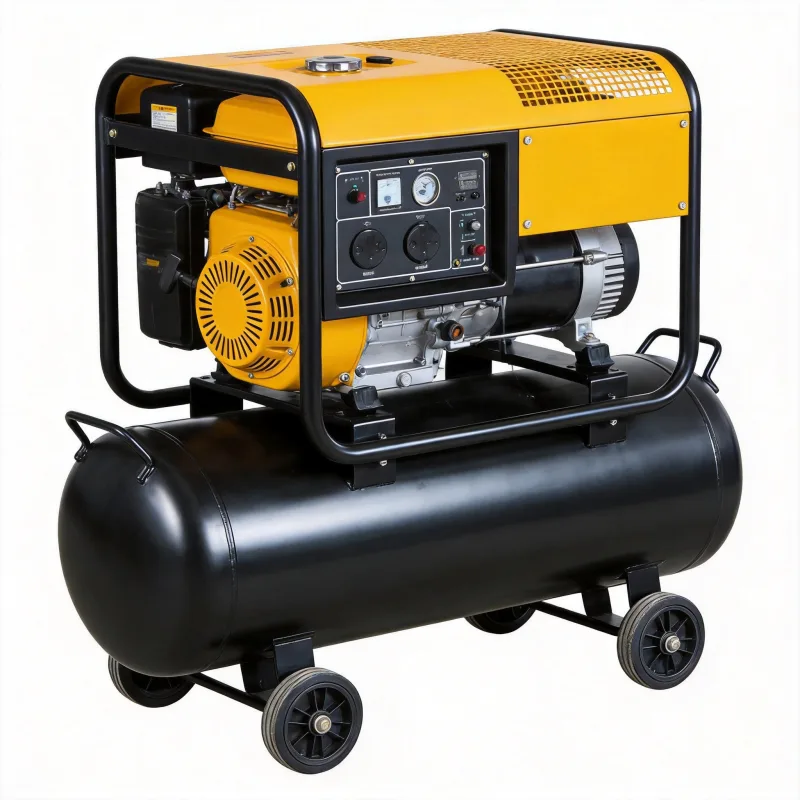
Navigating the choice between an integrated diesel air compressor with generator and separate standalone units for demanding construction work is a critical decision impacting operational efficiency and project budgets. While integrated units promise compact design and simplified logistics, often boasting a 15-20% smaller footprint crucial for congested urban sites, their "all-in-one" nature can introduce unique challenges. Conversely, standalone setups offer unparalleled flexibility, redundancy, and potentially optimized performance for specific tasks. Data suggests standalone configurations can reduce downtime by 10-12% over five years due to isolated component repair and may achieve 5-8% better fuel efficiency when units operate independently at optimal loads. This article provides a deep dive into the cost implications, operational advantages, and maintenance considerations for both options, empowering construction professionals to make informed decisions tailored to their portable industrial needs. * **Integrated units offer up to 20% smaller footprint, ideal for space-constrained urban construction.** * **Standalone setups provide superior operational flexibility and redundancy, potentially reducing downtime by 10-12% over five years.** * **Optimized standalone units can achieve 5-8% better fuel efficiency by matching power output precisely to demand.** * **Total Cost of Ownership (TCO) often favors standalone units long-term due to modular maintenance and higher resale value potential for individual components.** * **Job site specific requirements, such as noise regulations or varied power needs, are key determinants in the selection process.**
For portable industrial use in construction, choosing between integrated and standalone diesel air compressor with generator units hinges on specific project needs, long-term costs, and operational flexibility.
Related: combined compressor generator · separate power equipment · job site efficiency · mobile air power · heavy-duty air tools · industrial power solutions · equipment selection guide · operational costs
Integrated vs. Standalone: A Cost-Benefit Analysis for Construction Sites
The fundamental question for construction managers and equipment procurement specialists often boils down to total cost of ownership (TCO) and immediate capital outlay. An integrated diesel air compressor with generator unit, while seemingly a streamlined solution, presents a distinct financial profile compared to purchasing separate standalone units. Initial investment for a high-end integrated unit can sometimes be 5-10% higher than the combined cost of equivalent mid-range standalone units. However, the perceived simplicity of a single purchase often overshadows hidden long-term implications.
Consider fuel consumption: integrated units are designed to power both systems from a single engine. While convenient, this doesn’t always translate to optimal efficiency. For tasks requiring only compressed air or only electrical power, the integrated unit’s engine might still run at a suboptimal load to power the unused component, leading to wasted fuel. Industry analysis indicates that in scenarios where power and air demands fluctuate independently, optimized standalone units can achieve 5-8% better fuel efficiency. This efficiency gain, compounded over thousands of operating hours, can result in significant savings.
Maintenance costs also diverge. A single point of failure in an integrated unit means a complete shutdown, halting both air and power supplies. Repairing a specialized integrated system can demand technicians with dual expertise, potentially increasing labor rates and parts costs. Conversely, with standalone units, a generator failure doesn’t necessarily impact air tool operation, and vice-versa. This modularity allows for more targeted repairs and often quicker return to service. For instance, if a compressor fails, a replacement compressor can be brought in while the generator continues to provide power, minimizing overall project disruption.
Moreover, the resale market for standalone components tends to be more liquid. Selling a used generator or compressor independently often yields better returns than trying to offload a highly specialized, integrated unit whose specific combination of features might appeal to a smaller niche of buyers. This factor contributes significantly to the overall TCO, as depreciation can be managed more effectively with modular assets.
Operational Flexibility and Job Site Dynamics: Making the Right Choice
Job site conditions are rarely uniform, and operational flexibility is paramount for maximizing productivity. Integrated diesel air compressor with generator units excel in scenarios demanding a compact footprint. For example, on densely packed urban construction sites or bridge renovation projects where space is at a premium, an integrated unit’s 15-20% smaller physical footprint compared to an equivalent standalone setup can be a decisive advantage. This minimizes the required staging area, potentially reducing permit costs or freeing up valuable space for other materials and personnel.
However, this compactness comes with trade-offs. Noise levels, for instance, are concentrated from a single source. In metropolitan areas with strict noise ordinances, placing a single, larger, louder integrated unit might exceed permissible decibel limits. Distributing the noise source by using two separate, potentially quieter, standalone units might offer better compliance or allow for strategic placement to mitigate impact. According to a 2022 survey of construction site managers in major U.S. cities, 35% reported noise complaints as a significant challenge, suggesting that noise output and its distribution are increasingly important considerations.
Furthermore, the ability to independently position and utilize each component is a major benefit of standalone units. Imagine a scenario where compressed air is needed at one end of a large site for jackhammers, while electrical power is required at the other end for lighting and welding. With standalone units, both can be deployed precisely where needed, minimizing the length of air hoses and electrical cables, which in turn reduces voltage drop, pressure loss, and trip hazards. An integrated unit would necessitate running longer lines for one or both utilities, incurring efficiency losses and increasing safety risks.
The ability to scale resources is another critical differentiator. If a project temporarily requires more air power but not more electrical power, a standalone setup allows for the addition of another compressor without upgrading the entire power source. With an integrated unit, you’re locked into the combined capacity, potentially leading to over-specifying or under-specifying for variable job demands. This modularity is particularly beneficial for rental fleets, allowing them to mix and match equipment to meet diverse client needs more efficiently.
Maintenance, Durability, and Longevity: A Critical Decider
When assessing the long-term viability and reliability of construction equipment, maintenance, durability, and longevity are non-negotiable factors. The integrated diesel air compressor with generator, while offering a single point for pre-operation checks and fluid changes, can present complex diagnostic challenges. When a problem arises, identifying whether the fault lies with the compressor, the generator, or the shared engine system requires a technician highly skilled in all three domains. This specialized expertise can be harder to find and more expensive.
Conversely, standalone units allow for component-specific maintenance and troubleshooting. If the compressor isn’t performing, a compressor technician can diagnose and repair it without needing to be an expert in electrical generation. This often translates to faster repair times and lower labor costs. Studies from equipment rental companies indicate that standalone compressor-generator combinations experience 10-12% less downtime over a typical five-year period compared to integrated units of similar output, primarily due to easier component isolation for repairs and readily available specialized technicians.
Durability is also influenced by the design philosophy. Integrated units, by design, often share an engine block and cooling system. While this reduces parts count, it means excessive heat generated by one component (e.g., a heavily loaded generator) can negatively impact the performance and lifespan of the other (e.g., the compressor). Standalone units, by contrast, typically feature independent engines and cooling systems, allowing each component to operate within its optimal thermal parameters, potentially extending the overall lifespan of both the compressor and the generator.
Furthermore, the replacement cycle for compressors and generators can differ significantly. A compressor might wear out faster due to abrasive environments or continuous heavy load, while a generator might have a longer service life if primarily used for intermittent power. With standalone units, you can replace or upgrade individual components as needed, extending the useful life of the entire setup. An integrated unit forces a complete replacement when one major component reaches its end of life, regardless of the condition of the other, leading to potentially premature disposal of still-functional equipment.
Ultimately, the decision between integrated and standalone diesel air compressor with generator units for portable industrial use in construction work is not universal. It demands a thorough evaluation of specific project requirements, site constraints, long-term operational costs, and maintenance capabilities. While integrated units offer compact convenience, standalone setups typically provide superior flexibility, redundancy, and often a more favorable TCO over their operational lifespan due to modularity in maintenance, repair, and independent optimization.
Further Reading
Related Reading: Diagnosing & Repairing Quiet Diesel Air Compressors for Road Repair