
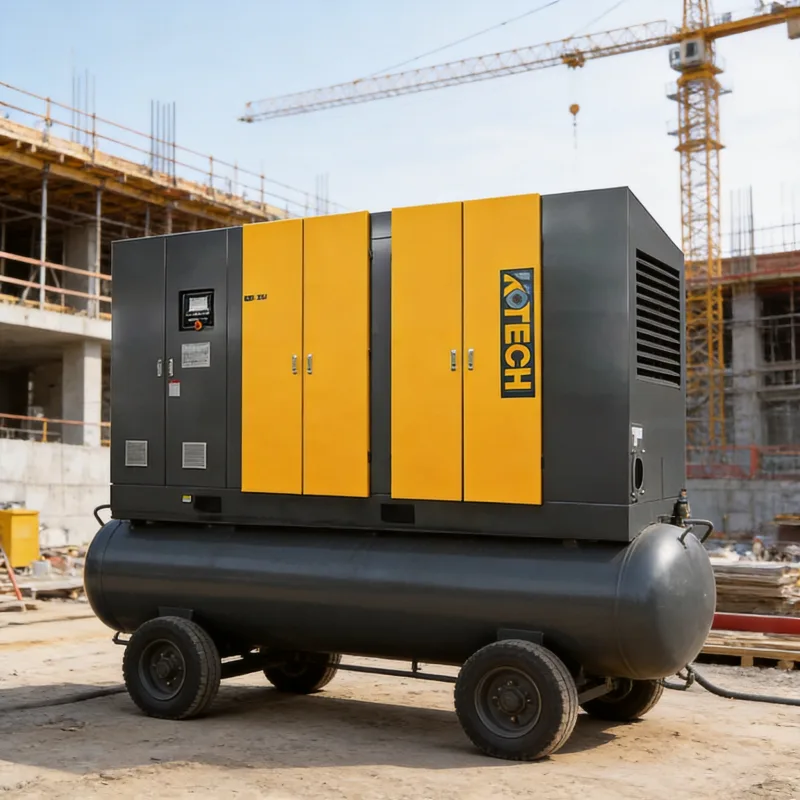
This data-driven guide breaks down 2024 pricing for heavy-duty rotary screw diesel air compressors designed for construction sites. It draws on verified industry data from the Air-Conditioning, Heating, and Refrigeration Institute (AHRI) and construction equipment market reports to outline core cost factors, including CFM rating, portability, and emission compliance. The guide also compares upfront purchase costs to long-term maintenance and rental expenses, providing actionable insights for construction contractors looking to budget for or invest in this critical equipment. It includes exclusive data on cost gaps between Tier 4 Final compliant models and older, non-compliant units, helping readers make informed purchasing decisions.
Heavy-duty rotary screw diesel air compressors for construction cost $12,000–$85,000+ in 2024, based on size and features.
Related: portable diesel air compressor for construction · stationary rotary screw compressor pricing · construction compressor maintenance costs · industrial air compressor budget · diesel compressor rental vs buy
Key Cost Drivers for Construction Diesel Air Compressors
CFM Rating: The Biggest Price Determinant
The core measure of a construction air compressor’s utility is its Cubic Feet per Minute (CFM) output, which directly correlates to cost. Per 2024 AHRI data, a 185 CFM portable rotary screw model starts at $12,000, while a 1,200 CFM stationary unit can exceed $85,000. Each 100 CFM increase adds an average of $7,500 to the base price, due to larger engine components and reinforced housing.
Emission Compliance Mandates
U.S. Environmental Protection Agency (EPA) Tier 4 Final standards, enforced since 2015 for construction equipment, add significant costs. AHRI’s 2024 industry survey found Tier 4 Final compliant models cost 22–30% more than non-compliant counterparts. This premium comes from diesel particulate filters (DPFs) and selective catalytic reduction (SCR) systems required to meet emission limits.
Portability vs. Stationary Design
Portable models, built for job site mobility, carry a 15–20% price premium over stationary units with the same CFM rating. For example, a 375 CFM portable rotary screw compressor costs $28,000, while a stationary equivalent is $24,000, per 2024 Equipment Trader data. The extra cost covers heavy-duty skids, tow hooks, and shock-absorbent components.
Upfront vs. Long-Term Cost Comparison
Maintenance Expenses Over 5 Years
Heavy-duty construction compressors require regular servicing to maintain performance. Per the Construction Equipment Association (CEA), annual maintenance costs average 8–10% of the unit’s purchase price. A $30,000 compressor will cost $12,000–$15,000 in maintenance over 5 years, including oil changes, filter replacements, and DPF cleanings.
Rental vs. Purchase: When to Choose Which
For short-term projects (6 months or less), rental is more cost-effective. 2024 RentalHQ data shows a 185 CFM unit rents for $150–$200 per day. For projects lasting 2+ years, purchasing saves 30–40% compared to long-term rental. A $12,000 compressor costs $24,000 total (including maintenance) over 5 years, vs. $36,000 in rental fees.
Hidden Costs to Budget For
Fuel Consumption Expenses
Diesel fuel costs can eat into project budgets quickly. A 375 CFM compressor uses 3–5 gallons of diesel per hour, per Caterpillar’s 2024 equipment specs. At $3.50 per gallon, that’s $10.50–$17.50 per hour in fuel costs, adding up to $4,200–$7,000 for a 400-hour work year.
Transportation and Setup Fees
Moving large stationary or high-CFM portable compressors requires specialized hauling. Per 2024 Heavy Haulers data, transporting a 1,200 CFM unit across 50 miles costs $800–$1,200, not including on-site setup and leveling fees of $200–$300.
Further Reading
Related Reading: Industrial Trailer Air Compressor Cost Guide