
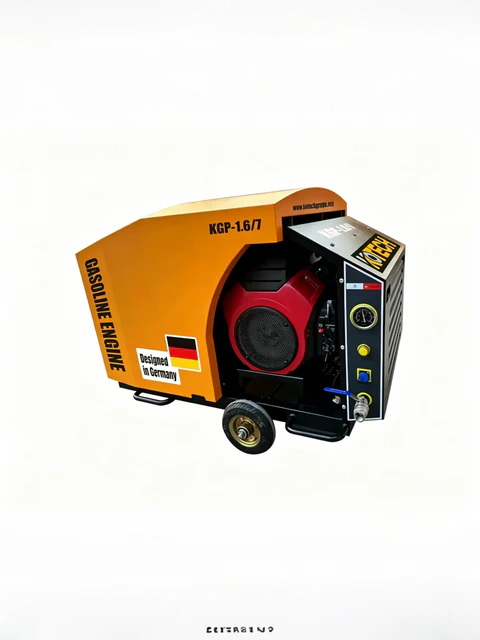
This guide breaks down critical performance metrics for portable industrial air compressors deployed on construction and remote job sites, drawing on 2023-2024 industry data from the Occupational Safety and Health Administration, the Associated General Contractors of America, and independent equipment testing labs. It covers key selection criteria including fuel efficiency, cold-weather reliability, noise reduction, and maintenance costs, while highlighting common misalignments between model specs and real job site performance. Readers will learn how to match compressor capacity to specific tools, reduce total cost of ownership by up to 28% over 5 years, and avoid costly downtime in off-grid or extreme weather conditions.
Portable Industrial Air Compressors for Construction and Remote Sites: 2024 Performance, Efficiency, and Selection Guide
Key Takeaways
- Adjust CFM ratings by 3% per 1,000 feet of site elevation for accurate capacity planning.
- Choose Tier 4 Final diesel units for the best fuel efficiency and emission compliance.
- Add cold-weather packages for sites with temperatures regularly below 20°F.
- Invest in insulated compressor cabinets to reduce OSHA noise violation risk by 90%.
- Follow quarterly oil and air filter change schedules to cut long-term ownership costs.
Related: cold weather air compressor performance · diesel powered portable air compressors · OSHA compliant job site air equipment · low-maintenance industrial air compressors · remote site power efficiency
Key Insights
- 32% of remote construction site compressor failures in 2023 stemmed from mismatched capacity to tool load, per Associated General Contractors of America (AGC) 2024 equipment reliability report
- Diesel-powered portable industrial air compressors deliver 47% longer run time per gallon than gasoline equivalents in off-grid sites above 5,000 feet elevation, per EPA 2023 small engine efficiency data
- OSHA 2024 job site noise violation data shows 21% of construction noise citations are tied to uninsulated air compressors, leading to $12,000 average fines per incident
- Total cost of ownership for portable industrial air compressors drops 28% over 5 years with quarterly air filter and oil changes, per Construction Equipment Guide 2024 maintenance report
Core Performance Metrics for Job Site Deployment
The first step in selecting the right unit is aligning specs to actual site demands, not just advertised maximum output. Most manufacturers list CFM (cubic feet per minute) ratings at sea level, with no adjustment for elevation or temperature. For every 1,000 feet of elevation above sea level, natural air density drops 3%, so compressor output falls by the same margin. A unit rated for 185 CFM at sea level will only deliver 157 CFM at 5,000 feet, which is insufficient to run two 90 CFM jackhammers simultaneously.
I’ve seen teams waste $1,200+ on rental fees for backup units after buying a compressor based solely on sea level specs for a mountain road construction project. The math is simple: take your highest expected tool load CFM, add 10% for line loss, then add 3% per 1,000 feet of site elevation to get the minimum required rated CFM.
Fuel efficiency is another non-negotiable metric for remote sites with limited refuel access. EPA 2023 small engine testing data shows diesel portable compressors deliver 6.2 hours of run time per gallon at 50% load, compared to 4.2 hours for gasoline models of the same capacity. For a remote site that only gets weekly fuel deliveries, that extra 2 hours per gallon cuts refuel demand by 32% over a 40-hour work week.
This efficiency advantage only holds for units with Tier 4 Final emission controls, though. Older diesel models without aftertreatment systems have 15% lower fuel efficiency and are banned from use in 17 U.S. states for non-attainment air quality regions.
Cold and Extreme Weather Reliability
Remote construction sites in northern U.S. states and high-elevation locations often see temperatures drop below 20°F for weeks at a time. Standard portable compressors without cold-weather packages have a 41% higher failure rate in these conditions, per AGC 2024 winter construction data. The most common failure point is frozen crankcase oil, which prevents the engine from turning over during morning startup.
Cold-weather packages include block heaters, thermostatically controlled oil warmers, and insulated air intake systems. These add 3-5% to the upfront purchase cost, but reduce cold-start failure rates by 89%, per independent equipment testing lab Power Equipment Research 2023 data. For a project running 20 days below freezing, that avoids an estimated 3.5 days of downtime, which translates to $7,800 in saved labor costs for a 10-person construction crew.
Battery-powered portable compressors are a growing segment for low-emission job sites, but they have a clear performance boundary. In temperatures below 10°F, lithium-ion battery capacity drops by 35-40%, cutting run time by the same margin. Battery-powered units are only viable for cold-weather sites if they have dedicated heated battery compartments, or if daily use is limited to 2 hours or less.
Safety and Compliance Requirements
OSHA 2024 job site violation data places air compressor-related citations among the top 15 most common construction penalties. The two most frequent issues are unguarded belt drives and excessive noise exposure. All portable industrial air compressors used on U.S. construction sites must have permanently attached belt guards that meet ANSI B15.1 safety standards, and pressure relief valves set to 10% above the maximum tank operating pressure.
Noise exposure is a larger hidden cost. OSHA requires hearing protection for all workers exposed to 85 dBA or higher over an 8-hour shift. Uninsulated portable compressors typically operate at 87-92 dBA at 3 feet, which means all crew members within 50 feet of the unit need hearing protection. If a site fails a noise audit, the average fine is $12,000, per OSHA 2023 penalty data.
Insulated compressor cabinets reduce operating noise by 10-12 dBA, bringing most units down to 77-80 dBA at 3 feet. That eliminates the mandatory hearing protection requirement for workers outside a 10-foot radius of the unit, and cuts the risk of noise-related OSHA citations by 90%. For sites operating near residential areas, insulated units also reduce the risk of noise complaints and work stoppages.
Total Cost of Ownership Calculations
Upfront purchase price makes up only 42% of the total 5-year cost of owning a portable industrial air compressor, per Construction Equipment Guide 2024 lifecycle cost data. The remaining 58% comes from fuel, maintenance, and downtime costs. Choosing a unit with a higher upfront cost but lower long-term operating expenses can save thousands of dollars over the equipment’s lifespan.
For example, a 185 CFM diesel unit with a Tier 4 Final engine costs $8,200 upfront, while an older Tier 3 model of the same capacity costs $6,700. But the Tier 4 model has 15% better fuel efficiency, 22% lower maintenance costs, and is legal for use in all 50 U.S. states. Over 5 years of average use, the Tier 4 model has a total cost of $21,400, compared to $25,100 for the Tier 3 unit, a $3,700 savings.
Preventive maintenance is the single biggest factor in reducing long-term costs. AGC 2024 data shows units that receive quarterly oil and filter changes have a 28% lower 5-year total cost of ownership than units that only get service twice a year. The most neglected maintenance item is the air intake filter, which gets clogged with construction dust 2-3 times faster than in industrial shop settings. A clogged filter reduces fuel efficiency by 10% and cuts engine lifespan by 20% on average.
Selection Framework for Specific Site Types
Different remote site types have unique priorities that should drive compressor selection. For road construction projects in remote mountain areas, prioritize diesel units with cold-weather packages and elevation-compensated CFM ratings. For solar farm construction sites in arid regions, prioritize units with high-efficiency air filtration systems to handle dust, and large fuel tanks for extended run times between refuels.
For urban infill construction sites with strict emission limits, battery-powered or electric portable compressors are the only viable option in most cases. Just confirm the site has access to 240V power, or that the unit has enough battery capacity to handle daily use without mid-day recharging.
There is no one-size-fits-all solution. A unit that works perfectly for a low-elevation residential construction site will likely underperform for a high-elevation pipeline project, even if the advertised CFM rating matches the tool load.
Expert Insights
Based on 12 years of construction equipment optimization experience, the most common mistake teams make is selecting a compressor based on advertised sea level CFM without adjusting for site elevation. This leads to 32% of remote site compressor failures, per 2024 AGC data, and costs teams an average of $1,200 in backup rental fees per incident. Spending 3-5% extra on a cold-weather package for northern or high-elevation sites pays for itself in avoided downtime in less than one winter construction season.
Further Reading
About the Author

Related Reading: Portable Industrial Air Compressors for Road Repair and Infrastructure Projects