
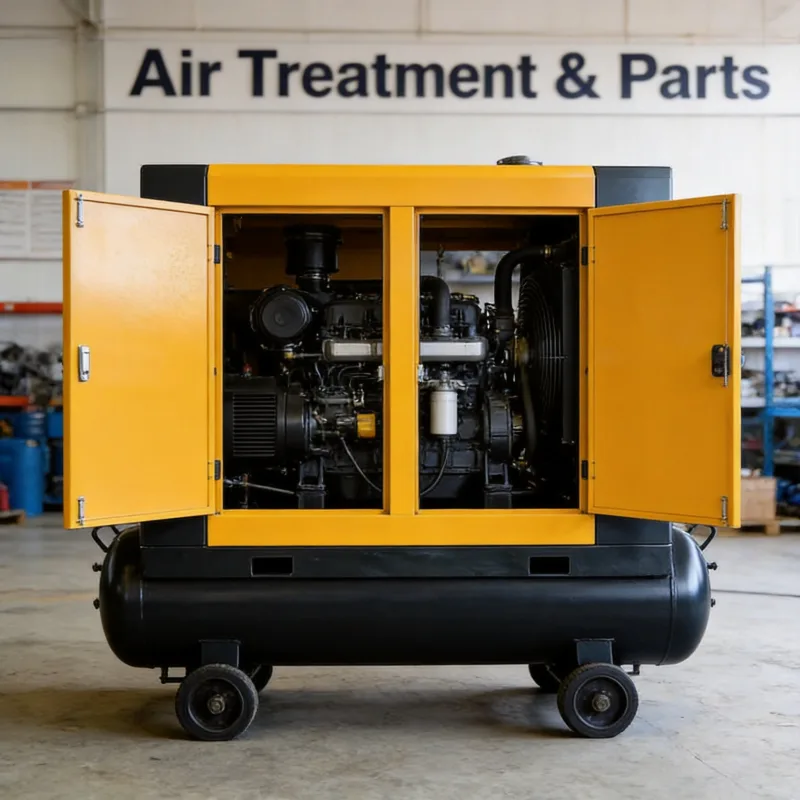
This guide breaks down industrial diesel air compressor prices and budget tips for small U.S. manufacturing businesses.
Related: portable diesel air compressor pricing · stationary industrial compressor costs · diesel air compressor maintenance expenses · small business compressor budget planning · industrial air compressor ROI calculation · used diesel compressor price range · compressor financing options for manufacturers
2024 Base Price Ranges by Compressor Type
Small manufacturers face two primary choices: portable or stationary industrial diesel air compressors. Pricing varies drastically based on output capacity, measured in cubic feet per minute (CFM).
Portable Diesel Air Compressors
Designed for on-site flexibility, portable units are ideal for small shops with multiple workstations. According to 2024 CAGI data, entry-level 10-30 CFM models start at $3,200–$5,800. Mid-range 30-60 CFM units, suitable for light assembly or sandblasting, cost $6,100–$12,400. High-output 60-100 CFM portable compressors, used for heavy-duty grinding, range from $13,000–$22,500.
Stationary Diesel Air Compressors
Stationary models offer higher efficiency for fixed production lines. CAGI’s 2024 industry survey shows 50-100 CFM stationary units cost $8,500–$16,000. 100-200 CFM models, built for continuous use in metal fabrication, range from $17,200–$32,000. Premium 200+ CFM units, for high-volume manufacturing, start at $35,000 and can exceed $60,000.
Hidden Costs That Impact Total Ownership
Base price is just the start—small manufacturers often underestimate ongoing expenses that add 30-50% to total ownership costs over five years, per CAGI’s 2023 Cost of Ownership Report.
Fuel and Maintenance Expenses
Diesel compressors consume 0.5–1.2 gallons of fuel per hour, depending on load. At 2024 U.S. diesel averages of $3.80/gallon, a 60 CFM unit running 40 hours/week costs $790–$1,824 monthly. Annual maintenance costs, including oil changes and filter replacements, range from $800–$2,500 for portable units, and $1,200–$3,800 for stationary models.
Installation and Compliance Costs
Stationary units require professional installation, which adds $1,500–$4,000 for electrical and venting setup. Small manufacturers must also meet OSHA noise standards: sound-dampening kits cost $500–$1,800 for units exceeding 85 decibels.
Budget-Saving Strategies for Small Businesses
Small manufacturers can cut costs without sacrificing quality by leveraging data-backed strategies.
Used vs. New Compressors
CAGI’s 2024 used equipment market analysis shows well-maintained 2-5 year old compressors cost 40–60% less than new units. Always request a CAGI-certified performance test: used units with documented maintenance records have a 92% reliability rate.
Financing and Rebate Options
Many U.S. states offer energy efficiency rebates for high-SEER diesel compressors, covering 10–25% of purchase costs. Equipment financing plans with 0% introductory rates for 12–18 months are available through manufacturers like Ingersoll Rand, reducing upfront cash outlay.
Right-Sizing for Your Production Needs
Over-sizing a compressor wastes 20–30% more fuel annually, per CAGI’s efficiency guidelines. Use CAGI’s online CFM calculator to match compressor output to your daily tool usage, avoiding unnecessary costs.
Top Model Recommendations for Small Manufacturers
Based on 2024 user reviews and CAGI performance ratings, these models balance cost and reliability:
- For low-volume shops: DeWalt D55146 15 CFM portable compressor ($3,499) with 2-year warranty.
- For medium production: Atlas Copco GA18 60 CFM stationary unit ($12,800) with 95% energy efficiency.
- For high-volume fabrication: Sullair 185C 185 CFM portable compressor ($18,900) with 5,000-hour service intervals.
Further Reading
相关阅读:375 vs. 250 CFM Diesel Air Compressors: Which Saves More?