



When a process needs very large air or gas volumes at relatively low pressure, dynamic machines are the natural answer. Centrifugal compressors, turbo blowers and vacuum pumps use high-speed impellers rather than positive-displacement rotors, delivering high flow with few wearing parts. Match each machine to its flow and pressure band and you gain both efficiency and reliability at scale.
How dynamic compression differs from positive displacement
A centrifugal machine accelerates gas through a rotating impeller and converts that velocity into pressure in a diffuser. Unlike a screw or lobe machine, it does not trap fixed pockets of gas, so flow changes with pressure and there are no contacting compression elements.
This gives high flow in a compact footprint, smooth oil-free compression when the gearbox is isolated, and low wear. The trade-off is that performance is flow-sensitive: at very low flow the machine approaches its surge limit.
- Impeller velocity converted to pressure in a diffuser
- High flow with no contacting compression parts
- Compact footprint for large volumes
- Flow must be kept above the surge limit
Centrifugal compressors, blowers and vacuum pumps compared
Centrifugal compressors deliver the highest pressures of the three and suit large continuous industrial and process duties. Turbo blowers provide large volumes at low pressure for aeration and conveying. Vacuum pumps use the same dynamic principle on the suction side to pull a defined vacuum for processing and packaging.
Choosing correctly depends on whether the limiting requirement is pressure (compressor), very high low-pressure flow (blower) or suction-side vacuum (pump), plus the turndown the process demands.
How to select and protect a dynamic machine
Define the normal and extreme flow and pressure points, then confirm the machine operates away from its surge line across the full control range. Variable inlet guide vanes or speed control improve part-load efficiency where demand varies.
For critical processes provide redundancy, monitor vibration and bearing condition, and ensure the lubrication system for the gearbox and bearings is maintained independently of the oil-free compression path. Proper inlet filtration protects the impeller.
- Map flow and pressure across the full duty range
- Keep operation clear of the surge line
- Use guide vanes or speed control for part load
- Monitor vibration, bearings and lubrication
- Provide clean inlet filtration and redundancy
Real centrifugal compressor ranges: flow, pressure and power
Indicative ranges by frame; exact points are confirmed during selection.
The table lists real centrifugal compressor model ranges with their flow, pressure and power bands. Select the range whose normal operating point sits comfortably inside the band and away from surge.
For flows of roughly 25 to 100 m3/min the KOA range is the common starting point, with larger frames extending to very high flows at multi-megawatt power levels for the largest industrial sites.
Typical applications and control
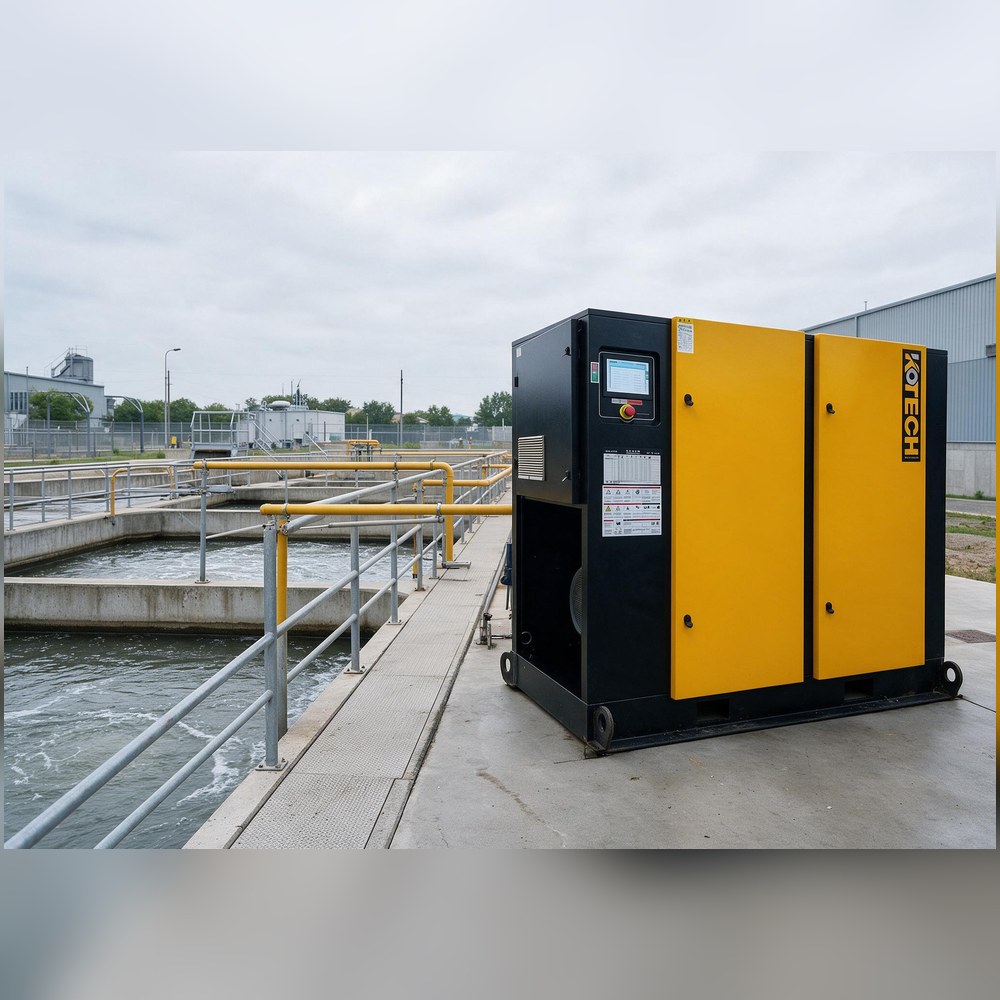
Centrifugal compressors serve air separation, large manufacturing and heavy processing; blowers serve wastewater aeration and pneumatic conveying; vacuum pumps serve packaging, processing and industrial suction. Each benefits from modern PLC control that coordinates machines and protects against surge.
Where a dynamic machine runs alongside positive-displacement units, a master controller sequences them so each operates in its efficient region.
What to confirm before you order
- Normal and extreme flow and pressure requirements
- Clear margin above the surge line across the range
- Part-load control method, such as guide vanes or speed
- Redundancy for critical continuous processes
- Lubrication, vibration and bearing monitoring
- Inlet filtration and site installation conditions
Frequently asked questions
What is the difference between a centrifugal compressor and a blower?
What is surge in a centrifugal machine?
Are centrifugal compressors oil-free?
When should I choose a centrifugal compressor over a screw compressor?
Can a centrifugal machine be used as a vacuum pump?
How is part-load efficiency improved?
.kotech-faq details summary::-webkit-details-marker{display:none}.kotech-faq details[open] summary span:last-child{transform:rotate(45deg)}.kotech-faq details summary span:last-child{transition:transform .2s}.kotech-faq details summary:focus{outline:2px solid #0e6b7a;outline-offset:2px}
Share your flow, pressure or vacuum requirements and operating pattern, and we will recommend the right centrifugal compressor, blower or vacuum pump configuration for your site.
{“@context”: “https://schema.org”, “@type”: “FAQPage”, “mainEntity”: [{“@type”: “Question”, “name”: “What is the difference between a centrifugal compressor and a blower?”, “acceptedAnswer”: {“@type”: “Answer”, “text”: “Both use impellers, but a centrifugal compressor is built for higher pressure, while a blower delivers large volumes at low pressure for duties such as aeration and conveying.”}}, {“@type”: “Question”, “name”: “What is surge in a centrifugal machine?”, “acceptedAnswer”: {“@type”: “Answer”, “text”: “Surge is an unstable reversal of flow that occurs when demand drops below the machine’s minimum stable flow. Selection and controls must keep operation above that limit.”}}, {“@type”: “Question”, “name”: “Are centrifugal compressors oil-free?”, “acceptedAnswer”: {“@type”: “Answer”, “text”: “The compression path can be fully oil-free when the gearbox is isolated by seals. The bearings and gearbox still use oil, but it is kept out of the gas stream.”}}, {“@type”: “Question”, “name”: “When should I choose a centrifugal compressor over a screw compressor?”, “acceptedAnswer”: {“@type”: “Answer”, “text”: “Centrifugal machines are favoured for very large continuous flows, while screw compressors are usually better at smaller flows and broader turndown. The crossover depends on flow and duty.”}}, {“@type”: “Question”, “name”: “Can a centrifugal machine be used as a vacuum pump?”, “acceptedAnswer”: {“@type”: “Answer”, “text”: “The same dynamic principle is applied on the suction side in centrifugal vacuum pumps, which are selected for the required suction vacuum and flow rather than discharge pressure.”}}, {“@type”: “Question”, “name”: “How is part-load efficiency improved?”, “acceptedAnswer”: {“@type”: “Answer”, “text”: “Variable inlet guide vanes and variable speed adjust output to demand more efficiently than throttling, while modern controls keep the machine away from surge.”}}]}{“@context”: “https://schema.org”, “@type”: “Article”, “headline”: “Centrifugal Compressors, Blowers & Vacuum Pumps: Industrial Selection Guide”, “description”: “How to choose centrifugal compressors, industrial blowers and vacuum pumps for large-flow duties, with real flow, pressure and power ranges plus selection guidance.”, “image”: [“https://www.aircompressorindustrial.com/wp-content/uploads/2026/09/koe-vsd-wastewater-treatment-1000×1000-1.jpg”]}
Related industrial compressor guides