



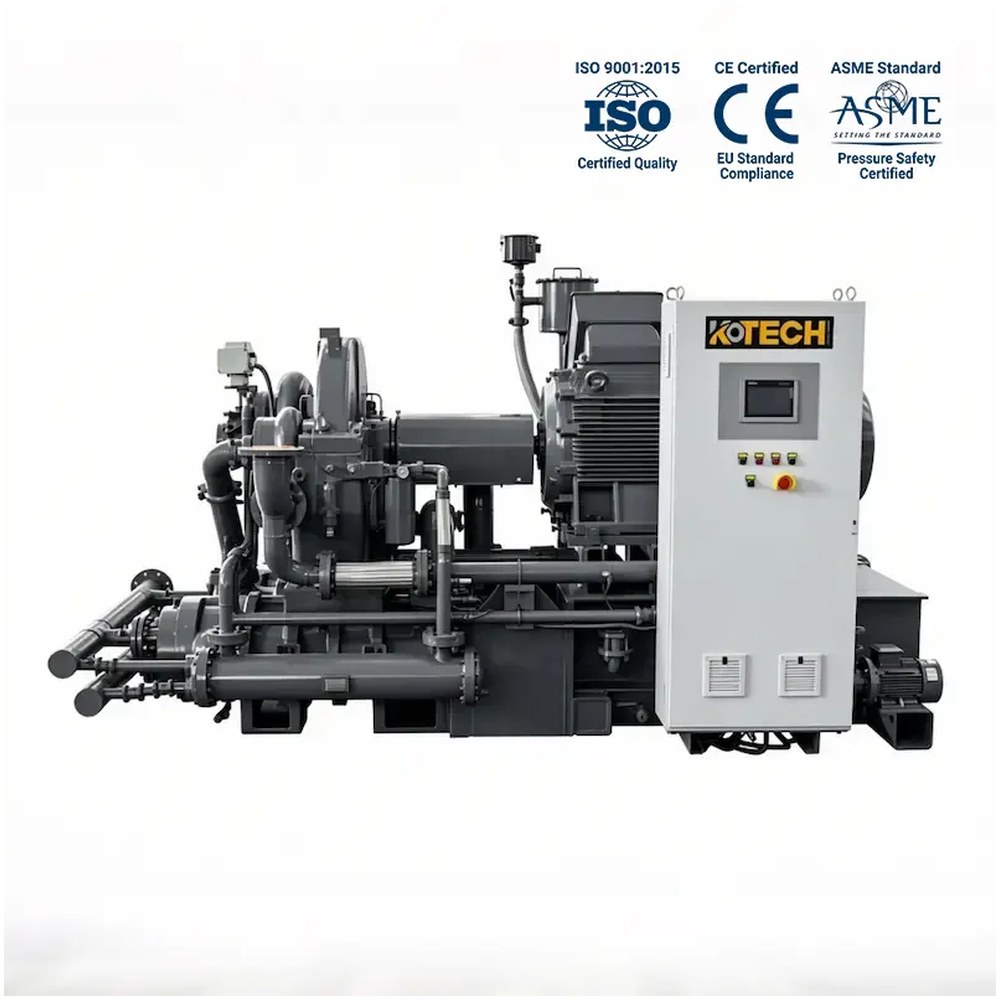
A modern textile park concentrates dozens of spinning, weaving, and processing mills in one development, and many of those mills need large, steady volumes of clean compressed air for spinning, splicing, weaving, and pneumatic handling. Supplying that from a central air station is more efficient than installing many small compressors, and for such large continuous flows an oil-free centrifugal compressor is a natural choice: it delivers high volume with no oil in compression and low maintenance on long runs. This guide explains why textile parks use centrifugal machines in central stations and how they are specified using real KOTECH data.
Why a textile park suits a central air station
Textile production uses compressed air in ring spinning and open-end frames for pneumatic functions, splicing, and cleaning, in weaving machines, and in material handling. Individual mills traditionally installed their own compressors, but a park development with many mills can instead build one central station and distribute treated air to tenants. That removes duplicated compressor rooms, concentrates maintenance, and lets the park match total output to combined demand.
The air demand from spinning and weaving is also relatively high and continuous over long shifts, which is the profile a large central machine serves best. A station built around several large units can stage output as tenant demand changes, rather than forcing every mill to run its own compressor at varying load.
- One central station replaces many duplicated mill compressor rooms
- Maintenance and operation are concentrated in a single facility
- Output is matched to the combined demand of all tenants
- High continuous spinning and weaving demand suits large machines
Why centrifugal technology fits high-volume duty
A centrifugal compressor is a dynamic machine: it accelerates air through an impeller and converts that velocity into pressure rather than trapping a fixed volume. At high flow rates it delivers large volumes efficiently and, in an oil-free design, introduces no oil into the air. With fewer wearing parts than a bank of small positive-displacement machines, it is well suited to continuous base-load duty.
Centrifugal machines are most effective in a defined operating range and are chosen for the steady high base load, sometimes combined with other machines that handle variation. Textile demand, which stays high and comparatively steady across long production runs, fits that characteristic better than a highly intermittent process would.
- Dynamic compression delivers large continuous air volumes efficiently
- Oil-free design introduces no oil into the air
- Fewer wearing parts suit long continuous running
- Best across a defined range for the steady base load
Oil-free air and quality in spinning
Oil contamination is undesirable in textile production because it can affect yarn quality, leave deposits, and create defects in downstream processing. An oil-free centrifugal compressor removes oil at the compression stage, which protects yarn and fabric even where air is used close to the product. Central treatment then dries and filters the air to the level tenants require.
A central station also allows the park to control air quality consistently for every tenant rather than depending on the treatment choices of individual mills. That consistency is valuable in developments that sell compressed air as a utility, because quality and pressure can be guaranteed at the station boundary.
- Oil-free compression protects yarn from contamination and defects
- Central drying and filtration set one consistent quality standard
- Air can be supplied to tenants as a guaranteed utility
- Quality and pressure are controlled at the station boundary
Real KOTECH oil-free centrifugal compressors
Current factory specifications for selected centrifugal frames used in large central air stations.
The table shows current KOTECH oil-free centrifugal models with air delivery range, pressure range, motor power, and base size as published on the KOTECH product page. These are range ratings rather than single points, because each centrifugal frame covers a family of flows: the KOA spans 25 to 100 m³/min and 100 to 600 kW, while the larger KOS covers 100 to 240 m³/min at higher power. A textile park station is normally built from several such units so one can be serviced without interrupting tenant supply.
Designing the station and distribution network
The central station and the distribution network have to be designed together. Total air demand, the layout of tenant mills, pipe routing, and pressure drop across the park all determine machine pressure and pipe size, while redundancy and future expansion should be allowed for in the station layout. As with other central systems, under-sized distribution can waste the benefit of efficient compressors.
Controls should coordinate the centrifugal units and manage their operating range as demand changes, while treatment and condensate handling are centralised in the station. Where the park is developed in phases, the station can start with a smaller number of machines and add centrifugal frames as new mills come online.
- Design machine pressure and pipe size around park-wide pressure drop
- Allow redundancy and space for future expansion
- Coordinate the centrifugal units through central controls
- Build in phases and add frames as tenant demand grows
Buying tips
- Base the station on combined tenant demand and future phases
- Use centrifugal units for the steady high base load
- Require oil-free compression to protect yarn quality
- Size the distribution network to control park-wide pressure drop
- Build in redundancy and space for additional centrifugal frames
Frequently asked questions
Why use a centrifugal compressor instead of many screw compressors in a textile park?
Is the air from a centrifugal compressor genuinely oil-free?
What happens if air demand falls below the centrifugal machine’s range?
How large does a textile park central station need to be?
Can a park add centrifugal compressors later as it grows?
Does compressed air quality really matter in spinning?
.kotech-faq details summary::-webkit-details-marker{display:none}.kotech-faq details[open] summary span:last-child{transform:rotate(45deg)}.kotech-faq details summary span:last-child{transition:transform .2s}.kotech-faq details summary:focus{outline:2px solid #0e6b7a;outline-offset:2px}
If you are planning a central air station for a textile development, share the expected tenant demand and layout for a centrifugal station sizing review.
{“@context”: “https://schema.org”, “@type”: “FAQPage”, “mainEntity”: [{“@type”: “Question”, “name”: “Why use a centrifugal compressor instead of many screw compressors in a textile park?”, “acceptedAnswer”: {“@type”: “Answer”, “text”: “At the high, steady flows a park-scale station supplies, centrifugal machines deliver large volumes efficiently with no oil in compression and fewer wearing parts. Many small screw compressors would duplicate capacity and maintenance. Screw machines may still be used to handle variable demand, but the centrifugal units carry the large continuous base load.”}}, {“@type”: “Question”, “name”: “Is the air from a centrifugal compressor genuinely oil-free?”, “acceptedAnswer”: {“@type”: “Answer”, “text”: “In an oil-free centrifugal design, the compression process introduces no oil, so the air is oil-free at compression. Central drying and filtration then bring it to the cleanliness tenants require, giving the park a consistent air quality it can guarantee as a utility.”}}, {“@type”: “Question”, “name”: “What happens if air demand falls below the centrifugal machine’s range?”, “acceptedAnswer”: {“@type”: “Answer”, “text”: “Centrifugal machines are most efficient inside a defined operating range, which is why stations pair them with controls and, where needed, machines that handle variation. In a textile park the high continuous spinning load normally keeps the units in range, while staging several machines allows output to follow demand.”}}, {“@type”: “Question”, “name”: “How large does a textile park central station need to be?”, “acceptedAnswer”: {“@type”: “Answer”, “text”: “It is sized from the combined air demand of the mills, their processes, and allowance for expansion and pressure drop across the network. Frames such as the KOA cover 25 to 100 m³/min and the larger KOS covers 100 to 240 m³/min, so several units are selected to match the park rather than one fixed size.”}}, {“@type”: “Question”, “name”: “Can a park add centrifugal compressors later as it grows?”, “acceptedAnswer”: {“@type”: “Answer”, “text”: “Yes. Central stations are commonly built in phases, starting with enough machines for the first tenants and adding frames as new mills connect. The station layout, pipework, and controls should be designed with that expansion in mind from the start.”}}, {“@type”: “Question”, “name”: “Does compressed air quality really matter in spinning?”, “acceptedAnswer”: {“@type”: “Answer”, “text”: “Yes. Oil or contamination in the air can affect yarn quality and create defects, particularly where air is used close to the fibre and in splicing and cleaning. Oil-free compression plus central treatment protects the product and lets the park supply every tenant from one controlled quality standard.”}}]}{“@context”: “https://schema.org”, “@type”: “Article”, “headline”: “Oil-Free Centrifugal Compressors for Textile Park Central Air Stations”, “description”: “Textile parks need large steady oil-free air flows for spinning and weaving. Compare oil-free centrifugal compressors, real KOTECH KOA specs and central station design.”, “image”: [“https://www.aircompressorindustrial.com/wp-content/uploads/2026/10/koa-centrifugal-textile-park-1000×1000-1.jpg”]}