



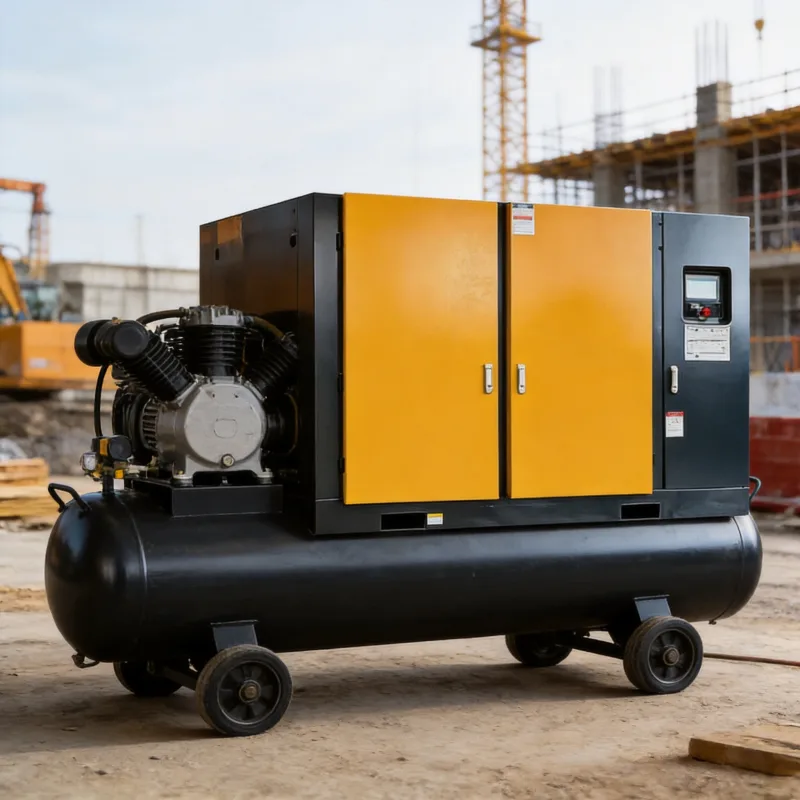
2024 industrial diesel air compressors have higher upfront costs but lower long-term TCO than electric models for U.S. heavy-duty users.
Upfront Purchase Price: Diesel vs. Electric Industrial Compressors
For oil-free industrial compressors rated 50-100 HP, 2024 U.S. market data paints a clear upfront cost gap. According to CAGI’s 2024 Industrial Compressor Pricing Report, diesel models range from $18,500 to $32,000 per unit. Electric oil-free compressors in the same HP bracket cost 15-20% less, with prices ranging from $15,800 to $27,200. The price difference stems from diesel’s integrated fuel systems, heavy-duty engines, and ruggedized frames for remote use. Electric models skip these components, relying on existing facility power infrastructure to cut upfront expenses.
Operational Costs: Energy, Maintenance, and Fuel
Energy and Fuel Expenses
Operational costs are where the pricing dynamic shifts dramatically for U.S. industrial users. EIA’s March 2024 data shows industrial diesel fuel averages $3.12 per gallon, while industrial electricity costs $0.14 per kWh. For a 75 HP compressor running 4,000 hours annually, diesel models consume 1.2 gallons per hour, totaling $14,976 in annual fuel costs. Electric models use 56 kWh per hour, leading to $31,360 in annual electricity costs—more than double diesel’s expense. This gap widens for users in regions with above-average electricity rates, such as California ($0.23 per kWh) or New York ($0.21 per kWh).
Maintenance Costs
Maintenance costs also favor diesel for high-hour operations, per CAGI’s 2024 data. Diesel oil-free compressors require $1,200-$1,800 in annual maintenance, including filter changes and engine tune-ups. Electric models, while simpler, need $1,500-$2,200 annually for motor inspections, oil-free seal replacements, and power component servicing. Electric compressors also face higher repair costs for failed variable frequency drives (VFDs), which average $3,500 per replacement vs. $1,200 for diesel fuel injectors.
Total Cost of Ownership (TCO) Over 10 Years
TCO is the most critical metric for industrial buyers evaluating long-term value. For a 75 HP oil-free compressor running 4,000 hours yearly, CAGI’s 2024 TCO calculator shows: Diesel models have a 10-year TCO of $192,200, including upfront, fuel, maintenance, and minor repair costs. Electric models have a 10-year TCO of $246,600—22% higher than diesel due to elevated electricity expenses. This gap shrinks for low-hour users (under 1,500 hours yearly), where electric models’ lower upfront costs offset higher energy bills. For remote sites without access to grid power, diesel’s TCO advantage jumps to 35%, as electric models require costly generator backups or grid extensions.
ROI and Break-Even Timelines
Despite higher upfront costs, diesel compressors reach break-even faster for high-hour users. CAGI data shows a 75 HP diesel compressor breaks even with an electric model in 2.3 years for 4,000-hour annual use. For low-hour users (1,000 hours yearly), electric models break even first, taking 3.7 years to offset diesel’s upfront premium. Diesel models also offer higher resale value: 2024 U.S. industrial equipment resale data shows 10-year-old diesel compressors retain 28% of their original value, vs. 22% for electric models. This resale premium adds to diesel’s long-term financial advantage for businesses rotating equipment fleets.
Regional and Use Case Variables
U.S. regional energy prices heavily impact compressor cost comparisons. In states with low electricity rates, such as Louisiana ($0.08 per kWh), electric models’ 10-year TCO drops to $201,400, narrowing diesel’s advantage to just 4.7%. For remote mining, construction, or oilfield operations, diesel is often the only viable option, eliminating electric’s upfront cost benefit entirely. Oil-free diesel compressors are also preferred for applications requiring consistent pressure in extreme temperatures, as electric motors struggle in sub-zero or high-heat environments.
Further Reading
Related Reading: 2024 Air Compressor Gas Price: Full Budget Guide for Buyers