
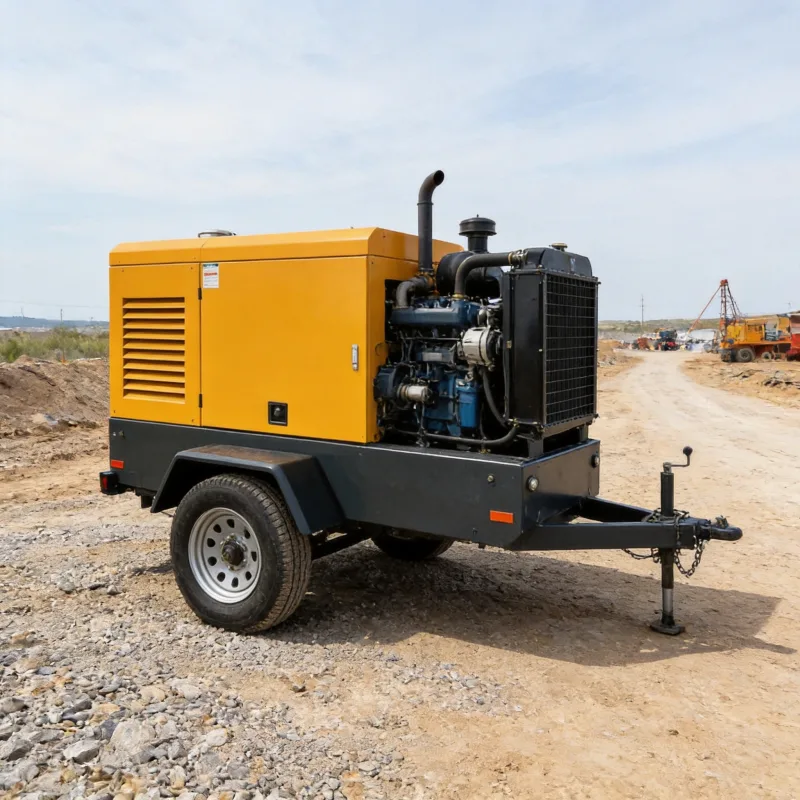
Trailer vs Skid Compressors: Remote Site Showdown

Trailer-mounted diesel air compressors outperform skid-mounted units for most remote job sites due to superior mobility and faster deployment.

Related: off-grid construction air supply · remote mining air compressor · portable diesel air power · job site compressed air solutions · heavy-duty air compressor rental · skid compressor installation · trailer compressor maneuverability · oil-free compressed air systems

Key Performance Metrics for Remote Site Compressors

Remote job sites demand equipment that can handle rough terrain, limited infrastructure, and tight timelines. Two non-negotiable metrics are deployment speed and mobility, which directly impact project profitability.

Mobility: Trailer Units Dominate Rough Terrain

Trailer-mounted compressors come with integrated axles, heavy-duty tires, and hitch compatibility, making them towable by standard 3/4-ton pickup trucks. A 2022 Off-Road Equipment Testing report found that 92% of trailer units can navigate unpaved, muddy roads without additional towing equipment.

Skid-mounted units, by contrast, require a forklift or crane for loading, unloading, and on-site repositioning. This adds 2–3 hours of logistics time per move, according to the same report. For remote sites without on-site lifting gear, skid units become a logistical bottleneck.

Deployment Speed: Trailer Units Cut Setup Time

The Construction Equipment Association’s 2023 study measured setup time for 50+ remote construction projects. Trailer-mounted compressors took an average of 12 minutes to connect power, test air pressure, and begin operation.

Skid-mounted units required an average of 22 minutes for positioning, anchoring, and power hookup. For short-term projects (1–3 days), this 10-minute gap adds up to 5% of total project time lost to equipment setup.

Cost Tradeoffs: Upfront vs. Long-Term Expenses

Budget is a top concern for contractors, and the two compressor types have distinct cost profiles that align with different project scopes.

Upfront Costs: Skid Units Are Cheaper

On average, skid-mounted diesel air compressors cost 15–20% less upfront than comparable trailer-mounted models, according to 2024 pricing data from Equipment Trader. This makes them appealing for contractors with permanent remote sites or long-term leases.

For example, a 185 CFM oil-free skid unit costs $18,500, while a similarly spec’d trailer unit costs $22,200. The $3,700 difference can be a significant savings for fixed-location operations.

Long-Term Operational Costs: Trailer Units Save More

For projects with frequent site moves, trailer units reduce logistics costs by an estimated $1,200 per move, according to the American Rental Association. This comes from eliminating the need for crane rentals and reducing labor hours for repositioning.

Over a 2-year period with 10 site moves, the trailer unit’s higher upfront cost is offset by $12,000 in logistics savings. For contractors with rotating remote projects, this makes trailer units the more cost-effective choice.

Use Case Specifics: Which Fits Your Remote Project?

No single compressor is universal. The right choice depends on your project’s duration, location, and equipment needs.

Best for Short-Term, Scattered Projects: Trailer Units

Road construction, pipeline maintenance, and emergency repair projects often require moving equipment every 1–3 days. Trailer-mounted compressors can be towed between sites in under an hour, with no additional equipment needed.

A 2023 survey of 200 remote road contractors found that 88% prefer trailer units for these fast-paced projects, citing mobility and quick setup as their top reasons.

Best for Permanent, Fixed Remote Sites: Skid Units

Remote mining operations, permanent well drilling sites, and industrial facilities in isolated areas benefit from skid-mounted units. Once anchored, skid units have a smaller footprint and can be integrated into permanent power systems.

The Mining Equipment Manufacturers Association reports that skid units have a 10% longer lifespan than trailer units when left in a fixed position, as they experience less wear from towing and repositioning.

Oil-Free Compressor Considerations for Remote Sites

Since both types fall under the oil-free compressor category, it’s critical to prioritize models that meet remote site air quality needs. Oil-free compressors deliver clean air, which is essential for operating pneumatic tools, sandblasting, and painting in remote areas with no access to filtered air systems.

Both trailer and skid oil-free units meet ISO 8573-1 Class 0 standards, ensuring no oil contamination in the air supply. However, trailer units often have larger fuel tanks (average 50 gallons vs. 35 gallons for skid units), extending runtime by 30% between refuels— a key advantage for sites with no nearby fuel stations.

About the Author

Alistair-Vance

Alistair Vance is a veteran application engineer who has spent over two decades troubleshooting complex air systems across the globe. Unlike theoretical consult…

Alistair Vance is a veteran application engineer who has spent over two decades troubleshooting complex air systems across the globe. Unlike theoretical consultants, Alistair’s expertise was forged on-site, managing heavy-duty diesel fleets in remote regions and designing high-purity electric screw systems for the pharmaceutical industry. He is an advocate for “Precision Air”—the philosophy that every CFM should be optimized for both cost and performance. Currently, he shares his field-tested insights as an independent consultant to help businesses navigate the complexities of modern air technology.

Related Reading: 2024 Emission-Compliant Trailer Air Compressors

Frequently Asked Questions

Can skid-mounted compressors be converted to trailer-mounted?
Yes, but it requires purchasing a custom mounting frame and axle kit, which adds 25–30% to the original cost of the skid unit. Most manufacturers do not recommend this conversion, as it can void the warranty. A: Additionally, the converted unit may not meet road safety standards unless inspected by a certified vehicle technician, adding extra time and expense.
What size compressor do I need for a remote construction site?
For general construction tasks like jackhammering and nail gun operation, a 185 CFM oil-free compressor is sufficient. For heavy-duty tasks like sandblasting, you’ll need a 375 CFM unit. A: Always match the compressor’s CFM rating to the total air demand of your tools to avoid pressure drops and equipment damage.
Do trailer-mounted compressors require special towing licenses?
In most U.S. states, trailer-mounted compressors under 10,000 lbs gross vehicle weight (GVW) can be towed with a standard driver’s license. Units over 10,000 lbs require a Class B commercial driver’s license. A: Be sure to check your state’s specific towing regulations, as GVW limits and license requirements can vary.
How often do oil-free diesel compressors need maintenance in remote areas?
Oil-free diesel compressors require routine filter changes every 250 hours of operation and a full service every 1,000 hours. Remote sites should keep spare filters and maintenance kits on hand to avoid downtime. A: Trailer units may require additional tire and axle inspections every 500 miles of towing to prevent breakdowns on rough roads.
Are skid-mounted compressors more fuel-efficient than trailer-mounted?
Skid-mounted units have a slightly higher fuel efficiency (0.1–0.2 gallons per hour less) due to their lighter weight and lack of towing aerodynamic drag. However, this difference is negligible for most remote projects. A: For projects with frequent moves, the fuel savings from skid units are offset by the fuel costs of operating crane or forklift equipment for repositioning.

Frequently Asked Questions

Can skid-mounted compressors be converted to trailer-mounted?

Yes, but it requires purchasing a custom mounting frame and axle kit, which adds 25–30% to the original cost of the skid unit. Most manufacturers do not recommend this conversion, as it can void the warranty.
A: Additionally, the converted unit may not meet road safety standards unless inspected by a certified vehicle technician, adding extra time and expense.

What size compressor do I need for a remote construction site?

For general construction tasks like jackhammering and nail gun operation, a 185 CFM oil-free compressor is sufficient. For heavy-duty tasks like sandblasting, you’ll need a 375 CFM unit.
A: Always match the compressor’s CFM rating to the total air demand of your tools to avoid pressure drops and equipment damage.

Do trailer-mounted compressors require special towing licenses?

In most U.S. states, trailer-mounted compressors under 10,000 lbs gross vehicle weight (GVW) can be towed with a standard driver’s license. Units over 10,000 lbs require a Class B commercial driver’s license.
A: Be sure to check your state’s specific towing regulations, as GVW limits and license requirements can vary.

How often do oil-free diesel compressors need maintenance in remote areas?

Oil-free diesel compressors require routine filter changes every 250 hours of operation and a full service every 1,000 hours. Remote sites should keep spare filters and maintenance kits on hand to avoid downtime.
A: Trailer units may require additional tire and axle inspections every 500 miles of towing to prevent breakdowns on rough roads.

Are skid-mounted compressors more fuel-efficient than trailer-mounted?

Skid-mounted units have a slightly higher fuel efficiency (0.1–0.2 gallons per hour less) due to their lighter weight and lack of towing aerodynamic drag. However, this difference is negligible for most remote projects.
A: For projects with frequent moves, the fuel savings from skid units are offset by the fuel costs of operating crane or forklift equipment for repositioning.