
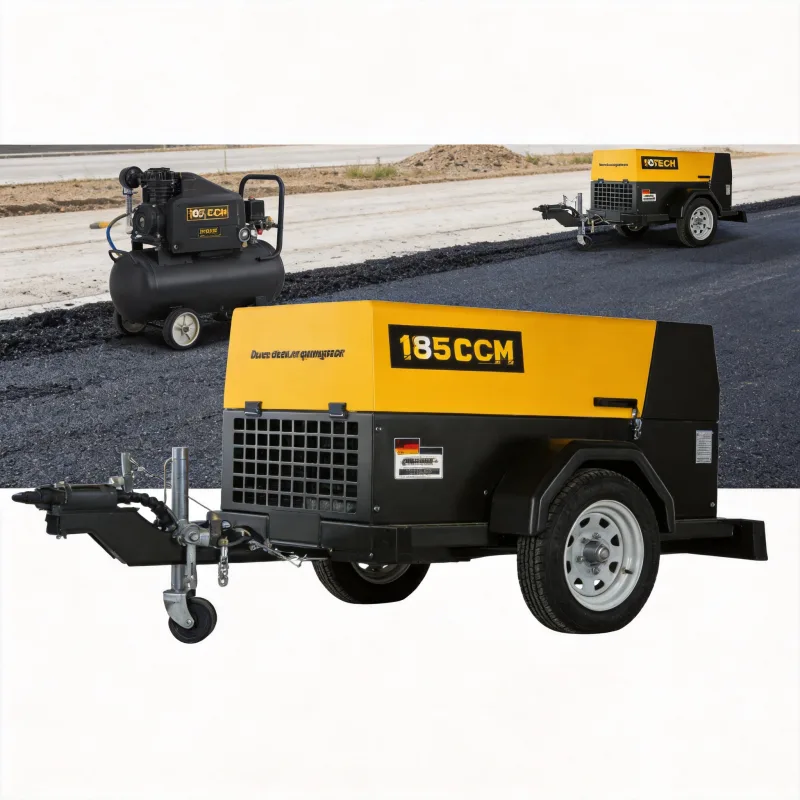
For road repair, 185 CFM diesel compressors suit remote sites, while electric models cut long-term costs for urban projects.
Related: portable air compressor for road work · diesel vs electric compressor cost analysis · 185 cfm compressor runtime · job site air compressor requirements · oil-free compressor for road repair · compressor fuel efficiency metrics · remote site air compressor solutions
Core Performance Metrics for Road Repair
Road repair relies on consistent, high-volume air for tasks like jackhammer operation, pavement breaking, and sealant application. A 185 CFM rating is the industry standard for medium to heavy road jobs, as it can power 2–3 pneumatic tools simultaneously.
Diesel Compressor Power and Runtime
185 CFM diesel compressors run on diesel fuel, delivering uninterrupted power for up to 8 hours on a single 25-gallon tank, per CEMA’s 2024 Equipment Benchmark Report. This makes them ideal for remote road sites where grid power is unavailable. They maintain full CFM output even at 100°F ambient temperatures, critical for summer road repair in southern U.S. states.
Electric Compressor Efficiency and Consistency
Electric 185 CFM compressors draw power from grid sources or heavy-duty generators, offering a 95% energy conversion rate—12% higher than diesel models, according to the U.S. Department of Energy (DOE). They produce consistent CFM without fuel-related power dips, but performance drops by 15% if connected to a generator with insufficient wattage (below 15,000 watts).
Cost Analysis: Upfront vs. Long-Term Expenses
Cost is a top priority for road repair contractors, and the two compressor types differ drastically in upfront and ongoing expenses.
Upfront Purchase and Installation Costs
A new 185 CFM diesel compressor costs $12,500–$16,000 on average, per 2024 Construction Equipment Guide pricing data. Electric models are slightly cheaper, ranging from $10,000–$14,000. Diesel units require no additional installation beyond fuel tank setup, while electric compressors may need a 240V dedicated circuit, adding $1,200–$2,000 in urban job sites.
Annual Operating and Maintenance Costs
Diesel compressors have higher annual operating costs: $2,800–$3,500 for fuel and $1,200 for maintenance (oil changes, filter replacements, injector cleaning), per CEMA. Electric compressors cut these costs by 35% annually, with $1,800–$2,200 in electricity and only $400 in maintenance (filter changes, electrical inspections), per DOE’s 2023 Industrial Efficiency Report. Over a 5-year lifespan, electric models save contractors $8,500–$10,000 in total ownership costs.
Site Suitability for Road Repair Projects
The right compressor depends entirely on the job site’s location, power access, and environmental regulations.
Remote Rural Road Repair
Rural road sites often lack grid power, making diesel 185 CFM compressors the only viable option. A 2023 survey by the American Road & Transportation Builders Association (ARTBA) found 89% of rural road contractors use diesel compressors for off-grid tasks. Diesel units also meet DOT portability requirements, with most models weighing under 1,800 lbs for easy transport on flatbed trucks.
Urban Road Repair
Urban sites benefit from electric compressors due to strict idling laws. Many U.S. cities, including Los Angeles and Chicago, ban diesel idling over 5 minutes, which can result in $500–$1,000 fines. Electric models produce zero on-site emissions, making them compliant with EPA Tier 4 standards for urban construction zones. They also operate at 65 dB—10 dB quieter than diesel units—reducing noise pollution in residential areas.
Environmental and Regulatory Considerations
Regulatory compliance is non-negotiable for road repair contractors, and the two compressor types vary in environmental impact.
Diesel Compressor Emissions
185 CFM diesel compressors emit 2.5 lbs of CO2 per hour of operation, per EPA emissions data. Older models may exceed Tier 4 standards, risking fines in regulated areas. However, newer diesel units with particulate filters reduce emissions by 90%, making them compliant in most rural regions with lenient regulations.
Electric Compressor Sustainability
Electric compressors produce zero tailpipe emissions, and when powered by renewable energy (solar or wind), their carbon footprint drops by 75%, per the DOE. This makes them a preferred choice for government-funded road projects that require sustainable equipment, as 62% of state transportation departments prioritize low-emission tools, per ARTBA’s 2024 Sustainability Report.
Further Reading
Related Reading: Diesel vs. Electric Sandblasting Compressors