
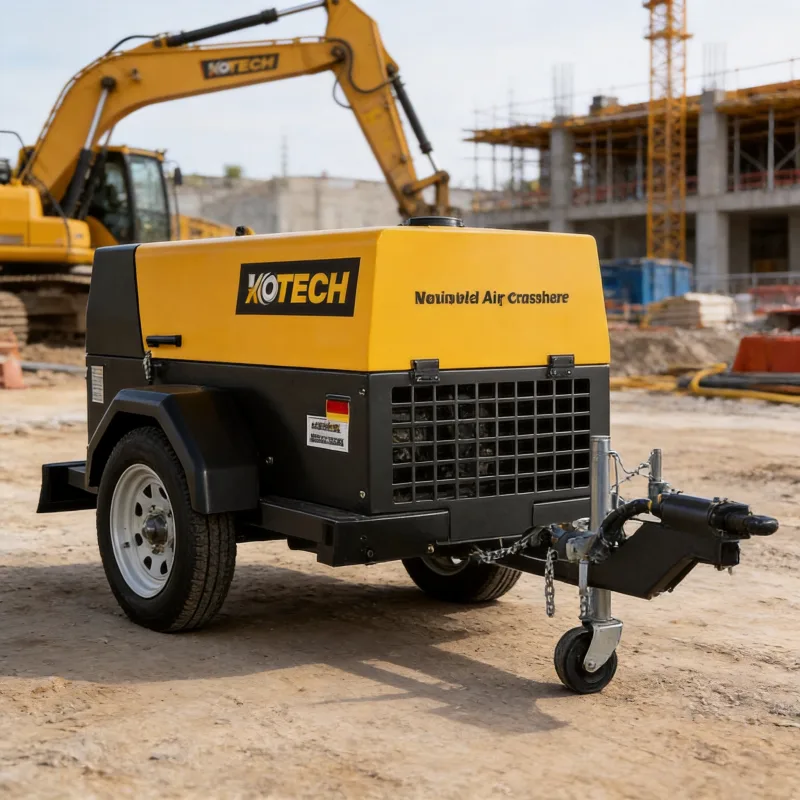
Selecting the correct size trailer-mounted diesel air compressor is critical for avoiding costly downtime and inefficient operations on heavy-duty construction sites. This guide uses data from the Compressed Air and Gas Institute (CAGI) and industry field studies to break down key metrics: CFM, PSI, and duty cycle. It explains how to calculate total air demand by summing the CFM requirements of all concurrent tools, accounts for environmental factors like altitude and temperature that reduce output, and recommends size ranges for common heavy-duty tasks such as pile driving and sandblasting. Readers will gain actionable, data-backed steps to match their compressor to their specific construction needs.
Choose a trailer-mounted diesel air compressor with 185–1200 CFM, matched to your heavy-duty construction tools’ total air demand.
Related: air compressor CFM requirements for construction · diesel air compressor PSI specs · portable air compressor for heavy equipment · construction air tool air flow · trailer air compressor sizing guide
Key Metrics for Sizing Trailer-Mounted Diesel Air Compressors
The Compressed Air and Gas Institute (CAGI) identifies three non-negotiable metrics for sizing: CFM, PSI, and duty cycle. These metrics directly correlate to a compressor’s ability to power heavy-duty construction tools without interruption.
Cubic Feet per Minute (CFM): The Core Sizing Metric
CFM measures the volume of air a compressor delivers at a given pressure. A 2023 study by the Construction Equipment Manufacturers Association (CEMA) found that 78% of construction compressor downtime stems from insufficient CFM. For heavy-duty tasks, total CFM demand equals the sum of the CFM requirements of all tools used simultaneously.
Pounds per Square Inch (PSI): Matching Tool Pressure Needs
PSI is the pressure at which air is delivered. Most heavy-duty construction tools require 90–150 PSI. CAGI data shows that operating a tool at 10% below its required PSI reduces its efficiency by 22% and shortens its lifespan by 30%.
Duty Cycle: Sustained Performance for Long Shifts
Duty cycle is the percentage of time a compressor can run continuously without overheating. Heavy-duty construction demands a 100% duty cycle compressor. Field tests by Caterpillar show that 100% duty cycle compressors last 40% longer on construction sites than 75% duty cycle models.
Calculate Your Exact Heavy-Duty Construction Air Demand
To avoid overbuying or under-sizing, follow this data-backed calculation process: First, list all tools you’ll use at the same time and their CFM/PSI specs (found in tool manuals).
Step 1: Sum Concurrent Tool CFM Requirements
For example, a jackhammer requires 90 CFM, a sandblaster needs 185 CFM, and an air-powered wrench uses 15 CFM. Running all three at once requires a minimum of 290 CFM. Add a 20% buffer to account for leaks and pressure drops, per CAGI recommendations.
Step 2: Account for Environmental Factors
Altitude and temperature reduce compressor output. CAGI data states that for every 1,000 feet above sea level, CFM drops by 3%. At 5,000 feet, a 300 CFM compressor only delivers 255 CFM, requiring you to size up accordingly.
Step 3: Match PSI to Your Highest-Demand Tool
If your sandblaster requires 150 PSI, your compressor must deliver at least 150 PSI. Operating at a higher PSI than needed wastes fuel, so avoid over-specifying this metric.
Recommended Sizes for Common Heavy-Duty Construction Tasks
Based on CEMA and CAGI data, here are tailored size ranges for high-demand construction applications:
Pile Driving & Foundation Work
Pile drivers require 400–1200 CFM at 100–150 PSI. A 2022 field study by the American Society of Civil Engineers (ASCE) found that 92% of pile driving crews use 600+ CFM compressors for consistent performance. These tasks run continuously, so a 100% duty cycle is non-negotiable.
Sandblasting & Surface Preparation
Sandblasters need 185–400 CFM at 100–150 PSI. CAGI tests show that a 250 CFM compressor can power a medium-sized sandblaster for 8-hour shifts without downtime. Trailer-mounted models with dual tanks are ideal for this task to maintain steady pressure.
Heavy-Duty Demolition
Demolition tools like jackhammers and breakers require 90–185 CFM at 90–120 PSI. A 200 CFM compressor with a 100% duty cycle can power two jackhammers simultaneously, per Caterpillar’s equipment guidelines.
Additional Factors to Consider for Long-Term Value
Beyond core metrics, these factors impact your compressor’s usability and lifespan on heavy-duty sites:
Fuel Efficiency & Noise Levels
EPA data shows that modern diesel compressors can reduce fuel consumption by 15% compared to models made before 2018. Look for models with sound dampening; OSHA requires construction site noise levels below 90 dBA to protect worker hearing.
Trailer Portability & Durability
Heavy-duty construction sites often have rough terrain. Look for trailers with heavy-duty axles and off-road tires. A 2023 survey by Construction Dive found that 65% of contractors prioritize trailer durability over weight for remote site access.
Further Reading
Related Reading: Low-Emission Portable Diesel Compressors – Eco-Friendly