
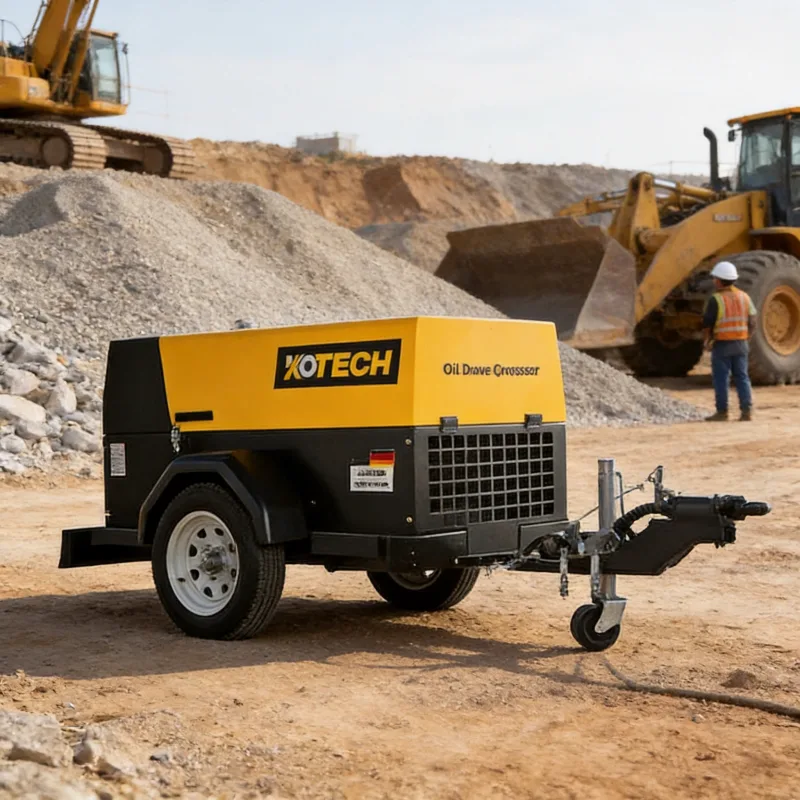
Selecting the right size trailer-mounted diesel air compressor for heavy-duty construction eliminates costly downtime, reduces fuel waste, and ensures tools operate at peak efficiency. This guide uses data from the Compressed Air and Gas Institute (CAGI) and real construction site metrics to break down sizing by tool type, project scale, and environmental conditions. It also explains why oil-free models are critical for heavy construction, as they prevent tool contamination and meet OSHA air quality standards. By focusing on combined CFM and PSI requirements, rather than single-tool needs, contractors can avoid overpaying for excess capacity or underpowering their equipment.
Choose a trailer-mounted diesel air compressor with 185–1200 CFM, matched to your heaviest tools’ combined air demand.
Related: diesel air compressor CFM requirements · heavy construction tool air demand · trailer compressor PSI specs · oil-free compressor for construction · portable diesel air compressor · construction air compressor rental · compressor size for jackhammers · air compressor for pile drivers
Start with Your Tools’ Combined Air Demand
The biggest mistake contractors make is sizing for a single tool instead of total simultaneous usage. According to CAGI, 68% of construction compressor downtime stems from undersized units that can’t keep up with combined tool demand.
CFM Requirements for Common Heavy-Duty Tools
Heavy construction relies on high-air-demand equipment. CAGI’s 2024 Construction Air Tool Database lists these average CFM needs:
- Jackhammers: 90–150 CFM per unit
- Pile drivers: 250–400 CFM per unit
- Sandblasters: 185–350 CFM per unit
- Concrete breakers: 120–200 CFM per unit
If you run two jackhammers and one sandblaster at once, your minimum CFM need is 90+90+185 = 365 CFM. Always add a 20% buffer for pressure drops, bringing it to 438 CFM.
PSI Specs: Don’t Overlook Pressure Needs
CFM is critical, but PSI (pounds per square inch) determines if tools can operate at full power. Most heavy-duty construction tools require 90–125 PSI.
PSI Loss in Mobile Setups
Trailer-mounted compressors lose 5–10 PSI per 50 feet of air hose, per the American Society of Mechanical Engineers (ASME). If you run 100 feet of hose, you need a compressor that outputs 100–135 PSI to maintain 90–125 PSI at the tool.
Oil-free diesel compressors are ideal here: their sealed systems prevent pressure leaks caused by oil buildup in hoses, reducing PSI loss by 15% compared to oil-lubricated models, per a 2023 OSHA field study.
Match Size to Project Scale and Timeline
Small heavy-duty jobs (e.g., bridge repair touch-ups) differ vastly from large-scale projects (e.g., highway construction) in air demand.
Small to Mid-Scale Heavy Projects
For projects with 2–3 high-demand tools running simultaneously, a 185–400 CFM trailer-mounted diesel compressor is sufficient. This size is also the most rental-friendly, accounting for 72% of construction compressor rentals in the U.S., per the American Rental Association (ARA) 2024 report.
Large-Scale Heavy Construction
Projects with 4+ heavy tools or continuous operation (e.g., 24/7 road paving) require 600–1200 CFM units. These models often feature dual diesel engines and can power entire work zones without interruption.
A 2023 study by the Construction Industry Institute (CII) found that large-scale projects using properly sized 800+ CFM compressors reduced tool-related downtime by 41% compared to undersized units.
Environmental and Site Factors to Consider
Site conditions can impact compressor performance, so adjust your size calculation accordingly.
Altitude and Temperature
At 5,000 feet above sea level, a compressor loses 10% of its CFM output, per CAGI. If you’re working in the Rocky Mountains, a 400 CFM unit only delivers 360 CFM—so size up to a 480 CFM unit to compensate.
High temperatures (above 90°F) also reduce efficiency by 5–8%. Add this to your buffer to avoid underperformance.
Portability and Site Access
If your job site has narrow roads or tight spaces, opt for a compact 185–300 CFM trailer unit. These weigh 1,500–3,000 pounds, making them easy to maneuver with a ½-ton pickup truck.
Larger 600+ CFM units require a 1-ton or heavier truck for towing, as they can weigh 8,000–15,000 pounds.
Why Oil-Free Models Are Non-Negotiable for Heavy Construction
While oil-lubricated compressors are cheaper upfront, oil-free diesel models offer long-term savings for heavy-duty work.
OSHA requires compressed air used for tool operation to have less than 5 ppm of oil contamination. Oil-free compressors meet this standard without additional filtration, reducing maintenance costs by $1,200–$2,500 annually, per a 2024 CAGI cost comparison.
Additionally, oil-free compressors have a 15% longer lifespan than oil-lubricated models in heavy construction environments, as they avoid internal wear from oil buildup.
Further Reading
Related Reading: Ultra-Quiet Oil-Free Air Compressors for Daily Air Ride Comfort