
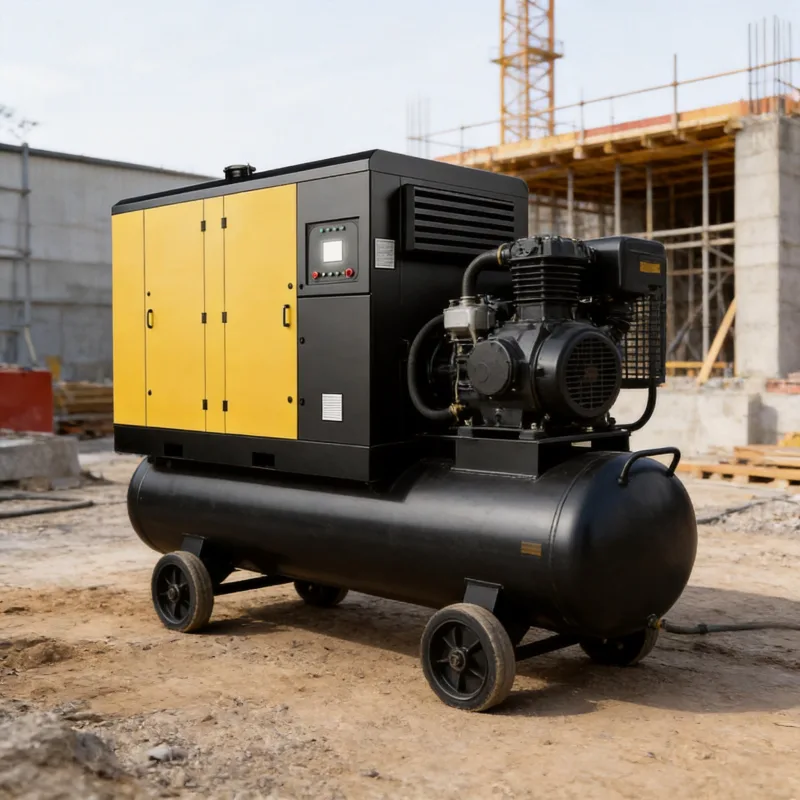
Navigating the selection of a diesel air compressor with an integrated generator for small construction sites demands a strategic approach, moving beyond basic specifications to practical operational realities. This guide offers a step-by-step methodology for making an informed decision, focusing on the unique challenges of confined spaces, varied power demands, and stringent environmental considerations. We delve into quantifying airflow and power needs, evaluating crucial factors like unit footprint, noise levels, and fuel consumption, all supported by actionable data and industry best practices. * **Assess Site Specifics First:** Prioritize understanding space, access, and local noise ordinances before reviewing equipment specs. * **Match CFM/PSI & kW Precisely:** Over- or under-sizing leads to inefficiency or insufficient power; calculate aggregate tool demands accurately. * **Prioritize Portability & Compact Design:** Small sites necessitate units designed for tight maneuvers and minimal footprint. * **Evaluate Noise & Emissions:** Modern units offer significant reductions; choose models meeting local regulations and enhancing worker comfort. * **Calculate Total Cost of Ownership:** Factor in fuel efficiency, maintenance, and resale value beyond the initial purchase price.
Selecting a diesel air compressor with generator for small job sites involves assessing site constraints, matching tool requirements, and prioritizing portability, noise, and fuel efficiency.
Related: portable compressor generator · job site power · air tool selection · fuel efficiency · noise reduction · compact equipment · construction machinery · site logistics · operational costs · equipment sizing
Understanding Small Job Site Dynamics
Choosing the right diesel air compressor with an integrated generator for a small construction site isn’t just about raw power; it’s about intelligent resource allocation. Small job sites inherently present unique challenges: limited space for equipment, potential for noise complaints in residential areas, restricted access, and often, a varied set of power and air tool requirements. Ignoring these specific constraints leads to inefficiencies, compliance issues, and increased operational costs. A strategic selection process must prioritize adaptability and efficiency within these confined parameters.
Defining Your Site’s Unique Footprint and Access
Before even looking at equipment specifications, precisely map out your typical small job site. Consider the available space for equipment placement, potential maneuvering room, and access points. A unit that’s technically powerful but too large to fit or position effectively is a liability. For instance, a common 185 CFM portable diesel compressor can range in length from 80 to 120 inches and weigh between 2,500 to 4,000 pounds. For extremely tight urban sites, a more compact, skid-mounted or utility-mounted unit might be essential, even if it means a slightly lower CFM or kW output.
Calculating Your Combined Airflow (CFM) and Power (kW) Needs
The core of your selection process lies in accurately quantifying the simultaneous demands for compressed air and electrical power. This step is critical to avoid both under-powering your tools and over-investing in unused capacity.
Step 1: Catalog All Air-Powered Tools and Their CFM/PSI Requirements
List every air tool you anticipate using simultaneously. For each, identify its required CFM (Cubic Feet per Minute) at a specific PSI (Pounds per Square Inch). Remember that most tool specifications provide “free air delivery” at a certain pressure.
- **Example:** A typical jackhammer might require 60-90 CFM at 90 PSI. A framing nailer needs significantly less, perhaps 2-4 CFM at 90 PSI, but if multiple are running, the aggregate adds up. A small sandblasting pot could demand 50-100 CFM or more.
- **Data Point:** Industry best practice suggests adding a 20-30% buffer to your calculated total CFM to account for pressure drops, hose leaks, and intermittent peak demands. If your total simultaneous demand is 120 CFM, aim for a compressor rated at least 144-156 CFM.
Step 2: Quantify Electrical Power Demands (kW)
Similarly, list all electrical tools and their wattage or amperage requirements. Convert amperage to wattage (Watts = Amps x Volts) if necessary, and then total them. Generators are rated in kilowatts (kW).
- **Example:** A 10-inch table saw might draw 2,000 watts (2 kW), a large grinder 1,500 watts (1.5 kW), and a welding machine could demand 5,000-10,000 watts (5-10 kW) depending on the process.
- **Data Point:** Always consider both continuous running watts and surge (starting) watts. Electric motors, especially, have high surge requirements. Your generator’s surge rating must accommodate the highest starting load of any single tool. A common rule of thumb is to ensure your generator’s continuous output is 1.5 to 2 times your expected average load.
Step 3: Integrating Air and Power Capacity
Once you have your buffered CFM and kW totals, look for units that meet or exceed both figures. Many manufacturers offer models specifically designed for construction, integrating both capabilities. For small sites, a unit offering 125-185 CFM and 4-10 kW of integrated generator power is often a sweet spot, capable of running multiple air tools alongside a few heavy-duty electrical tools or even a smaller welding rig.
Evaluating Portability, Noise, and Environmental Compliance
Beyond pure output, the practicalities of operating on a small site—mobility, noise, and environmental impact—are paramount.
Optimizing for Maneuverability and Storage
For small job sites, the physical dimensions and weight of the compressor-generator unit are critical. Look for features like compact designs, robust wheel kits, or skid-mount options that facilitate easy transport and positioning. Units with a smaller footprint (e.g., less than 90 inches long and 50 inches wide for a 185 CFM unit) are invaluable when space is at a premium. Consider how easily it can be towed by a standard pickup truck, as larger units might require heavier-duty vehicles. Some manufacturers offer models with lift points for crane access, which can be essential for multi-story or challenging terrain sites.
Addressing Noise Pollution and Worker Comfort
Noise is a significant concern, especially in urban or residential construction zones. OSHA guidelines mandate hearing protection for prolonged exposure above 85 dBA. Modern diesel compressor-generators have made considerable advancements in noise reduction.
- **Data Point:** Many top-tier units now operate in the 65-75 dBA range at 23 feet (7 meters), a substantial improvement over older models that could exceed 85-90 dBA. Prioritize models explicitly advertising “low noise” or “super silent” operation. Investing in a quieter unit not only helps with regulatory compliance but also improves worker communication and reduces community complaints, potentially saving you from costly fines or project delays.
Navigating Emission Regulations
Environmental regulations, particularly EPA Tier 4 Final standards for diesel engines, dictate emission levels. For small job sites, choosing a compliant unit is not just good practice but a legal necessity. Tier 4 Final engines utilize advanced technologies like Diesel Particulate Filters (DPF) and Selective Catalytic Reduction (SCR) to significantly reduce nitrogen oxides and particulate matter. While these units may have a higher upfront cost and require Diesel Exhaust Fluid (DEF), their long-term benefits in terms of environmental impact and avoided fines are substantial. Always verify that the unit you select meets the current emission standards for your operating region.
Assessing Fuel Efficiency, Maintenance, and Total Cost of Ownership
The initial purchase price is only one part of the equation. Long-term operational costs, reliability, and ease of maintenance significantly impact profitability on small projects.
Maximizing Fuel Efficiency for Cost Savings
Diesel fuel is a major operating expense. Different compressor-generator units, even with similar CFM/kW ratings, can vary considerably in fuel consumption.
- **Data Point:** A 185 CFM diesel compressor with a 6 kW generator might consume anywhere from 2.5 to 4 gallons per hour (GPH) under a typical 75% load. Over a 40-hour work week, this difference can amount to hundreds of dollars. Look for units with advanced engine management systems, variable speed controls, or “eco-mode” settings that optimize fuel consumption based on demand. A larger fuel tank, while adding weight, can extend run times, reducing the frequency of refueling, which is a significant advantage on remote or small sites without immediate fuel access.
Simplifying Maintenance and Ensuring Reliability
Downtime on a small job site is particularly disruptive. Opt for units known for their reliability and ease of maintenance.
- **Features to look for:** Easily accessible service points (oil filters, air filters, fuel filters), extended service intervals (e.g., 500-hour oil change intervals), and a robust, simple design. Consider the availability of parts and service technicians in your operational area. A strong dealer network can be invaluable for minimizing downtime. Furthermore, advanced diagnostic systems or telematics can provide real-time operational data, flagging potential issues before they cause breakdowns, which is a growing trend in modern construction equipment.
Calculating Total Cost of Ownership (TCO)
Beyond the purchase price, TCO includes fuel, maintenance, DEF (if applicable), depreciation, and potential resale value. A unit that is slightly more expensive upfront but offers superior fuel efficiency, longer service intervals, and higher resale value can be more economical in the long run. Factor in the cost of consumables like filters and fluids. For small businesses, TCO analysis provides a clearer financial picture and helps justify investments in higher-quality, more efficient equipment.
Final Considerations: Safety and User Interface
Safety is paramount. Ensure the unit has clear safety warnings, emergency shut-offs, and protective guards. A user-friendly control panel with intuitive gauges and controls reduces training time and the likelihood of operational errors. Digital displays offering real-time performance metrics (pressure, voltage, engine hours, fuel level) are a significant advantage for efficient monitoring and troubleshooting on dynamic small job sites.
Further Reading
Related Reading: Oil-Free Diesel Compressors: Unlocking Peak Performance in Extreme Heavy-Use Scenarios