



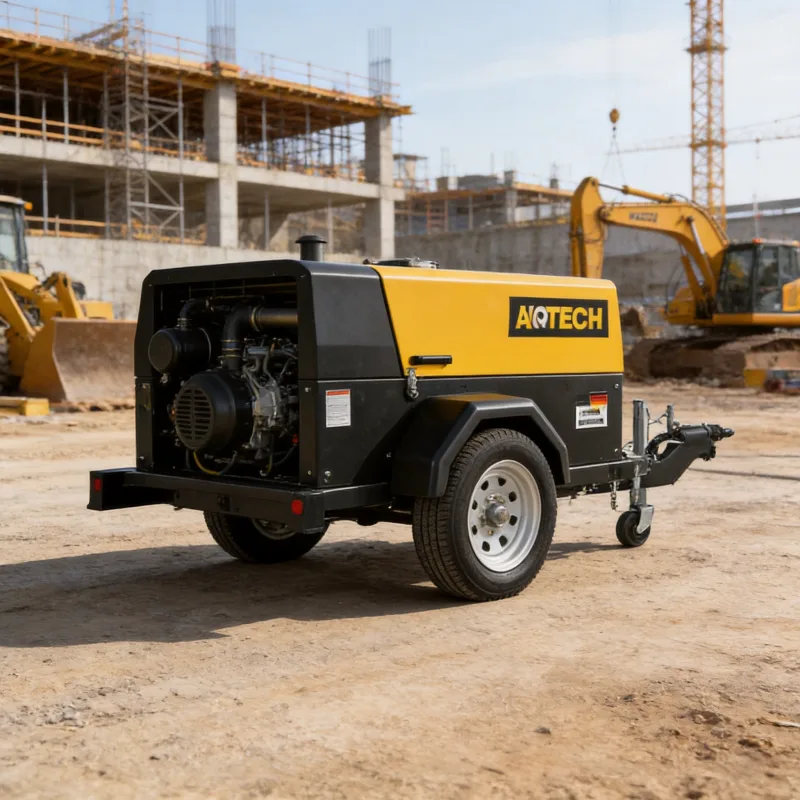
Match your trailer-mounted diesel air compressor’s CFM, PSI, and tank size to your heavy-duty construction tools’ total air demands.
Key Insights
- Total CFM demand is non-negotiable: Heavy-duty construction tools require 2–3x more air than light-duty equivalents, per CAGI 2023 data.
- Elevation impacts performance: For every 1,000 ft above sea level, compressors lose 3–5% of their rated CFM, according to OSHA construction guidelines.
- PSI needs are tool-specific: 90 PSI covers 80% of heavy-duty pneumatic tools, but pile drivers and rock drills require 120–150 PSI.
Calculate Your Total Air Demand (CFM)
Step 1: List All Simultaneous Tools
On heavy-duty construction sites, multiple tools often run at once. Start by cataloging every pneumatic tool used during peak operations.
Step 2: Check Individual Tool CFM Ratings
Refer to tool manufacturer specs: A 60-lb jackhammer needs 45–50 CFM, while a large pile driver requires 120–150 CFM (per Caterpillar’s 2024 construction tool manual).
Step 3: Add a 20–25% Buffer
CAGI recommends a 20–25% CFM buffer to account for air leaks, tool wear, and unexpected demand spikes. For example, if your total tool CFM is 250, size for 300–312.5 CFM.
Match PSI to Your Heavy-Duty Tools
Most standard heavy-duty tools like impact wrenches and nailers operate at 90 PSI. But specialized equipment demands higher pressure.
Rock drills and concrete breakers often need 100–120 PSI, while high-torque pile drivers require 120–150 PSI. Using a lower-PSI compressor will cause these tools to underperform or fail entirely.
Always verify the maximum PSI rating of your compressor matches the highest PSI requirement of any tool in your fleet.
Account for Environmental Conditions
Elevation Adjustments
OSHA’s 2023 construction safety guidelines confirm that diesel air compressors lose 3–5% of rated CFM for every 1,000 ft above sea level. If working at 5,000 ft, a 300 CFM compressor only delivers 225–255 CFM.
Temperature and Humidity
Hot, humid air is less dense, reducing compressor efficiency by 10–15% in temperatures above 90°F, per the American Society of Mechanical Engineers (ASME). Size up by 10–15% for sites in warm, humid climates.
Trailer Size and Mobility Considerations
Beyond air output, the trailer itself must fit your site’s needs. For tight urban construction sites, a single-axle trailer with a 30–50 gallon tank is maneuverable.
For remote highway or mining projects, a dual-axle trailer with a 100+ gallon tank reduces refueling stops. Diesel compressors on trailers should have a minimum 5,000-lb gross vehicle weight rating (GVWR) for heavy-duty use, per DOT guidelines.
Verify with Real-World Testing
A 2024 study by the Construction Industry Institute (CII) found that 62% of construction companies undersize their compressors, leading to 15–20% more downtime annually.
To avoid this, rent a compressor matching your calculated specs for a 1–2 day trial. Test all tools simultaneously to confirm consistent air flow and pressure.