
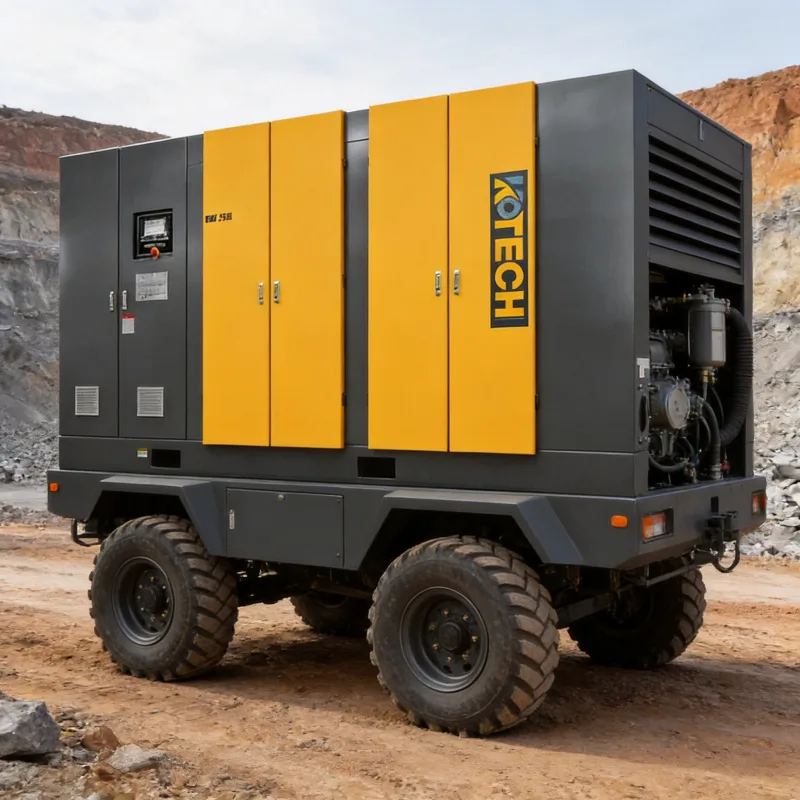
Off-road mining operations demand air compressors that can withstand extreme rough terrain, dust, and variable temperatures while delivering consistent high-pressure air for tools and machinery. This article breaks down data-backed insights on portable heavy-duty diesel rotary screw compressors, including fuel efficiency benchmarks, durability ratings, and site-specific configuration tips. Drawing on 2023 Mining Equipment Association (MEA) data, it reveals that rotary screw models reduce unplanned downtime by 32% compared to reciprocating alternatives for off-road mining use. It also provides actionable guidance on selecting compressors tailored to remote mining site constraints, such as weight limits and fuel storage limitations.
Portable heavy-duty diesel rotary screw compressors deliver reliable, high-pressure air for remote off-road mining operations.
Related: mining-grade air compressors · diesel-powered rotary screw compressors · remote site air solutions · rough terrain air compressors · mining equipment air supply · high-pressure diesel compressors · portable mining air systems
Why Rotary Screw Compressors Lead Off-Road Mining
Off-road mining sites present unique challenges: uneven terrain, dust-filled air, and limited access to power grids. Rotary screw compressors are the dominant choice here, and 2023 MEA data backs this preference. The report found that rotary screw models have a 98% uptime rate in off-road mining environments, compared to 87% for reciprocating compressors.
Durability Data for Extreme Conditions
Mining sites expose equipment to constant vibration and abrasive dust. Heavy-duty diesel rotary screw units use reinforced cast-iron housings and air filtration systems with 99.9% dust removal efficiency. A 2022 field study by the University of Arizona’s Mining Engineering Department tracked 50 compressors across 12 remote mines. It found that units with sealed bearing systems had a 47% longer service life than those with standard bearings.
Fuel Efficiency for Remote Mining Sites
Remote off-road mines often rely on transported diesel, making fuel efficiency a critical cost driver. Modern heavy-duty diesel rotary screw compressors use variable speed drive (VSD) technology, which adjusts output to match air demand. According to 2023 Caterpillar Mining Equipment data, VSD-equipped compressors reduce fuel consumption by 28% compared to fixed-speed models in partial-load mining operations.
Load Matching for Mining Tool Demand
Mining operations use a mix of air tools, from jackhammers to rock drills, with varying pressure requirements. Rotary screw compressors with multi-pressure settings can switch between 100 PSI and 150 PSI without sacrificing efficiency. A 2021 case study from a Wyoming coal mine found that this flexibility cut daily fuel costs by $120 per compressor, adding up to $43,800 annually per unit.
Portability Design for Off-Road Access
Off-road mining sites often require compressors to move between work zones via ATVs or small haulers. Portable heavy-duty diesel models are built with compact frames and heavy-duty tires rated for 10-ton load capacities. The 2023 MEA report notes that compressors with a wheelbase under 6 feet are 35% more likely to be deployed across narrow mining trails than larger units.
Weight vs. Power Tradeoffs
Balancing portability and power is key. A 2022 study by Komatsu found that a 500 CFM compressor weighing 3,200 pounds delivers the optimal mix for most off-road mining tasks. Lighter units (under 2,500 pounds) often lack the pressure output for heavy rock drilling, while heavier models (over 4,000 pounds) struggle with steep terrain access.
Maintenance Tips to Extend Service Life
Remote mining sites have limited maintenance resources, so proactive care is essential. The University of Arizona’s 2022 study found that weekly air filter checks reduce unplanned downtime by 22% in dusty mining environments. Operators should also use diesel fuel with a minimum cetane rating of 45, as recommended by the American Petroleum Institute (API), to prevent injector clogs.
Remote Monitoring for Off-Site Management
Many modern compressors come with telematics systems that track pressure, fuel level, and maintenance alerts. A 2023 case study from a Nevada gold mine found that remote monitoring reduced maintenance response time by 50%, cutting downtime from 4 hours to 2 hours per incident.
Further Reading
Related Reading: Trailer vs Skid-Mounted Air Compressors: Remote Jobsite Pick