



A gigawatt-scale solar photovoltaic plant consumes a large, remarkably steady stream of compressed air for pneumatic handling, actuation, cleaning and instrument systems across cell and module lines. Any oil carryover risks contaminating wafers, cells and encapsulation, and a sudden loss of air can stop an automated line mid-cycle. That combination, very high continuous flow, stringent air purity and a smooth demand profile, is the natural home of an oil-free centrifugal compressor. This guide explains why dynamic centrifugal machines suit PV manufacturing and how the real KOTECH KOA, KOS, KOT and KOL ranges scale from small plants to multi-gigawatt campuses.
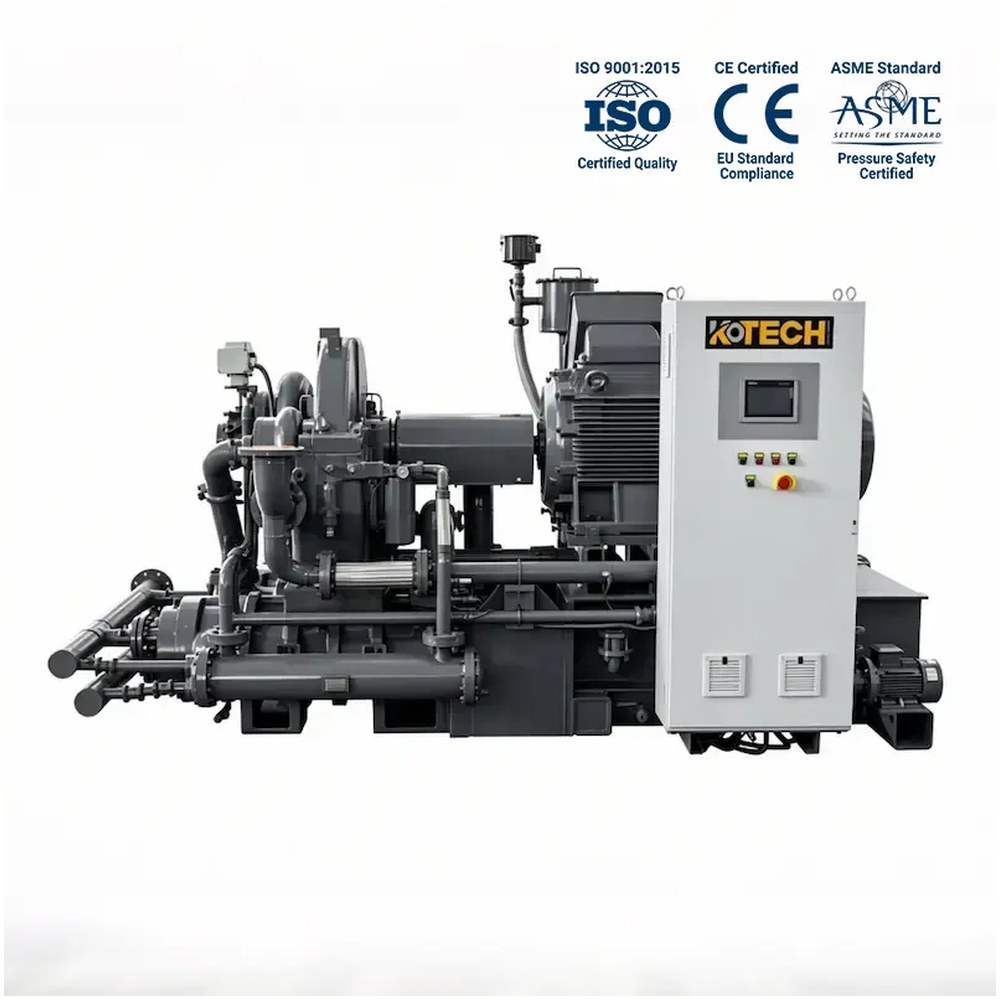
Why solar manufacturing needs oil-free air
Photovoltaic production handles delicate, high-value product. Wafers and cells pass through many automated steps where compressed air actuates grippers and valves, clears surfaces and supports conveying. Even tiny amounts of hydrocarbon aerosol can leave films on silicon or glass, interfere with coatings and contacts, or contaminate encapsulation, all of which threaten yield in a process where margin per module is thin. Oil-free compression removes the carryover risk at source rather than relying only on downstream filtration.
Consistency matters as much as purity. A module line running at high throughput is sensitive to pressure fluctuation; instruments, vacuum and pneumatic handling prefer a stable header. Interruptions are costly because product at several stages can be scrapped or the line restarted, so the compressed-air station is treated as critical process infrastructure with high availability.
Why a centrifugal machine fits a steady, high-flow load
Compressors fall into two broad families. Positive-displacement machines such as screws trap and squeeze fixed pockets of air and are excellent across a wide mid-range, especially where demand varies. Dynamic centrifugal machines accelerate air through an impeller and convert that velocity to pressure; they deliver very high, smooth, essentially pulse-free flow and are at their most efficient when running continuously at a large fraction of capacity.
Solar cell and module plants often present exactly that profile: a high base load that runs with the production line and limited turndown. In that window a centrifugal package offers high flow from a relatively small footprint, oil-free air from the compression process and low vibration, which suits installation near sensitive manufacturing equipment. Where demand swings widely, centrifugal machines can surge at very low flow, so the station is designed with trim capacity or a complementary machine to protect the operating range.
- Choose centrifugal where flow is large and the demand profile is steady near full output.
- Oil-free dynamic compression protects wafers, cells and encapsulation from hydrocarbon carryover.
- Pulse-free output and low vibration suit precision PV automation and instruments.
- Design the station with trim capacity to avoid surge during low-demand periods and line stoppages.
Real KOTECH centrifugal compressor families
Current published envelopes from the KOTECH product page. Each family is configured to the project’s flow and pressure within its range.
Because the values are configured ranges rather than single nameplates, selection is a process calculation: the design flow, pressure and turndown determine where inside the family envelope a machine is built. For most PV header duties at ordinary process pressure, the KOA through KOT families at up to 11 to 16 bar cover the requirement without stepping up to the high-pressure KOL configurations.
Sizing the clean-air station for a PV fab
Begin with an air balance across every process tool and utility, separating genuinely continuous demand from batch and cleaning loads, then add leakage and a growth margin for later capacity. Solar plants expand in phases, so a station often starts with one centrifugal train sized for the initial lines and adds identical trains as capacity grows, which keeps spares and maintenance common. A small variable-capacity trim unit can cover swing demand and protect the centrifugal machines from operating below their safe minimum flow.
Air treatment completes the specification. Even with oil-free compression, dryers and particulate filtration protect tools from moisture and dust, and heat-of-compression drying is a natural partner for oil-free centrifugal packages because it uses heat that is already being produced. Monitoring of pressure, temperature, vibration and surge margin lets the operations team run the station close to its efficient point with early warning of fouling or wear.
Reliability, installation and total cost
For a module plant the strongest argument for centrifugal compression is lifecycle cost on a continuous high-flow duty. A machine that runs with the line for years spends far more on electricity than it cost to buy, so high full-load efficiency and oil-free operation that protects yield both repay the investment. Low contact wear in the compression path and condition-based maintenance support long intervals between major overhauls.
Installation should plan for the package’s foundation, ventilation and intake, because a large centrifugal train benefits from clean, cool intake air and adequate heat rejection. Many plants recover that rejected heat for space heating or process water, improving overall energy use. Specifying the station as a configured system with redundancy, controls and treatment from the outset avoids costly retrofit once a new production line is already running.
Buying tips
- Confirm a high, steady base load; centrifugal machines are most efficient running continuously near capacity.
- Specify oil-free compression at source to protect wafers, cells and encapsulation from hydrocarbon film.
- Size from a full tool-level air balance, then add leakage and phased-expansion headroom.
- Add a small trim machine and anti-surge control for low-demand periods and line stoppages.
- Pair oil-free centrifugal packages with heat-of-compression drying and appropriate particulate filtration.
Frequently asked questions
Why do solar PV plants use oil-free centrifugal compressors?
What is the difference between a centrifugal and a screw compressor?
Which KOTECH centrifugal family fits a module plant?
What happens if the air demand drops below the centrifugal machine’s range?
Do oil-free compressors still need dryers and filters?
How is a centrifugal station expanded as a solar plant grows?
Share your solar plant’s process air balance, target pressure and expansion roadmap and our engineers will configure the right KOTECH oil-free centrifugal station for your cell or module facility.