



In a pharmaceutical plant, compressed air is a utility that can touch product, primary packaging and the surfaces of critical equipment. A single oil-contamination event can mean a rejected batch, a failed audit and a regulatory report. Dry oil-free machines remove oil from the compression path, but many sites also want to avoid high temperatures and complex gear drives in their clean utility room. A water-lubricated oil-free screw compressor answers that with a single screw running on a water film: no oil in the compression chamber at all, cool operation and ISO 8573-1 Class 0 air. This guide explains where water-lubricated machines belong in pharma and how to size them using real KOTECH KWI figures.
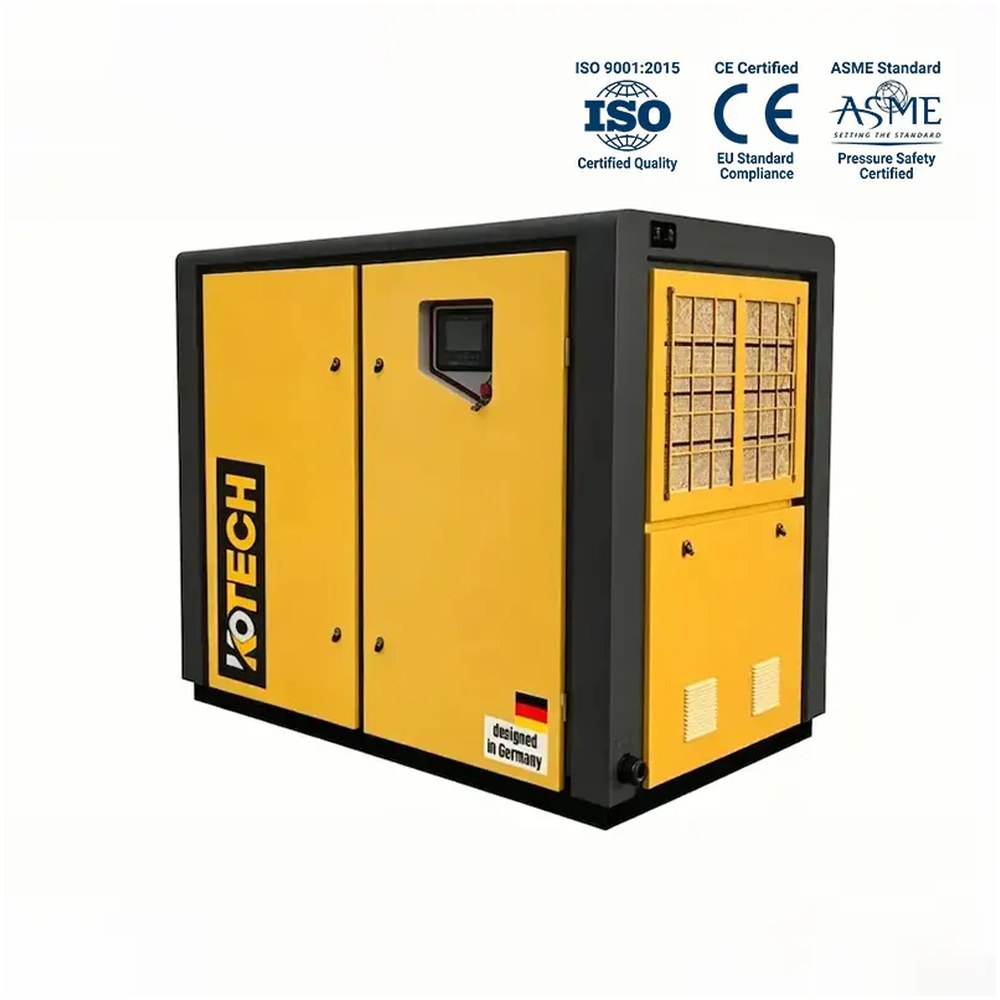
Why pharma clean utilities insist on Class 0 air
Pharmaceutical compressed air is classified by the risk of contact with product. Applications such as fermentation aeration, tablet and capsule conveying, blister packaging, vial and bottle handling, and drying of components can all expose product or contact surfaces to the airstream. For these uses the relevant standards and good-practice guides call for the highest purity class, ISO 8573-1 Class 0, which means no measurable oil aerosol, vapour or liquid, rather than merely a very low oil content.
Class 0 cannot be achieved reliably by filtering an oil-injected compressor and hoping the elements never fail. Filter blockage, bypass and saturation all create contamination risk, and oil vapour is not stopped by particulate filtration alone. Specifying an oil-free compression principle removes oil at the source, which is the defensible position in a qualification and audit context. Downstream drying and filtration are still required for water and particulates, but the hydrocarbon hazard is engineered out.
How water lubrication differs from dry oil-free
Oil-free screws use two main approaches. Dry-running twin-screw machines rely on timing gears so the rotors never touch and often run hot, needing substantial cooling. Water-lubricated single-screw machines instead inject treated water into the compression chamber. The water forms the lubricating and sealing film between rotor and gate rotors, removes the heat of compression and is separated and managed by a water circuit.
The practical consequences suit clean utilities. With no oil in the chamber there is no oil carryover and no oil-change waste stream, and near-isothermal compression keeps discharge temperature low, which improves efficiency and reduces thermal stress. The trade-off is water quality: the lubricating circuit must use suitably treated water with controls for hardness and microbiological condition, and the machine is best run regularly enough to keep the water system fresh. In a pharma plant, which already operates purified-water systems, that requirement is straightforward to meet.
- No oil in the compression chamber means Class 0 air is produced by design, not by filtration alone.
- Water injection removes compression heat for near-isothermal, low-temperature operation.
- Treated water and a maintained water circuit are the main operating requirements.
- Pair the compressor with validated drying and filtration to control moisture and particulates.
Real KOTECH KWI water-lubricated specifications
Current factory figures from the KOTECH product page. Free-air delivery is shown for the available pressure ratings and falls as pressure rises.
Because KWI output changes with the selected pressure, read the row at the rating you will actually run. Selecting a 10 bar machine and regulating down to 7 bar wastes some of the capability; choosing the rating nearest the true header requirement gives the best flow and efficiency for the kilowatt.
Sizing and integrating a pharma clean-air station
Size from a proper demand analysis of the clean-utility system: list every contact and non-contact application, apply realistic diversity and usage factors, and add leakage, a growth margin and redundancy for continuous supply. Pharma loads are often relatively steady across a production shift, which suits a well-loaded water-lubricated machine; variable-speed options help where packaging and batch equipment create a swing. Avoid the common error of grossly oversizing, which makes the compressor cycle and can leave the water circuit under-used.
Integration follows the site’s qualification model. The compressor room should provide clean intake air, and the treatment train after the compressor typically includes a dryer selected for the required pressure dew point and particulate and, where the risk assessment calls for it, catalytic or adsorption stages. Use stainless or compatible piping to prevent corrosion, and instrument the system for pressure, dew point and temperature so the supply can be monitored and trended as part of the site quality system. Treated make-up water and a documented maintenance schedule keep the lubrication circuit under control.
Validation, maintenance and total cost
For regulated manufacturers the compressor is part of a qualified system, so suppliers should support documentation such as material and air-quality certificates, and the design should permit routine servicing without compromising clean conditions. Water-lubricated machines avoid oil changes and oil-filter disposal, which reduces both consumable cost and an environmental waste stream, and their cool running supports long seal and component life when water quality is maintained.
Total cost therefore hinges on two factors: selecting the right frame and pressure for the real load, and disciplined water treatment. Done well, a KWI station gives continuous Class 0 air with low energy use and minimal consumables, which is precisely the combination a clean-utility engineer wants behind a validated production line. A short discussion with the supplier about the water standard, duty cycle and required dew point will confirm the exact configuration and redundancy for the plant.
Buying tips
- Specify ISO 8573-1 Class 0 at the compression principle, not only through downstream filters.
- Choose the pressure rating closest to the true header pressure to maximise flow per kilowatt.
- Plan treated make-up water and controls for hardness and microbiological condition.
- Add redundancy so servicing never interrupts a validated clean-utility supply.
- Instrument pressure, dew point and temperature and use compatible stainless piping.
Frequently asked questions
What is a water-lubricated oil-free screw compressor?
Why choose water-lubricated over a dry oil-free compressor?
Does Class 0 mean I do not need filters or a dryer?
Which KWI model suits a pharmaceutical production line?
What water quality does a water-lubricated compressor need?
Can a Class 0 compressor be oversized for safety?
Send our engineers your clean-utility air demand, required dew point, water standard and redundancy needs, and we will size the right KOTECH KWI Class 0 station for your pharmaceutical plant.