



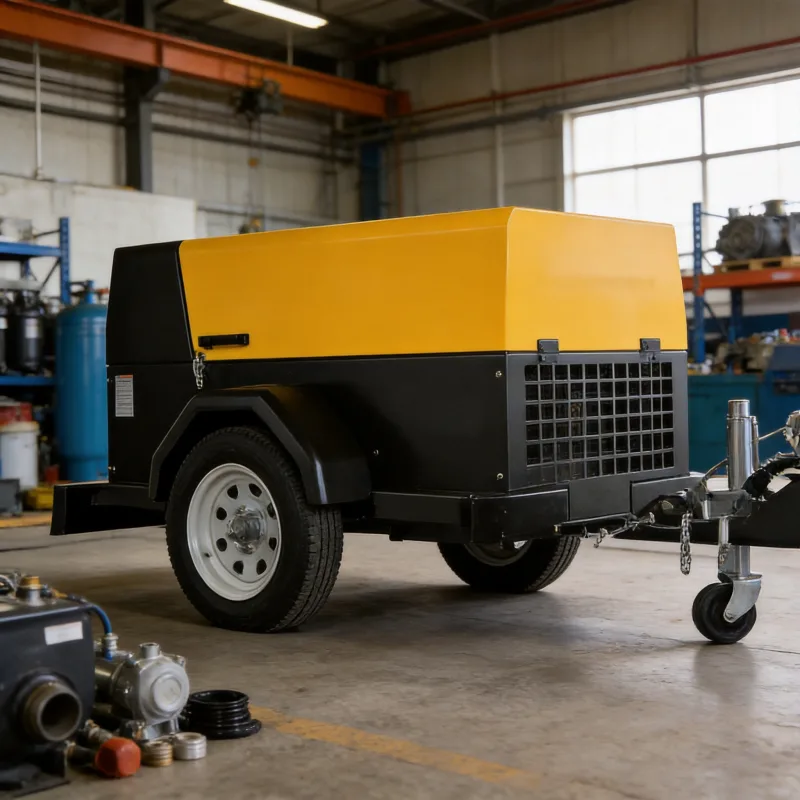
Industrial diesel air compressor prices vary due to specs, brand, manufacturing, regional taxes, and after-sales support, per industry data.
Key Technical Specifications That Drive Pricing
Capacity and Pressure Ratings
The most significant price driver is a compressor’s air output (measured in cubic feet per minute, CFM) and pressure (pounds per square inch, PSI). CAGI’s 2024 Industrial Compressor Benchmark Report shows that a 100 CFM/125 PSI portable unit averages $8,500, while a 1,000 CFM/150 PSI stationary model costs $75,000 on average. Higher-capacity units require larger, more durable components, including reinforced cylinders and heavy-duty cooling systems, which add 30–50% to manufacturing costs.
Engine Efficiency and Emissions Compliance
Diesel engine efficiency and emissions standards also impact pricing. EPA Tier 4 Final-compliant engines, required for most U.S. industrial use, cost 25–35% more than older Tier 2 engines, per the Diesel Technology Forum. These engines incorporate advanced exhaust aftertreatment systems, such as selective catalytic reduction (SCR), to reduce nitrogen oxide emissions by 90% compared to Tier 2 models.
Brand Reputation and Manufacturing Quality
Premium vs. Economy Brand Pricing
Brand reputation plays a critical role in price variation. Top-tier brands like Atlas Copco and Ingersoll Rand charge 20–40% more than lesser-known economy brands, according to a 2024 survey by Industrial Equipment News (IEN). Premium brands invest heavily in R&D, testing, and quality control—their units have a 15–20 year lifespan, compared to 8–10 years for economy models.
Domestic vs. Imported Manufacturing
Domestic U.S. manufacturing adds to costs due to higher labor and regulatory expenses. A 2023 Bureau of Labor Statistics (BLS) report found that U.S.-made industrial compressors cost 18–22% more than comparable imported units from China or India. However, domestic units often come with shorter lead times and easier access to replacement parts, reducing long-term operational costs.
Regional and Market-Specific Factors
Tax and Regulatory Differences
Regional tax policies and regulatory requirements can alter final prices. For example, California’s stringent air quality rules mandate additional emissions testing, adding $1,200–$2,500 to the cost of a diesel compressor, per the California Air Resources Board (CARB). States with sales tax rates above 7% also increase upfront costs by hundreds of dollars for high-value units.
Local Demand and Supply Dynamics
Local market demand and supply can create price fluctuations. In oil and gas-heavy regions like Texas, demand for high-capacity diesel compressors is 30% higher than the national average, leading to 5–10% higher prices during peak drilling seasons, per the Energy Information Administration (EIA). Conversely, regions with surplus inventory may offer discounts of 10–15% to clear stock.
After-Sales Support and Value-Added Packages
Warranty and Maintenance Plans
Extended warranty and maintenance packages can add 10–15% to the upfront price but reduce long-term costs. A 2024 CAGI study found that units with 5-year comprehensive warranties have 25% lower annual maintenance costs than those with standard 1-year warranties. These packages often include free routine servicing and priority access to replacement parts.
Customization and Installation Services
Customization options, such as weatherproof enclosures or integrated air treatment systems, can increase prices by 15–30%. For example, a compressor modified for offshore use requires corrosion-resistant materials and specialized sealing, adding $10,000–$20,000 to the base price, per marine industrial equipment supplier Parker Hannifin. Professional installation services also add $2,000–$5,000, depending on unit size and location.
Further Reading