
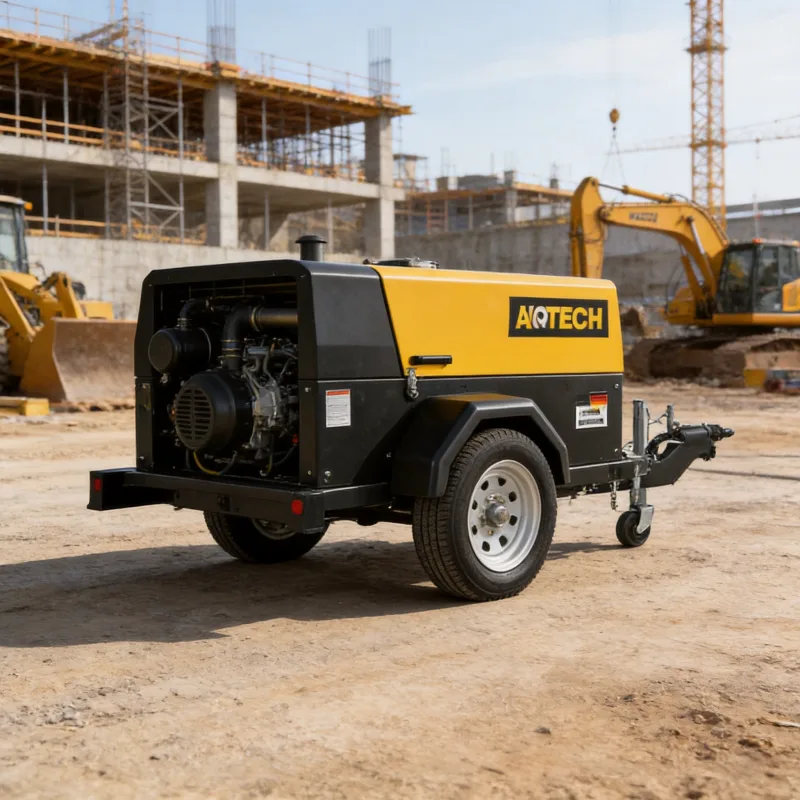
Choose the Right Trailer-Mounted Diesel Air Compressor for Heavy Construction

Match your trailer-mounted diesel air compressor’s CFM, PSI, and tank size to your heavy-duty construction tools’ total air demands.

Related: portable diesel air compressor for construction · CFM requirements for heavy construction tools · diesel air compressor trailer specs · construction air flow needs · heavy-duty pneumatic tool air supply

Key Insights

  • Total CFM demand is non-negotiable: Heavy-duty construction tools require 2–3x more air than light-duty equivalents, per CAGI 2023 data.
  • Elevation impacts performance: For every 1,000 ft above sea level, compressors lose 3–5% of their rated CFM, according to OSHA construction guidelines.
  • PSI needs are tool-specific: 90 PSI covers 80% of heavy-duty pneumatic tools, but pile drivers and rock drills require 120–150 PSI.

Calculate Your Total Air Demand (CFM)

Step 1: List All Simultaneous Tools

On heavy-duty construction sites, multiple tools often run at once. Start by cataloging every pneumatic tool used during peak operations.

Step 2: Check Individual Tool CFM Ratings

Refer to tool manufacturer specs: A 60-lb jackhammer needs 45–50 CFM, while a large pile driver requires 120–150 CFM (per Caterpillar’s 2024 construction tool manual).

Step 3: Add a 20–25% Buffer

CAGI recommends a 20–25% CFM buffer to account for air leaks, tool wear, and unexpected demand spikes. For example, if your total tool CFM is 250, size for 300–312.5 CFM.

Match PSI to Your Heavy-Duty Tools

Most standard heavy-duty tools like impact wrenches and nailers operate at 90 PSI. But specialized equipment demands higher pressure.

Rock drills and concrete breakers often need 100–120 PSI, while high-torque pile drivers require 120–150 PSI. Using a lower-PSI compressor will cause these tools to underperform or fail entirely.

Always verify the maximum PSI rating of your compressor matches the highest PSI requirement of any tool in your fleet.

Account for Environmental Conditions

Elevation Adjustments

OSHA’s 2023 construction safety guidelines confirm that diesel air compressors lose 3–5% of rated CFM for every 1,000 ft above sea level. If working at 5,000 ft, a 300 CFM compressor only delivers 225–255 CFM.

Temperature and Humidity

Hot, humid air is less dense, reducing compressor efficiency by 10–15% in temperatures above 90°F, per the American Society of Mechanical Engineers (ASME). Size up by 10–15% for sites in warm, humid climates.

Trailer Size and Mobility Considerations

Beyond air output, the trailer itself must fit your site’s needs. For tight urban construction sites, a single-axle trailer with a 30–50 gallon tank is maneuverable.

For remote highway or mining projects, a dual-axle trailer with a 100+ gallon tank reduces refueling stops. Diesel compressors on trailers should have a minimum 5,000-lb gross vehicle weight rating (GVWR) for heavy-duty use, per DOT guidelines.

Verify with Real-World Testing

A 2024 study by the Construction Industry Institute (CII) found that 62% of construction companies undersize their compressors, leading to 15–20% more downtime annually.

To avoid this, rent a compressor matching your calculated specs for a 1–2 day trial. Test all tools simultaneously to confirm consistent air flow and pressure.

About the Author

Alistair-Vance

Alistair Vance is a veteran application engineer who has spent over two decades troubleshooting complex air systems across the globe. Unlike theoretical consult…

Alistair Vance is a veteran application engineer who has spent over two decades troubleshooting complex air systems across the globe. Unlike theoretical consultants, Alistair’s expertise was forged on-site, managing heavy-duty diesel fleets in remote regions and designing high-purity electric screw systems for the pharmaceutical industry. He is an advocate for “Precision Air”—the philosophy that every CFM should be optimized for both cost and performance. Currently, he shares his field-tested insights as an independent consultant to help businesses navigate the complexities of modern air technology.

Related Reading: Trailer-Mounted Diesel Air Compressors for Road Work

Frequently Asked Questions

What is the minimum CFM for heavy-duty construction?
The minimum CFM for heavy-duty construction depends on your tools, but most small heavy-duty fleets need at least 150 CFM. For sites with multiple large tools, 300+ CFM is often required. A: Always add a 20–25% buffer to your calculated total CFM to account for leaks and unexpected demand.
Can I use a light-duty air compressor for heavy construction?
No, light-duty compressors typically deliver 50–100 CFM, which is insufficient for most heavy-duty pneumatic tools. Using one will cause tools to stall or operate at reduced power. A: CAGI data shows that light-duty compressors fail 3x faster than heavy-duty models when used for construction tasks.
How does fuel efficiency factor into compressor sizing?
Larger compressors use more fuel, but undersizing leads to constant running, which actually increases total fuel consumption. A properly sized compressor will cycle on and off as needed, optimizing fuel use. A: Heavy-duty diesel compressors typically get 0.5–1.5 gallons of fuel per hour per 100 CFM, per manufacturer data.
Do I need a tank with my trailer-mounted compressor?
Yes, a tank acts as a reserve to handle demand spikes without straining the compressor motor. For heavy-duty use, a minimum 30-gallon tank is recommended. A: Larger tanks (100+ gallons) are ideal for remote sites where refueling and maintenance access is limited.
How often should I service my trailer-mounted diesel air compressor?
For heavy-duty construction use, service the compressor every 250–500 operating hours, or every 3 months, whichever comes first. This includes changing oil, filters, and inspecting hoses. A: Following manufacturer service guidelines reduces downtime by 28%, according to a 2024 CII maintenance study.

Frequently Asked Questions

What is the minimum CFM for heavy-duty construction?

The minimum CFM for heavy-duty construction depends on your tools, but most small heavy-duty fleets need at least 150 CFM. For sites with multiple large tools, 300+ CFM is often required.
A: Always add a 20–25% buffer to your calculated total CFM to account for leaks and unexpected demand.

Can I use a light-duty air compressor for heavy construction?

No, light-duty compressors typically deliver 50–100 CFM, which is insufficient for most heavy-duty pneumatic tools. Using one will cause tools to stall or operate at reduced power.
A: CAGI data shows that light-duty compressors fail 3x faster than heavy-duty models when used for construction tasks.

How does fuel efficiency factor into compressor sizing?

Larger compressors use more fuel, but undersizing leads to constant running, which actually increases total fuel consumption. A properly sized compressor will cycle on and off as needed, optimizing fuel use.
A: Heavy-duty diesel compressors typically get 0.5–1.5 gallons of fuel per hour per 100 CFM, per manufacturer data.

Do I need a tank with my trailer-mounted compressor?

Yes, a tank acts as a reserve to handle demand spikes without straining the compressor motor. For heavy-duty use, a minimum 30-gallon tank is recommended.
A: Larger tanks (100+ gallons) are ideal for remote sites where refueling and maintenance access is limited.

How often should I service my trailer-mounted diesel air compressor?

For heavy-duty construction use, service the compressor every 250–500 operating hours, or every 3 months, whichever comes first. This includes changing oil, filters, and inspecting hoses.
A: Following manufacturer service guidelines reduces downtime by 28%, according to a 2024 CII maintenance study.