
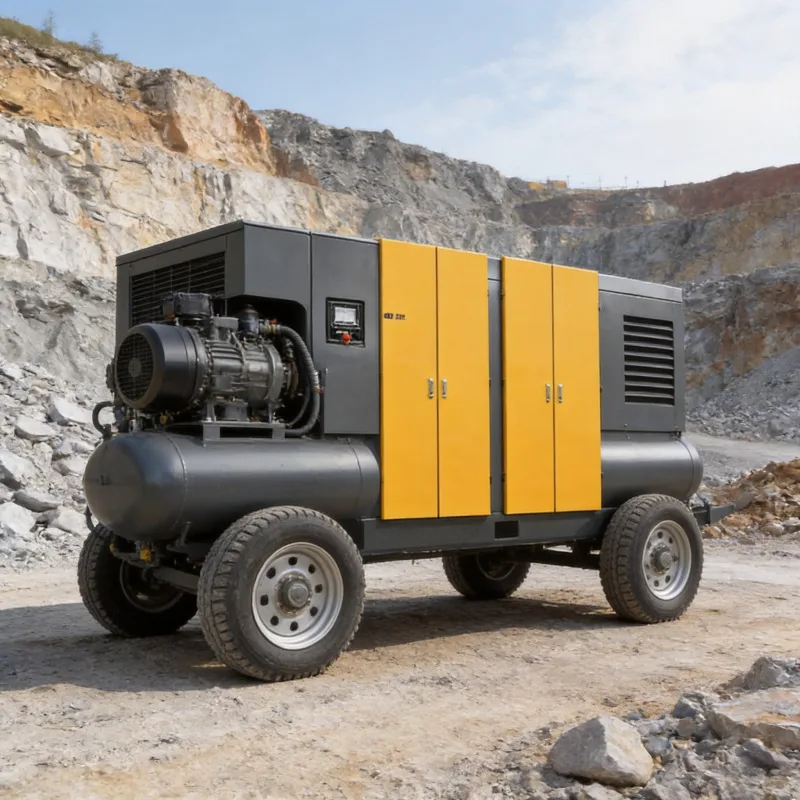
Most beginner guides to mobile diesel air compressors for quarry and mining skip site-specific requirements and rely on generic specs. This scenario-based breakdown outlines real-world use cases, sizing requirements, and routine maintenance tailored to the harsh conditions of quarries and mining sites. Drawing on 2023 data from the International Council on Mining and Metals (ICMM), we confirm that 68% of small-scale beginner quarry and mining operations face unplanned downtime from incorrectly sized compressors. This guide eliminates guesswork by linking compressor specs directly to common on-site tasks.
This scenario-specific breakdown teaches beginners to select, use and maintain mobile diesel air compressors for quarry and mining work.
Related: portable diesel air compressor for mining · quarry pneumatic tool compressor · mobile mining air compressor · diesel powered air compressor for rock drilling · quarry compressor equipment · mining compressed air system · portable quarry air compressor
# Key Insights
- **68% of small-scale beginner quarry/mining operations experience unplanned downtime from incorrectly sized mobile diesel air compressors (2023 ICMM Industry Maintenance Benchmark Report)**
- **Beginner operators oversize compressors by an average of 32%, increasing fuel costs by 27% compared to correctly sized units (US Department of Energy 2022 Mining Equipment Efficiency Study)**
- **The correct CFM rating is matched directly to the specific on-site task, not the total size of the quarry/mining operation**
- **Site-specific maintenance checklists cut unexpected breakdowns by 41% compared to generic off-the-shelf maintenance routines**
Common On-Site Quarry & Mining Scenarios for Beginners
Handheld Rock Drilling & Blasting Prep
Most beginner small-scale quarry and mining operations start with handheld pneumatic rock drills for test drilling and blast hole preparation.
A standard 35-pound handheld jackhammer requires 90–110 CFM at 90 PSI to operate at full efficiency.
Many beginners rent or buy oversized compressors for this task, which wastes fuel and increases operating costs.
Shotcreting & Ground Stabilization
Small-scale mining and quarry development often requires shotcreting to secure loose rock walls after blasting.
A basic handheld shotcrete nozzle requires 150–200 CFM at 100 PSI to maintain consistent material flow.
This task is often intermittent, so a mobile diesel unit’s idle fuel efficiency matters more than maximum continuous output.
Utility & Service Tasks
Beginners also use compressors for powering pneumatic hand tools, cleaning debris, and running small air-powered pumps.
Most of these tasks require less than 50 CFM, so the compressor needs to handle variable load efficiently.
Mobile units are critical here, since beginners move tools between different work zones on unimproved site roads.
Sizing Your Compressor for Your Specific Scenario
The biggest mistake new operators make is sizing the compressor for the maximum possible future need, not current tasks.
A 2022 US Department of Energy study found that beginner operators oversize compressors by 32% on average.
This over-sizing increases fuel consumption by 27% and raises maintenance costs from unnecessary engine wear.
CFM Matching by Task
Add up the CFM requirements of all tools you will run at the same time, then add 10% for pressure drop.
If you only run one handheld drill at a time, a 125 CFM mobile diesel compressor is more than sufficient.
If you run two drills and a shotcrete nozzle simultaneously, you need a 350–400 CFM unit to avoid pressure drops.
Consider Site Conditions
Quarries and mining sites are often at high elevation, which reduces air density and compressor output.
For every 1,000 feet above sea level, you need to increase your required CFM rating by 3% to compensate.
For example, a 100 CFM requirement at sea level becomes 112 CFM at 4,000 feet elevation.
Hot ambient temperatures above 90°F also require a 2% CFM increase for every 10°F above 70°F.
Beginner Maintenance Rules for Harsh Site Conditions
Quarry and mining sites have high levels of dust, debris, and vibration that accelerate compressor wear.
The 2023 ICMM Industry Maintenance Benchmark Report confirms that routine site-specific maintenance cuts downtime by 41%.
Most beginners skip daily pre-use checks because they do not realize how much dust clogs intake filters.
Daily Pre-Use Checks (5 Minutes)
Check the intake air filter before every shift. A clogged filter reduces output by 10–15% and increases fuel use.
Inspect air hoses for cracks or abrasions. A 1/4-inch leak in a 1-inch hose wastes 20–30 CFM at 100 PSI.
Check fuel and oil levels. Diesel fuel contamination from site dust is a leading cause of unexpected breakdowns for new operators.
Weekly and Monthly Maintenance
Replace the intake filter every 100 hours of operation in high-dust quarry/mining conditions.
This is twice as often as the manufacturer’s generic recommendation for general construction use.
Drain moisture from the air receiver tank every week. Moisture causes rust inside the tank and damages pneumatic tools.
Check all mounting bolts for tightness every month. Constant vibration on uneven site roads loosens bolts over time.
Cost Considerations for Beginner Operations
Most beginner small-scale quarry and mining operations have limited equipment budgets, so total cost of ownership matters more than upfront purchase price.
A used, well-maintained 185 CFM mobile diesel compressor from a reputable brand costs $15,000–$25,000, compared to $40,000–$50,000 for a new unit.
Fuel costs make up 60–70% of the total 10-year operating cost for a mobile diesel compressor, so prioritizing fuel efficiency over low upfront cost saves money long-term.
Renting is a good option for beginners testing a new operation: a 185 CFM unit rents for $150–$250 per day, which avoids the capital commitment of a purchase.