



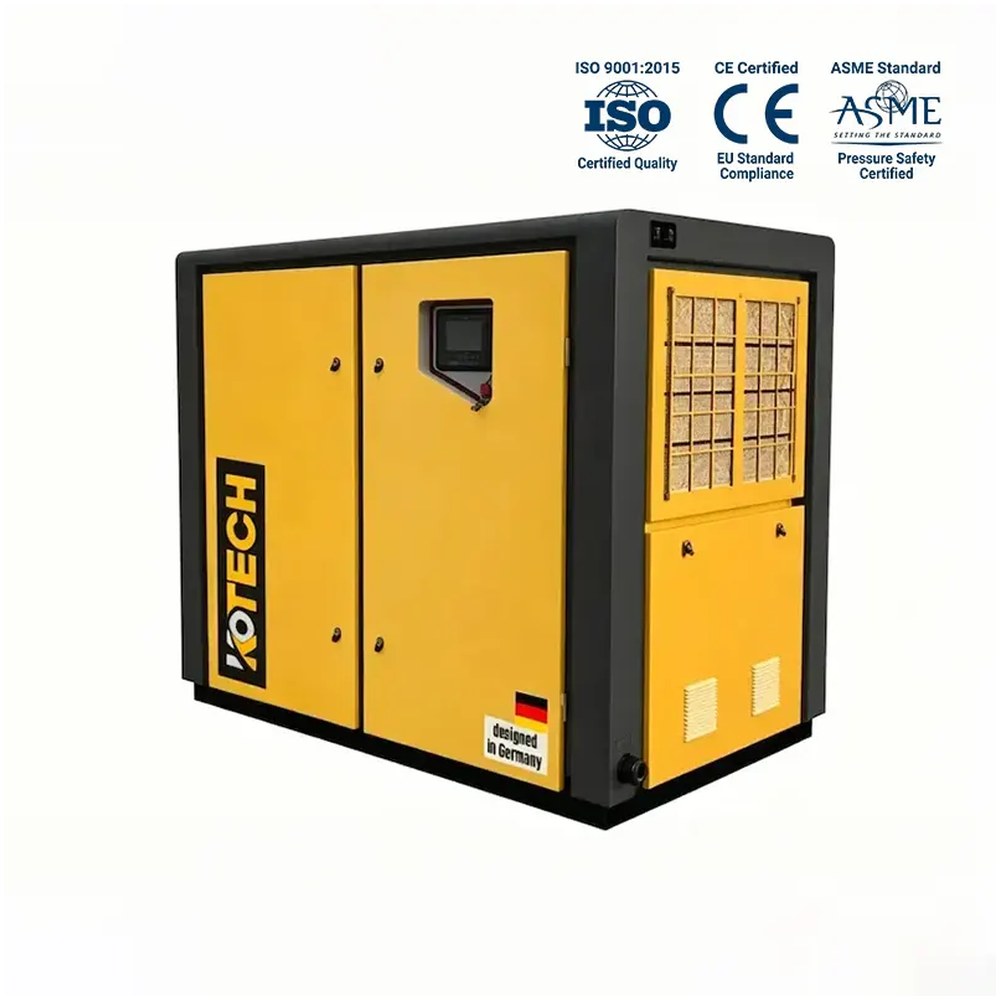
In a dairy or beverage plant, compressed air often reaches areas very close to product and packaging: filling, blowing, actuators on filling lines, and pneumatic conveying of dry ingredients. If that air carries oil, the plant faces contamination risk and product holds. A water-lubricated oil-free compressor removes oil from the compression stage entirely and uses water as the sealing and cooling medium, which is why food and beverage producers specify it for sensitive duty. This guide explains how the technology works, where it fits, and how to select one using real KOTECH KWI specifications.
Why oil-free air matters in food and beverage
Compressed air in a dairy or beverage plant is used in filling and packaging machines, pneumatic valves, bottling and canning lines, and sometimes in direct contact applications such as blowing or moving product. The closer the air gets to product or packaging, the higher the required cleanliness. Oil carryover from a lubricated compressor can contaminate product, leave deposits in lines, and force cleaning and downtime.
Food safety standards and internal quality programmes push producers toward oil-free compression rather than relying only on filtration after an oil-lubricated machine. The two approaches are not equivalent: oil-free compression removes oil at the air end, while downstream filters on a lubricated machine reduce carryover but do not change the compression principle.
- Air reaches filling, packaging, blowing, and conveying points near product
- Oil carryover risks contamination, deposits, and product holds
- Oil-free compression removes oil at the source rather than filtering it later
- Filtration on a lubricated machine is not an equivalent safeguard
How water lubrication replaces oil
A water-lubricated screw compressor uses treated water to seal, lubricate, and cool the compression element instead of oil. Because there is no oil in the compression chamber, the compressed air contains no oil carryover from the machine. The water is circulated, separated, and managed by the unit, and the air-end construction uses materials suited to water contact.
The trade-off is water quality and treatment. The lubricating water must meet the machine’s requirements, and the water circuit has to be maintained to protect the air end. Plants that already handle water treatment in their process are well placed to support this, and the payoff is genuinely oil-free air with low contamination risk.
- Water seals and cools the compression element in place of oil
- No oil in the chamber means no oil carryover from the compressor
- Air-end materials are designed for water contact
- Water quality and treatment must be maintained to protect the element
Where a water-lubricated unit fits best
The strongest applications are continuous processes where oil-free air is needed near product and where the plant can support the water circuit. Filling and packaging halls, aseptic and extended-shelf-life lines, dairy powder handling, and ingredient conveying all suit the technology. Plants with steady long running hours also benefit because the compressor stays within its efficient continuous range.
For light, intermittent, or remote duty where oil-free air is still required, other oil-free technologies may fit better, depending on demand and site conditions. The decision should follow the actual air quality requirement at each use point rather than applying one machine type to the whole facility.
- Filling, packaging, aseptic, powder, and ingredient conveying duties
- Steady continuous operation matches the machine’s efficient range
- Water treatment capability in the plant supports the circuit
- Intermittent or remote duty may suit a different oil-free technology
Real KOTECH KWI water-lubricated oil-free compressors
Current factory specifications for selected air-cooled KWI models; CFM is shown at each machine’s listed pressure points.
The table lists current KWI air-cooled water-lubricated models with pressure, air delivery in CFM, motor power, and weight as published on the KOTECH product page. Each machine is shown at several pressure points, because CFM falls as pressure rises: the KWI-22A, for example, delivers 134.2 CFM at 100 PSI and 113.0 CFM at 145 PSI. Smaller plants commonly select compact units such as the KWI-22A and KWI-37A, while high-speed filling and large bottling halls move up to the KWI-55A and larger frames.
Drying, filtration, and installation
Oil-free compression solves oil carryover, but the air still has to be dried and filtered to the level each use point requires. Filling and packaging areas often specify refrigerated or desiccant drying plus particulate and, where appropriate, higher-grade point-of-use filtration. The compressor and treatment should be selected together rather than as separate purchases.
Installation should give the machine a clean intake, adequate ventilation or cooling-water arrangement, and room for service. In food plants the compressor room is normally separated from production while piping carries treated air to the line, which keeps the machine accessible without exposing product to maintenance activity.
- Pair oil-free compression with drying and point-of-use filtration
- Match treatment to the cleanliness class each use point requires
- Provide a clean intake and adequate cooling and service space
- Locate the compressor separately and pipe treated air to production
Buying tips
- Define air cleanliness at each use point before selecting a compressor
- Confirm the plant can supply and treat the lubricating water
- Size from CFM at the working pressure, accounting for pressure drop
- Specify drying and point-of-use filtration together with the compressor
- Plan a clean intake, cooling, and service access in a separate room
Frequently asked questions
Is a water-lubricated compressor truly oil-free?
Does water lubrication require a lot of extra maintenance?
Can water-lubricated compressors be used in direct food contact applications?
What happens to air flow at higher pressure on these machines?
Are water-lubricated compressors energy efficient?
How large a unit does a dairy or beverage plant need?
.kotech-faq details summary::-webkit-details-marker{display:none}.kotech-faq details[open] summary span:last-child{transform:rotate(45deg)}.kotech-faq details summary span:last-child{transition:transform .2s}.kotech-faq details summary:focus{outline:2px solid #0e6b7a;outline-offset:2px}
If your dairy or beverage plant needs oil-free air near the filling line, share your equipment list and required air quality for a water-lubricated sizing review.
{“@context”: “https://schema.org”, “@type”: “FAQPage”, “mainEntity”: [{“@type”: “Question”, “name”: “Is a water-lubricated compressor truly oil-free?”, “acceptedAnswer”: {“@type”: “Answer”, “text”: “Yes. The compression element uses water rather than oil to seal and cool, so there is no oil in the compression chamber and no oil carryover produced by the machine. The plant still needs appropriate drying and filtration, but the oil risk at the compression stage is removed.”}}, {“@type”: “Question”, “name”: “Does water lubrication require a lot of extra maintenance?”, “acceptedAnswer”: {“@type”: “Answer”, “text”: “It requires management of the water circuit and water quality rather than engine-style maintenance. Treated water and correct operation protect the air end, and plants that already run water-treatment processes find the system straightforward. The maintenance profile is different from an oil machine, not automatically heavier.”}}, {“@type”: “Question”, “name”: “Can water-lubricated compressors be used in direct food contact applications?”, “acceptedAnswer”: {“@type”: “Answer”, “text”: “They are commonly selected where compressed air is close to or in contact with food and packaging, because the air is oil-free at compression. Whether a specific use point is suitable depends on the full treatment chain, including drying and point-of-use filtration, which must meet the required cleanliness class.”}}, {“@type”: “Question”, “name”: “What happens to air flow at higher pressure on these machines?”, “acceptedAnswer”: {“@type”: “Answer”, “text”: “Flow falls as pressure rises, as on any compressor. On the KWI family, a model such as the KWI-22A delivers more CFM at 100 PSI than at 145 or 181 PSI, so the compressor should always be sized from the CFM needed at the actual working pressure rather than from one headline number.”}}, {“@type”: “Question”, “name”: “Are water-lubricated compressors energy efficient?”, “acceptedAnswer”: {“@type”: “Answer”, “text”: “They are efficient within their designed continuous operating range, which suits the steady demand typical of filling and packaging plants. Efficiency also depends on running at the correct pressure, avoiding leaks, and matching the dryer and controls to the duty.”}}, {“@type”: “Question”, “name”: “How large a unit does a dairy or beverage plant need?”, “acceptedAnswer”: {“@type”: “Answer”, “text”: “Size from the combined demand of the filling, packaging, and conveying equipment at the working pressure, with allowance for future lines. Smaller plants often use compact KWI units around 15 to 37 kW, while large bottling halls require larger frames such as the KWI-55A and above to keep high-speed lines supplied.”}}]}{“@context”: “https://schema.org”, “@type”: “Article”, “headline”: “Water-Lubricated Oil-Free Compressors in Dairy and Beverage Plants: A Selection Guide”, “description”: “Dairy and beverage plants need clean compressed air near food contact. Compare water-lubricated oil-free compressors, real KOTECH KWI specs and selection advice.”, “image”: [“https://www.aircompressorindustrial.com/wp-content/uploads/2026/10/kwi-water-lubricated-dairy-beverage-1000×1000-1.jpg”]}