



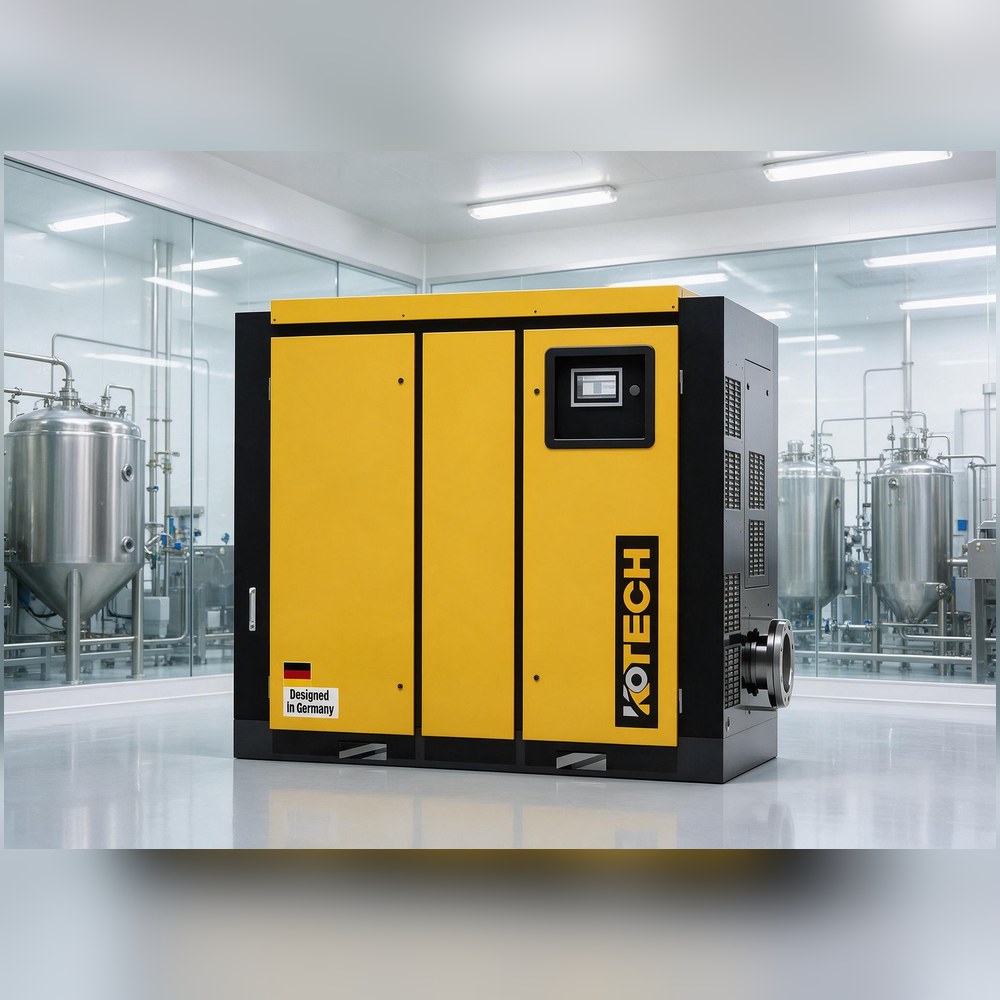
Aerobic fermentation is an aeration process at industrial scale: every cubic metre of broth needs a steady supply of sterile, oil-free air to keep oxygen transfer, cell metabolism and product titre on spec. The equipment behind that air is rarely an ordinary 8 bar compressor — fermentation headers run at low overpressure but very high volume, and any oil carried into the broth becomes a contamination and regulatory problem. A low-pressure oil-free screw blower, purpose-built for the 0.5 to 2.5 bar range, delivers the airflow at a fraction of the energy a general compressor would consume. This guide explains how aeration air should be specified for pharmaceutical fermentation and where KOTECH KSB oil-free screw blowers fit the utility room.
What fermentation actually demands from the air system
In a stirred-tank or airlift bioreactor, compressed air is sparged below the impeller and dispersed through the broth; oxygen dissolves at the bubble interface while waste gases leave at the headspace. Aeration rates are commonly expressed in vessel volumes per minute, and across large production fermenters that translates to thousands of cubic metres of air per hour, delivered twenty-four hours a day through sterile filters. The pressure at the blower is modest — enough to overcome the sparger, liquid head, filter and piping resistance, typically landing between roughly 0.5 and 1.5 bar overpressure — but the volume is continuous and the purity requirement is absolute.
Oil in the airstream is unacceptable for three reasons. It can contaminate the culture and the product, triggering batch loss in a regulated process; it blinds the hydrophobic sterile filters, increasing pressure drop and shortening membrane life; and it introduces a substance that must be accounted for in the qualification and impurity package. An oil-free compression principle removes the hazard at source rather than relying on coalescing filters whose performance degrades between services. The air is then dried and filtered to the site’s sterile-filter specification, but no hydrocarbon is ever introduced to manage.
- High volume at low overpressure: typically about 0.5 to 1.5 bar, thousands of m³/h per train.
- Continuous 24/7 duty across fermentation campaigns with little room for unplanned stops.
- Zero oil carryover to protect culture, product and hydrophobic sterile filters.
- Stable header pressure keeps oxygen transfer and control valves predictable.
Why a screw blower beats a throttled compressor
A general-purpose 7 to 8 bar screw compressor has an internal compression ratio matched to that pressure, so even when regulated down it has already done the thermodynamic work of high compression on every rotation; the surplus is discarded into a low-pressure header. On a duty that runs continuously, the wasted energy is large enough to dominate life-cycle cost. A low-pressure screw blower uses a purpose-designed airend with a larger displacement and low built-in ratio, moving the same air in the 0.5 to 2.5 bar window at materially lower shaft power — the same logic that has driven the move from compressed air to blower technology in wastewater aeration, applied to sterile fermentation.
Screw blowers also offer advantages over the traditional Roots-type lobe blower. With internal compression rather than purely external compression against full back-pressure, screw machines are more efficient at the upper end of the pressure range and run more quietly with lower pulsation, which simplifies piping and acoustic treatment in a clean utility area. Variable-speed control is particularly valuable in fermentation because oxygen demand changes with the growth phase; a speed-controlled blower tracks dissolved-oxygen control rather than loading and unloading against a receiver.
Real KOTECH KSB oil-free screw blower specifications
Current factory figures at 1.0 bar from the KOTECH product page; values span the published variable-speed range, and the line covers 0.5 to 2.5 bar.
The flow figures span the published speed range of each frame; a variable-speed installation operates inside that band according to dissolved-oxygen demand. Read the row at the pressure the header will actually run, since KSB output and shaft power both change with the rating.
Designing the sterile aeration train
Sizing begins with the process: take the design aeration rate in vessel volumes per minute from fermentation engineering, multiply by working volume for each vessel and sum the vessels that run together, then add filter and piping losses and a growth margin. Pressure is calculated bottom-up from sparger depth, liquid head, sterile-filter resistance (including the end-of-run fouled condition), valves and header friction. Installing a pressure logger on the furthest vessel during a campaign reveals whether the set-point has crept above need; trimming it is a free energy saving, provided the sterile filters still clear their worst-case pressure drop.
The utility-room design should place the blower on clean, cool intake air, since intake temperature directly changes mass flow and blower efficiency. After compression the air is cooled — inter- and after-cooling on multi-stage configurations — dried or conditioned as the organism and filter supplier require, and passed through pre-filtration before the final sterile filter at the vessel. Use stainless piping with sanitary connections downstream of the sterile boundary, instrument pressure and temperature continuously, and arrange condensate management that cannot become a contamination path. Blowers should be sequenced automatically against header pressure, with run-hour equalisation and remote alarms so a developing fault is visible before it threatens a campaign.
Reliability, qualification and total cost
Fermentation air systems are process-critical in a way few other compressed-air duties are, so qualification support and documentation belong in the specification: material certificates, oil-free air certification to ISO 8573-1 Class 0, factory test records and validated maintenance procedures. An oil-free screw blower has no oil in the compression chamber, which removes oil changes in the airend and the associated waste stream, while routine care concentrates on intake filters, drive service, cooling and controls. Planned maintenance should align with campaign gaps rather than the calendar where possible, supported by the N+1 configuration that lets one machine run while another is serviced.
Economic comparison should be built on a realistic horizon of continuous operation, because energy will account for the large majority of total cost. The efficiency gap between a purpose-built screw blower and a throttled general compressor, multiplied by thousands of operating hours and several vessels, normally decides the case on its own; quieter operation, lower sterile-filter loading and Class 0 assurance add to it. A short air-demand study across one full growth curve is usually enough to confirm frame size, turndown and the best base-plus-trim configuration for the plant.
Buying tips
- Specify oil-free Class 0 compression at source; do not rely only on downstream filtration of an oil-lubricated blower.
- Size from vessel volumes per minute across all fermenters in campaign, including end-of-life sterile-filter pressure drop.
- Choose a purpose-built low-pressure screw blower over an 8 bar compressor regulated down.
- Use variable-speed trim control to follow dissolved-oxygen demand through the growth phases.
- Configure N+1 machines and align maintenance with campaign gaps to protect multi-day batches.