



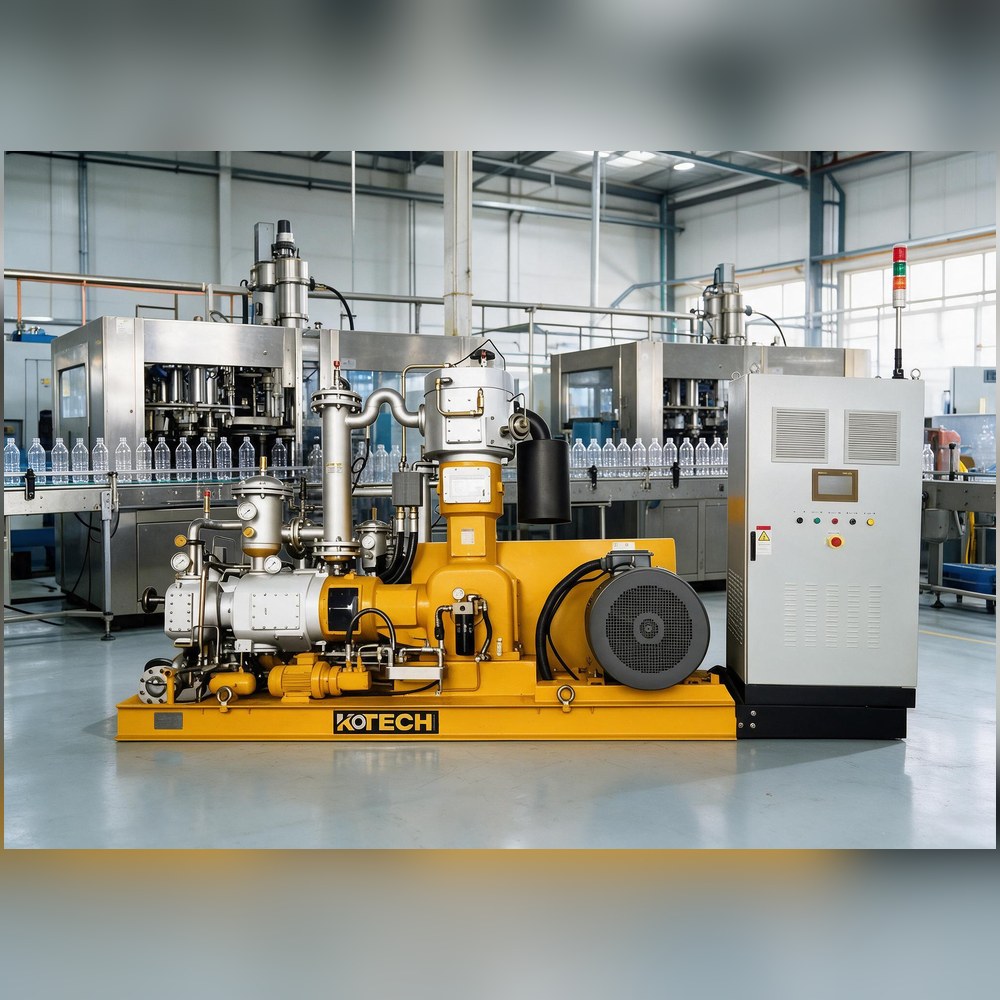
In PET bottle production, compressed air is both the shaping force and a product-contact utility: a preform is stretched and blown into its final mould at roughly 30 to 40 bar, and that same air enters the bottle that will soon hold water, juice, oil or medicine. An oil carryover event does not merely threaten a valve — it can contaminate food-contact packaging, trigger quality holds and damage customer trust. Bottle plants therefore specify oil-free high-pressure compression close to the blow moulder, usually backed by a separate low-pressure system for pre-blow and service air. This guide explains how the two-pressure PET air system works and how to size oil-free high-pressure piston compressors such as the KOTECH KHW range, built for 25 to 40 bar.
The two compressed-air pressures in a PET plant
A modern stretch blow-moulding machine uses air at two distinct pressures. High-pressure air at typically 35 to 40 bar does the final blow, forcing the heated preform against the cooled mould to set bottle shape, neck finish and mechanical properties. Pre-blow air, at roughly 8 to 12 bar, starts the stretch gently so material distributes evenly before high pressure takes over; the same low-pressure header often feeds conveyors, actuators, chiller-side equipment and workshop services. Trying to produce both from one 40 bar machine wastes energy, because compressing all plant air to high pressure and then reducing most of it throws away the compression work.
The efficient layout separates the duties: an oil-injected or oil-free rotary screw compressor with a dryer supplies the low-pressure header, while a dedicated oil-free high-pressure compressor charges a high-pressure receiver and feeds the blow moulder, sometimes with its own buffer sized for the moulding cycle’s sharp air pulses. High-pressure piping, filtration and dry-air dew point are specified separately, because moisture and particulates show up as streaks, bloom or rejected bottles even when pressure is correct. Understanding this split is the first step in sizing the high-pressure machine correctly.
- Final blow: about 35 to 40 bar, the shaping force that sets bottle geometry.
- Pre-blow and service: about 8 to 12 bar, best supplied by a separate rotary screw.
- High-pressure receivers buffer the moulding cycle’s pulsed demand.
- Dry, oil-free, filtered high-pressure air protects food-contact bottles and moulds.
Why oil-free high-pressure compression matters
Blowing air contacts the entire inner surface of every bottle at the moment it is formed, so compressed-air quality is a food-safety issue rather than a maintenance detail. Oil-injected compression followed by filtration can reach very low oil content, but the protection then depends entirely on filter elements that must be monitored, replaced and never bypassed; any failure sends hydrocarbon aerosol into bottles and moulds. An oil-free high-pressure compressor removes oil from the compression cylinders by design, producing ISO 8573-1 Class 0 air at source and removing a failure mode from the quality plan — the same logic regulators and brand owners apply across food-contact packaging.
Piston compressors remain a standard answer at PET pressures. Reciprocating compression handles 30 to 40 bar efficiently in multi-stage cylinders with inter-stage cooling, and oil-free piston designs use non-lubricated cylinders with self-lubricating wear parts and distance pieces that keep crankcase oil away from the compressed gas. For plants that run a defined number of blow moulders at steady output, a stationary oil-free piston high-pressure station offers simple service, tolerance of the pulsed cycle and a clear Class 0 qualification story, at a capital cost well below exotic alternatives. It should be paired with adequate receiver volume so the machine runs on a sensible duty cycle rather than chasing every blow pulse directly.
Sizing the high-pressure station from the blow moulder
Start from the machine specification rather than a generic bottle count: the blow moulder manufacturer publishes high-pressure air consumption in normal litres or cubic metres per bottle or per hour for each cavity and bottle format. Multiply by cavities, cycle rate and line efficiency to get average high-pressure flow, then add leakage, purge, pressure-decay allowance over the high-pressure header and a growth margin for future cavities or larger containers. Peak instantaneous flow is handled by receiver storage, while the compressor is sized for average demand plus recharge; an undersized receiver causes pressure dips during a burst of blows, appearing as poorly formed bottles, while an oversized compressor short-cycles and wears prematurely.
Pressure selection should match the product. Most water, CSD and edible-oil bottles blow at 35 to 40 bar, which points to a 40 bar compressor; lighter bottles and special processes can run at 25 to 30 bar where the moulder supports it, and selecting a 25 or 30 bar machine for genuinely lower-pressure duty saves energy compared with always specifying 40 bar. Cooling, ventilation and foundation requirements grow sharply with power, and high-pressure stations need dedicated condensate management and oil-free air certification. Finally, plan redundancy for continuous lines: a small buffer receiver plus a backup machine or a service contract with rapid response protects a filling line that cannot wait days for a part.
Real KOTECH KHW oil-free high-pressure piston specifications
Current factory figures from the KOTECH product page; the KHW line covers 25 to 40 bar oil-free piston compression for PET and similar high-pressure duties.
Flow and power rise together while pressure is fixed per model, so choose the pressure rating the moulder genuinely runs. A 25 bar bottle process on a 40 bar machine wastes compression energy; conversely a moulder specified at 40 bar will not form correctly on a 25 bar frame.
Integration, air treatment and operating cost
The high-pressure station sits in a dedicated utility area with clean intake air, good ventilation and a reinforced foundation sized for the machine’s dynamic load. Air treatment typically includes after-cooling, a dryer giving a pressure dew point suited to the plant climate and bottle specification, and particulate filtration before the high-pressure receiver; the receiver, distribution piping and quick couplings must all be rated for the working pressure with proper safety factors and isolation for maintenance. Oil-free operation eliminates the oil-related filter stage and its replacement programme, but cylinder and valve service intervals remain part of the plan, with spare parts held for the wear components most exposed to the pulsed duty.
Life-cycle economics in PET are dominated by energy and line uptime. High-pressure compression is expensive in kilowatt-hours, so the two-pressure layout, leak repair on the high-pressure header, correct receiver sizing and pressure set only as high as the bottle and mould require all return quickly. Oil-free air also protects the brand: a single contaminated batch, a customer audit finding or a mould-cleaning shutdown caused by oil deposits dwarfs the equipment price difference. Converter buyers should compare total installed cost — compressor, receiver, treatment, foundation and projected energy — rather than selecting the high-pressure machine on purchase price alone.
Buying tips
- Split pre-blow (8 to 12 bar) and final blow (35 to 40 bar) into two compressor systems instead of reducing all air from 40 bar.
- Size on the blow moulder’s published average air consumption plus recharge; let the receiver handle the pulse.
- Specify oil-free Class 0 compression because blow air contacts the food-contact inside of every bottle.
- Choose the pressure rating the bottle process actually runs — 25/30 bar where supported, 40 bar only when required.
- Plan receiver volume, high-pressure-rated piping, dew-point treatment, foundation and backup for continuous lines.