



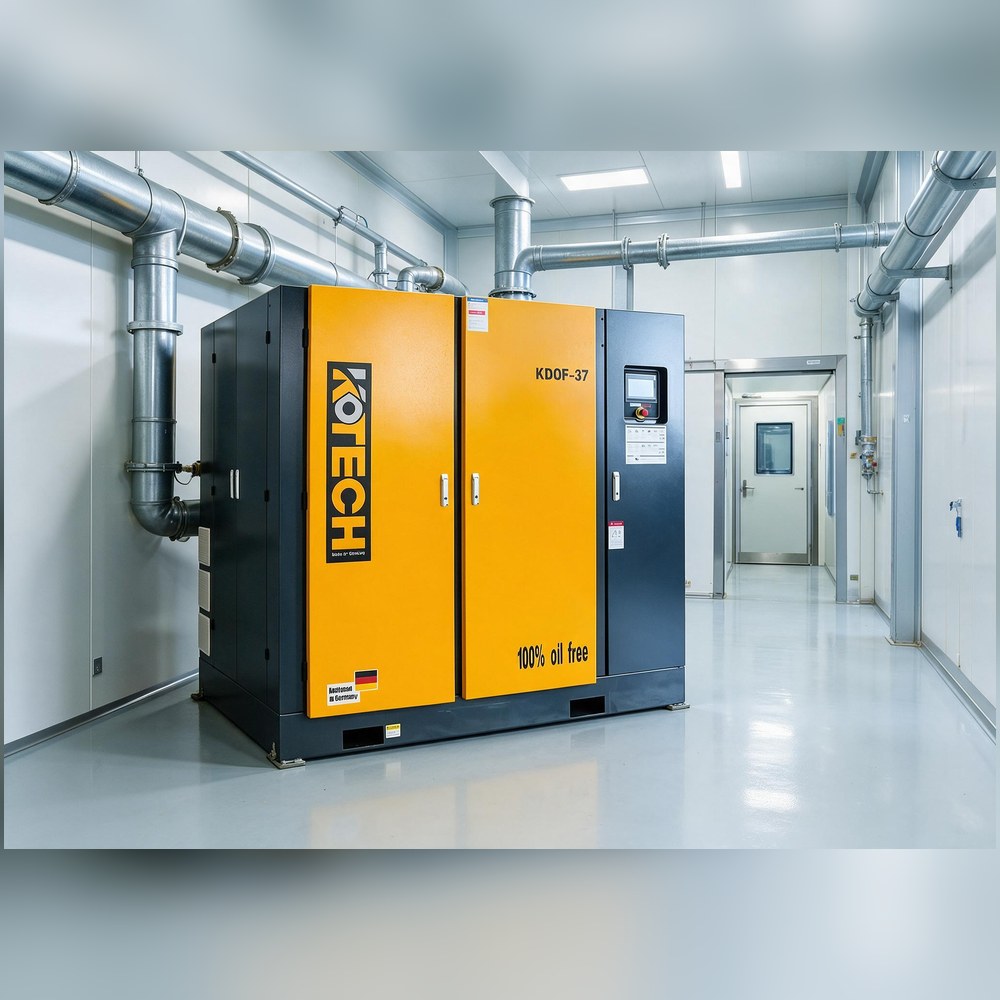
Lithium-ion battery manufacturing is unusually unforgiving with compressed air. Electrode coating, cell assembly and dry-room operations demand air that contains neither oil nor more than traces of moisture, because hydrocarbons contaminate chemistry and water reacts with cell materials, while pressure fluctuation disturbs precision handling and dehumidification control. A battery plant cannot achieve this by filtering an oil-injected compressor and hoping the elements never fail; it specifies dry oil-free screw compression that produces ISO 8573-1 Class 0 air at source, then dries and filters it to the dry-room dew-point class. This guide explains how dry-room air systems are sized and where KOTECH KDOF two-stage dry oil-free screw compressors, rated 37 to 355 kW, fit a battery factory.
Why battery dry rooms demand Class 0 dry air
A modern lithium battery plant contains several distinct air demands. The dry rooms where moisture-sensitive materials and cells are handled are maintained at very low humidity, and their make-up and pneumatic systems must not introduce water vapour that the dehumidification plant then has to remove; dry, oil-free instrument air feeds actuators, handling systems and dry-air utilities inside the controlled envelope. Electrode manufacturing uses compressed air for slurry-area equipment, coating and calendering utilities, and assembly plants use it for leak testing, cleaning and actuation. In every case, oil in the airstream risks depositing on foils, separators or sealing surfaces, creating defects that may only appear later as field failures.
The engineering response is twofold: remove oil at the compression principle and control moisture at the dryer. A dry-running twin-screw compressor uses timing gears so the rotors never touch, with no oil in the compression chamber at all, producing ISO 8573-1 Class 0 air regardless of filter condition. That air then passes through drying — commonly desiccant or rotary-drum technology sized for a pressure dew point well below the dry-room requirement — plus particulate filtration. Filtration of an oil-injected machine can approach low oil content, but it leaves a filter-dependent failure mode in a plant where a single contamination event can scrap expensive material and halt a line; Class 0 at source removes that risk structurally.
- Dry-room and cell-assembly air must carry neither oil aerosol nor water vapour into the controlled envelope.
- Dry screw compression gives ISO 8573-1 Class 0 air by design, independent of filter condition.
- Desiccant or rotary-drum drying adds the pressure dew point the dry room and chemistry require.
- Stable header pressure protects precision handling and humidity-control performance.
Why dry screw rather than oil-injected or other oil-free types
Battery plants evaluate three broad options for Class 0 air. Water-lubricated oil-free screws remove oil well but introduce a water circuit that must be treated and maintained, which some dry-room operators prefer to keep away from their low-humidity environment. Scroll oil-free machines are excellent at small laboratory and island-cell flows but do not scale economically to the continuous hundreds of kilowatts a gigafactory utility room needs. Dry-running twin-screw compressors with two-stage compression cover the industrial power range with no oil and no process water in the compression path, which matches the way large battery plants prefer their critical utilities: electrically driven, water- or air-cooled, and simple to qualify.
Two-stage compression matters at battery-plant scale because it approaches isothermal compression through inter-stage cooling, improving energy efficiency at 7 to 10.5 bar and reducing thermal stress on the airend. Permanent-magnet or high-efficiency motors with VSD are valuable because battery plant demand is rarely flat: coating lines, dry-room HVAC pneumatic loads and assembly shifts change through the day, and a variable-speed machine tracks the header without wasteful loading and unloading. Given that compressed air runs continuously across a facility measured in tens of thousands of square metres, the energy difference between a well-chosen dry oil-free station and an oversized fixed-speed alternative is substantial over a factory’s life.
Real KOTECH KDOF dry oil-free screw specifications
Current factory figures from the KOTECH product page; KDOF is a two-stage dry oil-free water-cooled line covering 37 to 355 kW at 7.5 to 10.5 bar.
The three flow figures per frame are the published outputs at 7.5, 8.5 and 10.5 bar respectively; select at the pressure the treatment equipment and dry-room header actually require. Specifying the highest pressure ‘just in case’ sacrifices free-air delivery and wastes energy across continuous running.
Designing the dry-room air station
Begin with an air-demand study: list every user by area — coating, drying, assembly, dry-room pneumatic and instrument loads, leak testing, cleaning — apply realistic diversity across shifts, and add leakage, purge and growth margins. Battery plants expand in phases, so the station should be modular: staged dry screw machines with common headers let capacity follow construction without running one oversized compressor at poor part-load for years. N+1 redundancy is standard for production lines, because a Class 0 air outage can force controlled shutdowns and material holds. Receiver volume should be sized to smooth pulsed handling and test loads so the trim machine adjusts steadily.
Air treatment is integral rather than accessory. Specify the pressure dew point from the dry-room and process requirements — often far below zero degrees Celsius for sensitive cells — with desiccant or rotary-drum dryers sized for worst-case inlet conditions, pre- and post-filtration, and stainless or internally treated piping to prevent corrosion particles. Intake air should be cool and clean, with the compressor room separated from coating and solvent areas; heat rejected by the compressors can be recovered for facility hot water or make-up air heating. Instrument pressure, dew point and temperature continuously, tie the alarms into the building management system, and validate the installation as a qualified utility with documented Class 0 air quality before it feeds production.
Qualification, maintenance and life-cycle cost
Battery customers audit utilities almost as carefully as production equipment, so suppliers should support the qualification package: ISO 8573-1 Class 0 certification, material documentation, factory test records and a maintenance plan that keeps the air quality warranty valid. Dry oil-free machines eliminate oil changes and oil separation elements from the compression path, removing a consumable waste stream; service concentrates on intake filters, timing-gear oil on its own long interval, cooling, belts or drive and controls. Water-cooled frames need treated cooling water on the standard schedule, with temperature alarms protecting the airend.
As in all continuous-process plants, the compressor decision should be made on total cost across the facility’s operating life, where energy dominates equipment price several times over. The combination of correctly sized two-stage dry screw frames, a variable-speed trim machine, pressure set only as high as the dryer and header require, an aggressive leak-repair programme and heat recovery normally produces the lowest cost per cubic metre of qualified air. A short pre-purchase monitoring campaign on an existing building, or a phased design for a new plant, gives the demand data needed to right-size the first KDOF machines and leave clean space for the next phase.
Buying tips
- Specify ISO 8573-1 Class 0 at the compression principle rather than relying on filtration of oil-injected air.
- Pair dry screw compression with desiccant or rotary-drum drying sized for the dry-room dew-point requirement.
- Build a modular, N+1 station that expands with factory phases and includes one VSD trim machine.
- Choose the pressure rating closest to real header need; flow falls and energy rises at 10.5 bar.
- Instrument dew point and pressure continuously, and validate the station as a qualified utility before production.
Frequently asked questions
What compressed air quality do lithium battery dry rooms need?
Why not filter an oil-injected compressor instead of buying dry oil-free?
What size compressor does a battery plant need?
Why are two-stage dry screw compressors used in battery factories?
Does dry-room compressed air affect room humidity control?
How should a gigafactory compressor station expand with production phases?
Share your plant layout, dry-room dew-point class, shift demand and expansion plan, and our engineers will size a phased KOTECH KDOF Class 0 station with drying, redundancy and controls.