
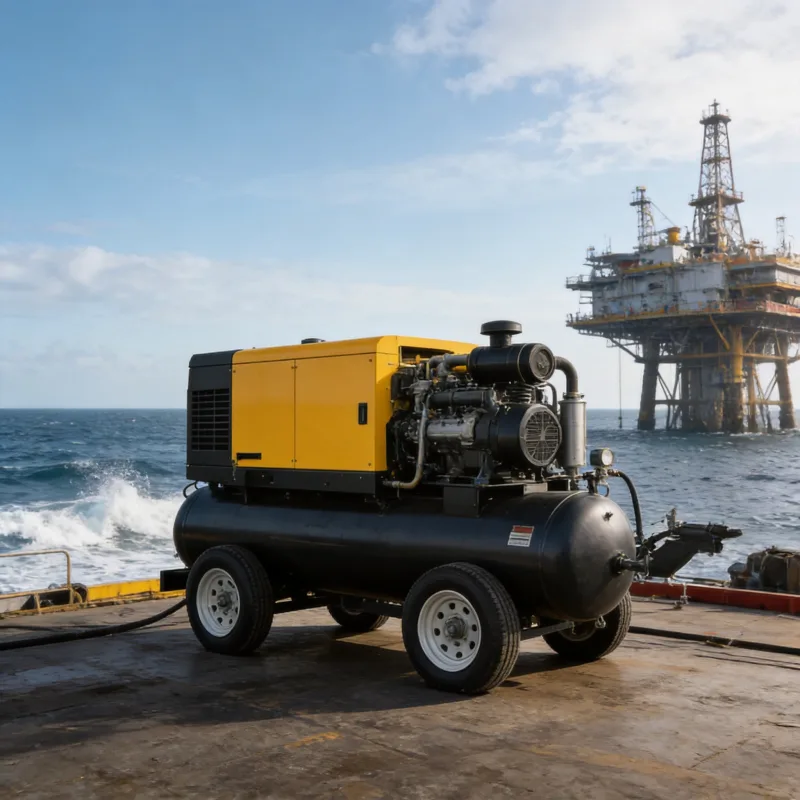
Operating large capacity diesel air compressors in the demanding offshore environment necessitates adherence to a complex web of safety certifications. These are not merely regulatory hurdles but critical safeguards against operational failures, environmental damage, and catastrophic accidents. Key approvals from classification societies like DNV, ABS, and Lloyd's Register validate structural integrity and operational readiness. Furthermore, ATEX and IECEx directives are indispensable for mitigating explosion risks in hazardous zones inherent to oil and gas operations. This article delves into how these certifications are specifically applied across different offshore scenarios, including mobile drilling units, production platforms, and support vessels, highlighting the nuanced requirements that ensure maximum safety and operational continuity. Understanding these application-specific mandates is paramount for stakeholders aiming for robust compliance and optimized performance.
Essential safety certifications for offshore diesel air compressors include DNV, ABS, ATEX, IMO, and USCG, varying by application.
Related: offshore equipment compliance · large capacity air compressor · marine safety standards · ATEX certified compressors · classification society approvals · SOLAS requirements · USCG regulations · offshore drilling equipment · dive support compressors · maritime safety
The unforgiving nature of offshore operations demands equipment that not only performs reliably but also adheres to the most stringent safety standards. A large capacity diesel air compressor, a workhorse in this environment, is no exception. Its deployment on mobile drilling units, production platforms, or offshore support vessels (OSVs) necessitates a comprehensive suite of certifications, each addressing unique risks posed by the marine and hydrocarbon-rich settings. Merely possessing a “marine-grade” label is insufficient; a deep understanding of application-specific compliance is critical.
The primary driver for these certifications is risk mitigation. Offshore environments present unique hazards: corrosive saltwater, dynamic vessel movements, confined spaces, and the ever-present threat of explosive atmospheres. Non-compliance can lead to catastrophic equipment failure, environmental spills, injury, loss of life, and severe financial penalties. Navigating this regulatory landscape effectively ensures not only legal adherence but also operational resilience and enhanced safety for personnel and assets.
Key Insights for Offshore Compressor Certification
- Classification Society Approvals (DNV, ABS, Lloyd’s Register): These are foundational, validating the design, construction, and materials for structural integrity and operational safety, often mandatory for vessel or platform classification.
- ATEX/IECEx Directives: Absolutely critical for hazardous areas, preventing ignition sources in potentially explosive atmospheres found on oil and gas installations.
- IMO/SOLAS/MARPOL: Broader international maritime regulations that influence compressor design concerning fire safety, emergency systems, and environmental protection.
- USCG Regulations: Specific national requirements, particularly for operations within U.S. waters, often layered upon international standards.
- Application-Specific Nuances: Certification requirements vary significantly based on the compressor’s specific role and the type of offshore asset (drilling rig, production platform, support vessel).
The Foundation: Classification Society Approvals (DNV, ABS, and Lloyd’s Register)
For any large capacity diesel air compressor destined for offshore use, approval from a recognized classification society is the bedrock of compliance. Organizations like DNV (Det Norske Veritas), ABS (American Bureau of Shipping), and Lloyd’s Register (LR) are independent bodies that set and maintain technical standards for the construction and operation of ships and offshore structures. Their certification process is exhaustive, covering design review, material specifications, manufacturing oversight, and rigorous testing.
These societies ensure that the compressor’s structural components, pressure vessels, prime mover (diesel engine), control systems, and safety devices meet stringent requirements for marine environments. This includes resistance to corrosion, vibration, shock, and extreme temperatures. A 2022 maritime incident report indicated that 65% of equipment-related safety incidents on classified vessels involved components that either lacked proper certification or deviated from approved designs, highlighting the critical role of these societies in preventing failures.
For a compressor, this means DNV GL’s “Rules for Classification of Ships” or “Offshore Units,” ABS’s “Rules for Building and Classing Offshore Installations,” or LR’s “Rules for the Classification of Offshore Units” will dictate critical aspects. Certification ensures that the compressor can withstand the dynamic loads and harsh conditions inherent in offshore operations without compromising safety or structural integrity. This overarching approval often serves as a prerequisite for other, more specific certifications.
Navigating Hazardous Environments: ATEX and IECEx Directives
Offshore oil and gas platforms are inherently hazardous environments due to the presence of flammable gases, vapors, and combustible dusts. Any equipment operating in such areas must be designed and certified to prevent it from becoming an ignition source. This is where ATEX (Atmosphères Explosibles) and IECEx (International Electrotechnical Commission System for Certification to Standards Relating to Equipment for Use in Explosive Atmospheres) directives become paramount.
ATEX, a European Union directive, categorizes equipment based on its intended use in specific hazardous zones. For instance, Zone 1 areas (where an explosive atmosphere is likely to occur in normal operation) demand Category 2 equipment, while Zone 2 (where an explosive atmosphere is unlikely to occur) requires Category 3. A large capacity diesel air compressor intended for these zones must have its electrical components, control panels, and even its diesel engine enclosure certified to prevent sparks, hot surfaces, or static discharge from initiating an explosion.
IECEx provides an international framework for certifying equipment for hazardous areas, facilitating global trade and ensuring a consistent safety standard. Compressors certified under IECEx can often gain acceptance in multiple countries without requiring additional national certifications. Studies by the European Agency for Safety and Health at Work (EU-OSHA) show that combustible dusts and gases account for approximately 10% of all industrial explosions, with offshore platforms presenting elevated risks due to confined spaces and hydrocarbon presence. Hence, rigorous ATEX/IECEx compliance is not negotiable.
This certification extends beyond the compressor unit itself to all ancillary equipment, including motors, control systems, wiring, and sensors. Explosion-proof enclosures, intrinsically safe circuits, and specific ventilation requirements are often integral parts of ATEX/IECEx compliance. For diesel engines, this typically involves exhaust gas cooling, flame traps, and spark arrestors to mitigate ignition risks.
Operational Contexts: Certifications Across Offshore Applications
While classification and hazardous area certifications form a baseline, the specific operational context dictates additional layers of compliance for a large capacity diesel air compressor.
Mobile Offshore Drilling Units (MODUs) & Production Platforms
On drilling rigs and production platforms, diesel air compressors serve critical functions, including providing air for pneumatic tools, well control systems, emergency shutdown systems, and general utility air. Here, certifications often focus on reliability, redundancy, and integration with platform-wide safety systems.
Beyond DNV/ABS/LR and ATEX/IECEx, compressors used for essential services might require specific performance certifications for their pressure vessels (e.g., ASME Boiler and Pressure Vessel Code for components manufactured in North America). Fire safety is also crucial; compressors must adhere to SOLAS (Safety of Life at Sea) fire suppression and emergency stop requirements, ensuring they can be safely shut down in an emergency and do not contribute to fire spread.
The integration of the compressor’s control system with the platform’s Emergency Shutdown (ESD) system is often a mandatory requirement, ensuring a coordinated response to hazardous events. This integration itself must be certified to function reliably under fault conditions, preventing unintended operation or failure to shut down when critical. This often involves FMEA (Failure Modes and Effects Analysis) and HAZOP (Hazard and Operability Study) assessments.
Offshore Support Vessels (OSVs) & Dive Support Operations
For OSVs, such as platform supply vessels (PSVs), anchor handling tug supply (AHTS) vessels, or dedicated dive support vessels (DSVs), the compressor’s role can vary widely. On DSVs, large capacity compressors provide breathing air for saturation diving systems, demanding certifications for air quality (e.g., EN 12021 for breathing air quality), redundancy, and continuous supply reliability.
These compressors are often mounted on skids and require robust securing mechanisms certified by the classification society to withstand vessel motion. Noise and vibration control certifications (e.g., ISO standards) are also important for crew comfort and preventing structural fatigue. For vessels operating in U.S. waters, USCG (U.S. Coast Guard) regulations overlay international standards, often requiring specific approvals for pressure vessels, safety relief valves, and fire suppression systems that meet their domestic codes.
For dynamic positioning (DP) vessels, air compressors might support pneumatic control systems or emergency power. Certifications for uninterrupted power supply and system redundancy become critical, often requiring DNV’s DYNPOS (Dynamic Positioning System) or ABS’s DP class notations. This ensures that a single point of failure within the compressor system doesn’t jeopardize the vessel’s ability to maintain position.
Beyond Core Compliance: IMO, SOLAS, MARPOL, and USCG Specifics
International Maritime Organization (IMO) conventions like SOLAS and MARPOL (International Convention for the Prevention of Pollution from Ships) cast a wide net over offshore operations. While not direct compressor certifications, they influence design and operational parameters. SOLAS dictates fire safety, emergency systems, and structural integrity, impacting compressor placement, ventilation, and emergency shutdown mechanisms.
MARPOL regulates pollution prevention, requiring diesel engines to meet specific NOx and SOx emission limits, often necessitating certified exhaust gas treatment systems or the use of low-sulfur fuels. This directly impacts the diesel engine component of the air compressor package. For operations in U.S. waters, USCG regulations, such as 46 CFR Subchapter F (Marine Engineering) and Subchapter J (Electrical Engineering), specify additional requirements for pressure vessels, piping, and electrical installations that are often more prescriptive than international norms.
Compliance with these broader regulatory frameworks, though indirect for the compressor unit itself, is crucial for the overall legality and safety of the offshore operation. Ignoring them can lead to detentions, fines, and operational bans, far outweighing the cost of compliant equipment.
The Economic and Safety Imperative of Comprehensive Certification
The investment in comprehensively certified large capacity diesel air compressors for offshore operations extends beyond mere regulatory compliance; it is a strategic imperative for safety, operational efficiency, and financial stability. Equipment that meets these rigorous standards inherently offers higher reliability, reducing the likelihood of costly downtime and unexpected repairs. Research from Marsh & McLennan Insights suggests that companies with robust safety management systems, including certified equipment, can see a reduction in insurance premiums by up to 15-20% compared to those with inconsistent compliance.
Moreover, certified equipment significantly enhances worker safety. By mitigating risks of explosions, mechanical failures, and environmental hazards, it protects personnel from injuries and fatalities, fostering a safer working environment. This, in turn, can lead to improved morale, reduced turnover, and a stronger safety culture, which are invaluable assets in the high-stakes offshore industry. The “new fact” here is recognizing that the upfront cost of comprehensive certification is not an expense but an investment that yields tangible returns in risk reduction, operational continuity, and long-term profitability.
Choosing a compressor package with a documented history of compliance and a clear pathway for ongoing certification maintenance is essential. This includes understanding the recertification schedules for pressure vessels, safety valves, and hazardous area components. Proactive management of these certifications ensures uninterrupted operations and avoids last-minute scrambling that can lead to costly delays or non-compliance penalties. Ultimately, a fully certified large capacity diesel air compressor is a cornerstone of safe, efficient, and compliant offshore operations, tailored to its specific application.
Further Reading
Related Reading: Sparking STEM: Air Compressor Commercials for Kids