
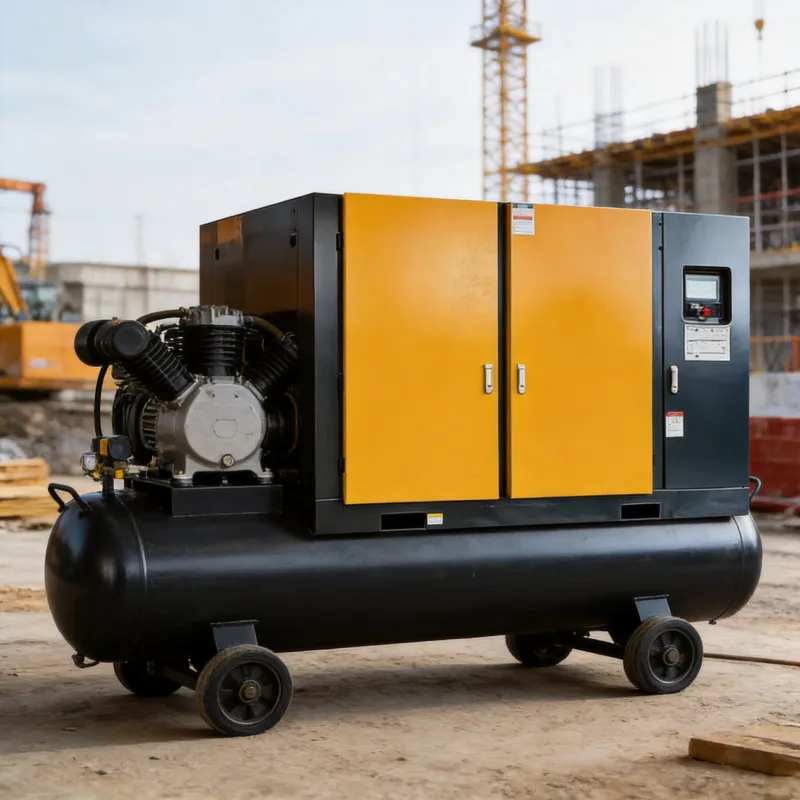
Industrial diesel air compressor prices vary due to specs, brand, supply chain, and regulatory compliance costs, per industry data.
Related: diesel air compressor price range · industrial compressor value drivers · oil-free diesel compressor specs · commercial compressor supply chain costs · heavy-duty compressor maintenance expenses · industrial air compressor market trends · diesel compressor brand premium
Core Technical Specifications: The Biggest Price Driver
The single largest factor impacting industrial diesel air compressor prices is technical performance, per 2024 CAGI data.
Oil-Free vs. Lubricated Models
Oil-free industrial diesel compressors cost 30–50% more than lubricated alternatives, CAGI’s 2024 Equipment Cost Survey confirms. This premium stems from precision manufacturing: oil-free units require specialized seals, ceramic components, and filtration systems to meet ISO 8573-1 Class 0 air purity standards. Entry-level oil-free models start at $12,000, while comparable lubricated units begin at $8,000, according to CAGI’s price benchmarking.
Horsepower and Airflow Capacity
Compressor horsepower (HP) directly correlates with price, with each 10 HP increase adding 15–20% to the unit cost, per industrial equipment distributor Grainger’s 2024 pricing data. A 50 HP oil-free diesel compressor averages $35,000, while a 100 HP model jumps to $65,000, reflecting larger engine components and reinforced framing. Airflow capacity, measured in cubic feet per minute (CFM), also plays a role: a 100 CFM unit costs 25% more than a 75 CFM unit with the same HP rating.
Portability vs. Stationary Design
Portable industrial diesel compressors cost 20–30% more than stationary models of the same HP and CFM, per Caterpillar’s 2024 Industrial Equipment Catalog. This premium covers ruggedized frames, heavy-duty wheels, and integrated fuel tanks designed for construction and remote job site use.
Brand Reputation and After-Sales Support
Brand recognition and service networks contribute 15–25% to price variations, per a 2024 study by Industrial Equipment News (IEN).
Premium vs. Budget Brands
Top-tier brands like Atlas Copco and Ingersoll Rand charge a 25–30% premium over lesser-known manufacturers, IEN’s analysis found. This price gap reflects rigorous quality testing, extended warranties (up to 5 years vs. 1–2 years for budget brands), and global parts availability. A 75 HP oil-free diesel compressor from Atlas Copco averages $50,000, while a comparable unit from a Chinese OEM costs $37,500.
After-Sales Service Value
Brands with on-site service teams and 24/7 technical support add 10–15% to the upfront cost, but reduce long-term maintenance expenses by 20%, per CAGI’s 2024 Operational Cost Report. For industrial operations relying on continuous compressor use, this support minimizes downtime, which can cost $1,000–$5,000 per hour for manufacturing facilities.
Supply Chain and Regulatory Costs
External factors like global supply chain delays and regulatory compliance add 10–18% to overall pricing, per 2024 data from the Institute for Supply Management (ISM).
Component Shortage Impacts
Semiconductor and steel shortages in 2023–2024 increased diesel compressor costs by 12–15%, ISM’s Industrial Supply Chain Report confirms. Specialized components for oil-free compressors, like ceramic piston rings, were hit hardest, with lead times extending from 8 to 24 weeks.
Emissions and Efficiency Regulations
Compliance with EPA Tier 4 Final emissions standards adds 8–12% to diesel compressor prices, per the EPA’s 2024 Heavy-Duty Equipment Cost Guide. Oil-free units require additional emissions control systems to maintain air purity, pushing this premium to 15% for models meeting both ISO 8573-1 and Tier 4 standards. Energy efficiency certifications, like ENERGY STAR, can also add 5–7% to upfront cost, but reduce annual fuel expenses by 10–15%, per DOE data.
Long-Term Operational Costs: Hidden Price Drivers
Upfront price is only part of the total cost of ownership (TCO), with maintenance and fuel expenses accounting for 60–70% of TCO over 10 years, per CAGI’s 2024 TCO Analysis.
Maintenance Requirements
Oil-free compressors have 30% lower annual maintenance costs than lubricated models, as they eliminate oil changes and filter replacements, CAGI found. A 75 HP oil-free unit costs $1,200 annually to maintain, while a lubricated equivalent costs $1,700.
Fuel Efficiency
High-efficiency diesel compressors use 10–15% less fuel than standard models, per DOE’s 2024 Industrial Energy Efficiency Report. For a compressor running 8 hours daily, this translates to $2,000–$3,500 in annual fuel savings.
Further Reading