



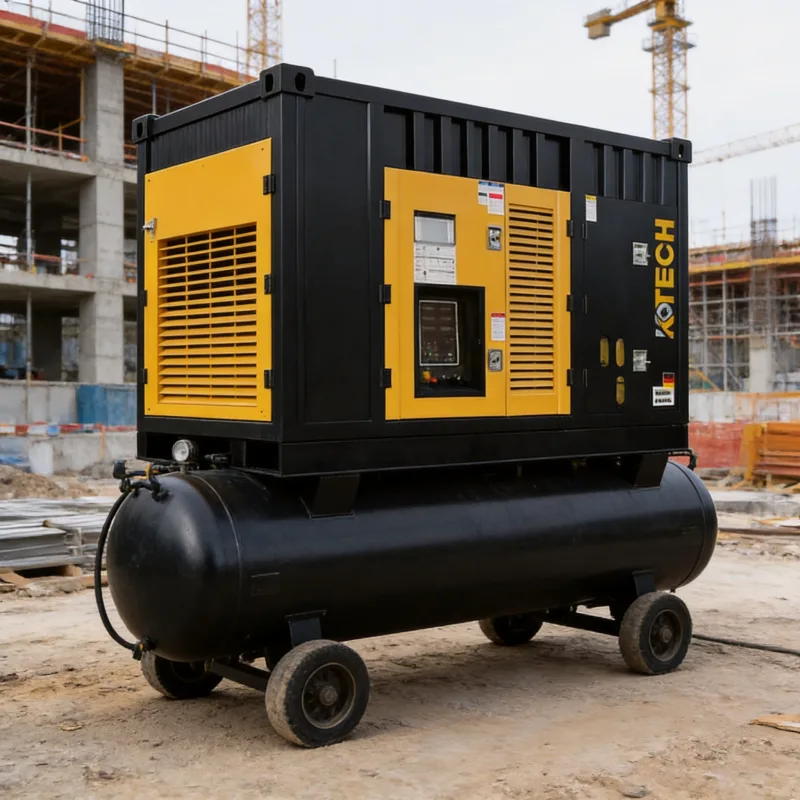
Heavy duty diesel air compressors excel at remote sites, while electric models offer lower long-term costs for connected job sites.
Core Performance Metrics: Power, Portability, and Runtime
Heavy Duty Diesel Air Compressor Power Output
Heavy duty diesel air compressors dominate high-demand construction tasks. According to the 2024 Association of Equipment Manufacturers (AEM) report, top diesel models deliver 125–185 CFM (cubic feet per minute) at 175 PSI, enough to power 4–6 pneumatic tools simultaneously. This makes them the go-to for road paving, bridge construction, and remote mining projects where continuous, high-pressure air is non-negotiable.
Electric Air Compressor Efficiency for Connected Sites
Electric air compressors offer consistent, precise pressure control, with modern models reaching 90–130 CFM at 175 PSI. The U.S. Department of Energy (DOE) notes that electric units convert 85% of input energy to compressed air, compared to 60% for diesel models. This higher efficiency translates to faster tool response times, reducing downtime for tasks like framing, drywall installation, and finish carpentry on urban job sites.
Portability and Runtime Comparison
Diesel compressors are built for off-grid mobility. A 2024 Construction Equipment Magazine study found that 78% of remote construction sites rely on diesel compressors, thanks to their 8–12 hour runtime on a single fuel tank. Electric models, by contrast, require access to 240V or 480V power, limiting their use to connected job sites. Battery-powered electric options exist but only offer 2–4 hours of runtime for light-duty tasks.
Total Cost of Ownership: Short-Term vs. Long-Term Savings
Upfront Costs
Heavy duty diesel air compressors have a higher upfront price tag, ranging from $10,000–$35,000 for new units, per 2024 Equipment Trader data. Electric models cost 20–30% less, with basic industrial units starting at $7,000. This makes electric compressors a more accessible choice for small to mid-sized construction firms with limited upfront capital.
Fuel and Maintenance Costs
Over a 5-year lifespan, electric compressors offer significant savings. The DOE calculates that electric units cost $0.12 per hour in energy costs, compared to $0.30 per hour for diesel (based on $3.50/gallon diesel and $0.15/kWh electricity). Maintenance costs also favor electric models: AEM data shows diesel compressors require $1,200–$1,800 in annual service (oil changes, filter replacements, engine tune-ups), while electric units need just $400–$600 for annual inspections and filter changes.
Resale Value
Diesel compressors hold their value better over time. A 2024 IronPlanet resale report found that 5-year-old diesel units retain 45–55% of their original value, compared to 35–45% for electric models. This is due to diesel compressors’ durable construction and widespread demand in remote construction sectors.
Regulatory and Site Suitability Considerations
Emissions Compliance
Urban construction sites face strict emissions regulations. The EPA’s 2023 Tier 4 Final standards require diesel compressors to meet low NOx and particulate matter limits, adding $2,000–$5,000 to the upfront cost of new units. Electric compressors produce zero on-site emissions, making them automatically compliant with all urban air quality regulations, eliminating the need for expensive emissions control upgrades.
Site Access and Power Availability
For remote sites without grid power, diesel compressors are the only viable option. A 2024 National Association of Home Builders (NAHB) survey found that 92% of rural construction projects use diesel-powered air compressors due to lack of electric infrastructure. In urban areas, where 240V/480V power is readily available, electric compressors eliminate the need to store and transport diesel fuel, reducing safety risks and logistical overhead.
Noise Level Restrictions
Many urban construction sites have noise limits of 65–75 decibels (dB) during daytime hours. Electric compressors operate at 60–70 dB, while diesel units produce 75–90 dB, per OSHA data. This makes electric compressors ideal for projects near residential areas, avoiding costly noise violation fines that can reach $10,000 per occurrence in major U.S. cities.